
A trapped-ion memory removes errors without measurement feedback
An autonomous correction experiment has reached Nature Physics. Its memory result depends on the protected state, noise and baseline being compared.

Yi Li and colleagues’ trapped-ion memory study appeared in Nature Physics on October 23. The publisher reports a lifetime beyond the unprotected-qubit baseline using autonomous . The experiment was already public in an April 23, 2025 preprint, so the current milestone is journal publication rather than the first disclosure of the result.[1][2]
The preprint describes a encoded across several internal states of one calcium ion. Engineered coupling transfers error-related entropy into the ions’ motion; sympathetic cooling through a second ion removes it. Repeating that process protects the stored information without repeatedly measuring an error syndrome and feeding a correction decision back into the system.[2]
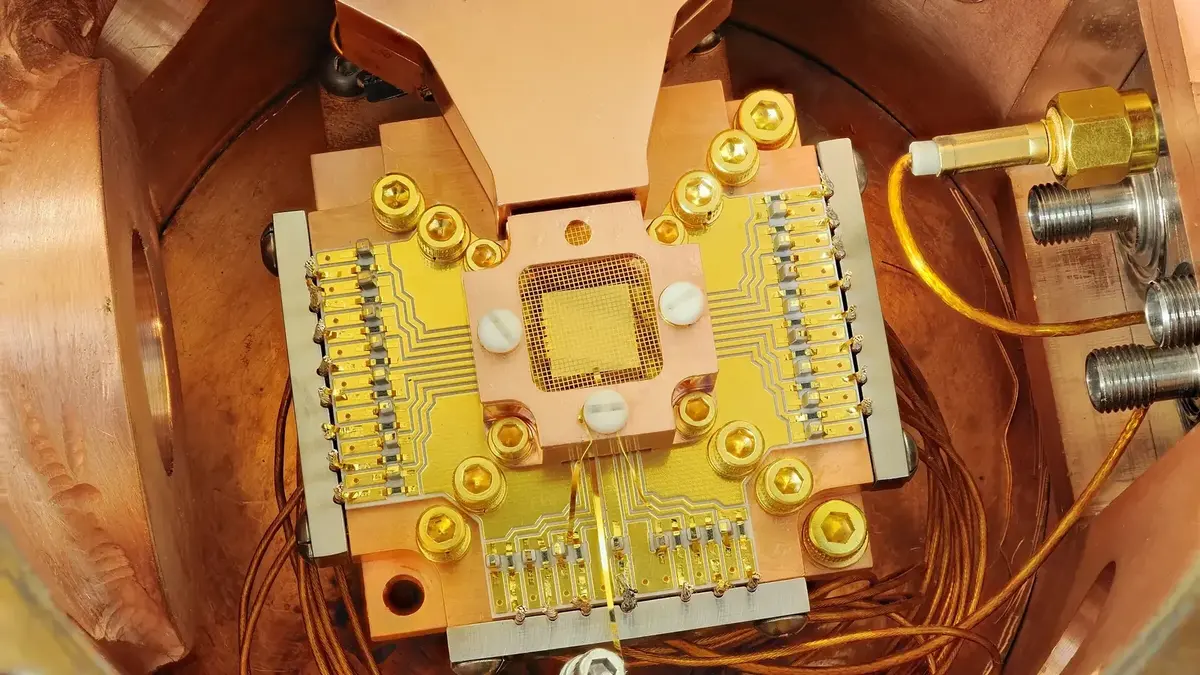
That is a different engineering bargain from measurement-driven correction. The protection still needs carefully controlled physical operations and an auxiliary ion. Here, autonomous describes how the correction is implemented; it does not mean that the memory runs without lasers, calibration or supporting hardware. The archival NIST photograph shows a different beryllium-ion apparatus, photographed in 2011.[2]
The authors study ambient conditions and deliberately injected low-frequency magnetic noise. Their preprint’s memory comparisons address dephasing under those conditions. This account uses its reviewed methods to explain the mechanism and does not transfer its detailed numerical lifetimes into an unverified final-paper comparison. The final publisher abstract confirms lifetime extension in both noise settings.[1][2]
A memory benchmark answers how long information can be retained. It does not by itself answer how well a machine performs a sequence of logical gates. Readers comparing error-correction results should therefore keep the protected task, unprotected baseline, noise and supporting resources together, rather than treating every use of break-even as the same test.
The useful next milestone is protection that remains effective while operations are performed on the stored information, followed by evidence that the approach works with the errors and interactions of a larger device. Those tests would connect this memory experiment to the broader challenge of making reliable computations.