
Skip to content
HARDWARE · TRAPPED-ION HARDWARE

AQT's LYNX preprint separates processor size from benchmark scale

A processor characterization shows why the size of each benchmark belongs in the headline discussion.
Published Source report Sources checked
My reading list
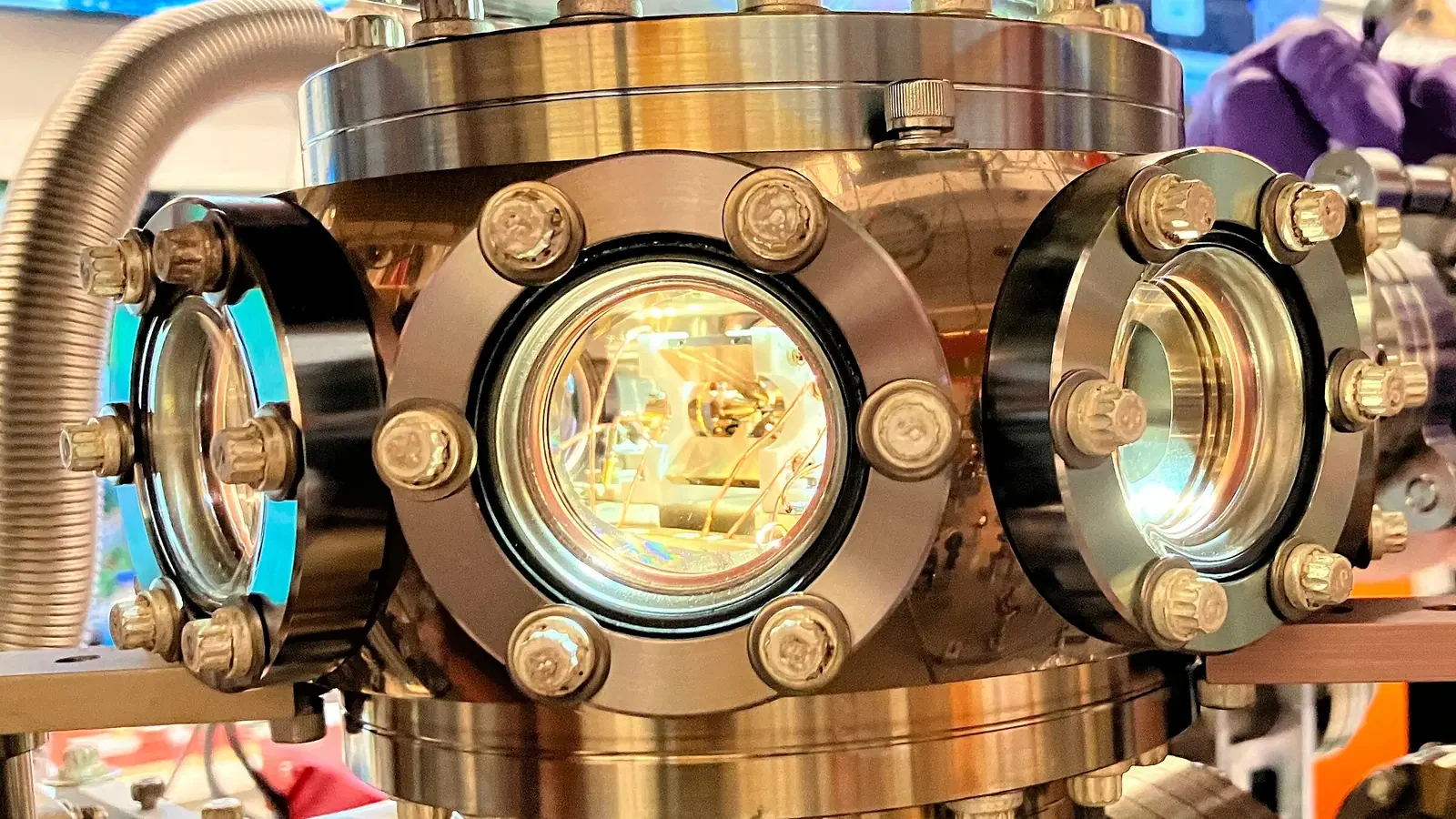
A linear ion trap and its electrodes inside a vacuum chamber.
A linear Paul ion trap inside a vacuum chamber. Trapped-ion hardware context; not AQT LYNX or the apparatus used for its reported benchmarks.Image: Linear Paul ion trap vacuum chamber · Coldsmokerider · CC BY-SA 4.0Full image credit

Alpine Quantum Technologies researchers describe LYNX, a trapped-calcium-ion processor supporting up to 31 with all-to-all connectivity. Their October 23 preprint reports several benchmarks at clearly specified register sizes.[1]

In a 24-qubit register, randomized benchmarking gives an average single-qubit gate error of (8 plus or minus 5) times 10 to the minus 5. Interleaved randomized benchmarking reports an average two-qubit gate error of (2.84 plus or minus 0.08) times 10 to the minus 3.[1]

The processor also passes quantum-volume tests using up to 15 qubits, corresponding to a quantum volume of 2 to the power 15.[1]

Those register sizes are part of the result. The gate-error averages were measured in a 24-qubit register, while quantum volume was assessed using 15 qubits; neither number should be presented as the result of a full 31-qubit benchmark.[1]

The work offers a detailed hardware characterization. Its metrics do not by themselves show commercial quantum advantage or a fault-tolerant logical processor.[1]

Keep your reading trail

Your Updates →

Evidence & context

1 linked source

Experimental preprint v1, October 23, 2026; capacity and benchmark register sizes differ.

How to read the evidence and dates

An announcement records what an organization stated. An experiment reports an observation. A simulation or resource estimate depends on its assumptions. QubitWire’s analysis connects these sources; the labels are not quality scores.

Published is the article’s first QubitWire publication. Updated marks a substantive content change. Sources checked records a review of the underlying evidence. An older paper can support a new explanation, and another press release about the same work is not independent replication.

Sources

  1. LYNX - A trapped-ion quantum information processor

    Experimental system-characterization preprint submitted October23; source dated 2026-10-23. Reviewed 2026-10-27.

READ NEXT

Continue exploring

All Hardware stories
  1. Related reading

    How to tell if a quantum computer is getting better

    Three questions about the task, the answer and the clock can make quantum performance headlines far easier to understand.

    Published · Source report · Sources checked
  2. Related reading

    Helios Has 98 Qubits. The Error Rate Tells You More.

    Quantinuum’s trapped-ion machine shows why counting qubits is only the start of comparing quantum computers.

    Source report · Sources checked
THE QUANTUM BRIEFING

A clearer signal.
Read the latest edition.

A little perspective on a fast-moving field.

Read the on-site briefing →

Read selected quantum coverage in the on-site briefing, or register your interest below.