Would you rather have more qubits, or qubits that make fewer mistakes? For a useful quantum computer, the answer eventually has to be both.
Quantinuum’s Helios makes the second half of that equation hard to ignore. The machine uses 98 trapped barium ions. A June 2026 Nature paper reports average two-qubit of about 99.921 percent, alongside all-to-all connectivity.[1]
Gate fidelity describes how closely an operation matches its intended action under the reported test. It is not the probability that an entire algorithm will return the right answer. A long calculation has many opportunities for errors to accumulate.[1]
The architecture is part of the story. Helios moves ions between storage and operation regions, bringing selected qubits together for gates. Any qubit can interact with any other through this routing system. That does not mean every possible pair operates simultaneously.[1]
Better operations and flexible connectivity can reduce some of the work involved in protecting quantum information. encodes logical information across physical qubits; a bigger physical-qubit total does not automatically buy a more useful computation.[1]
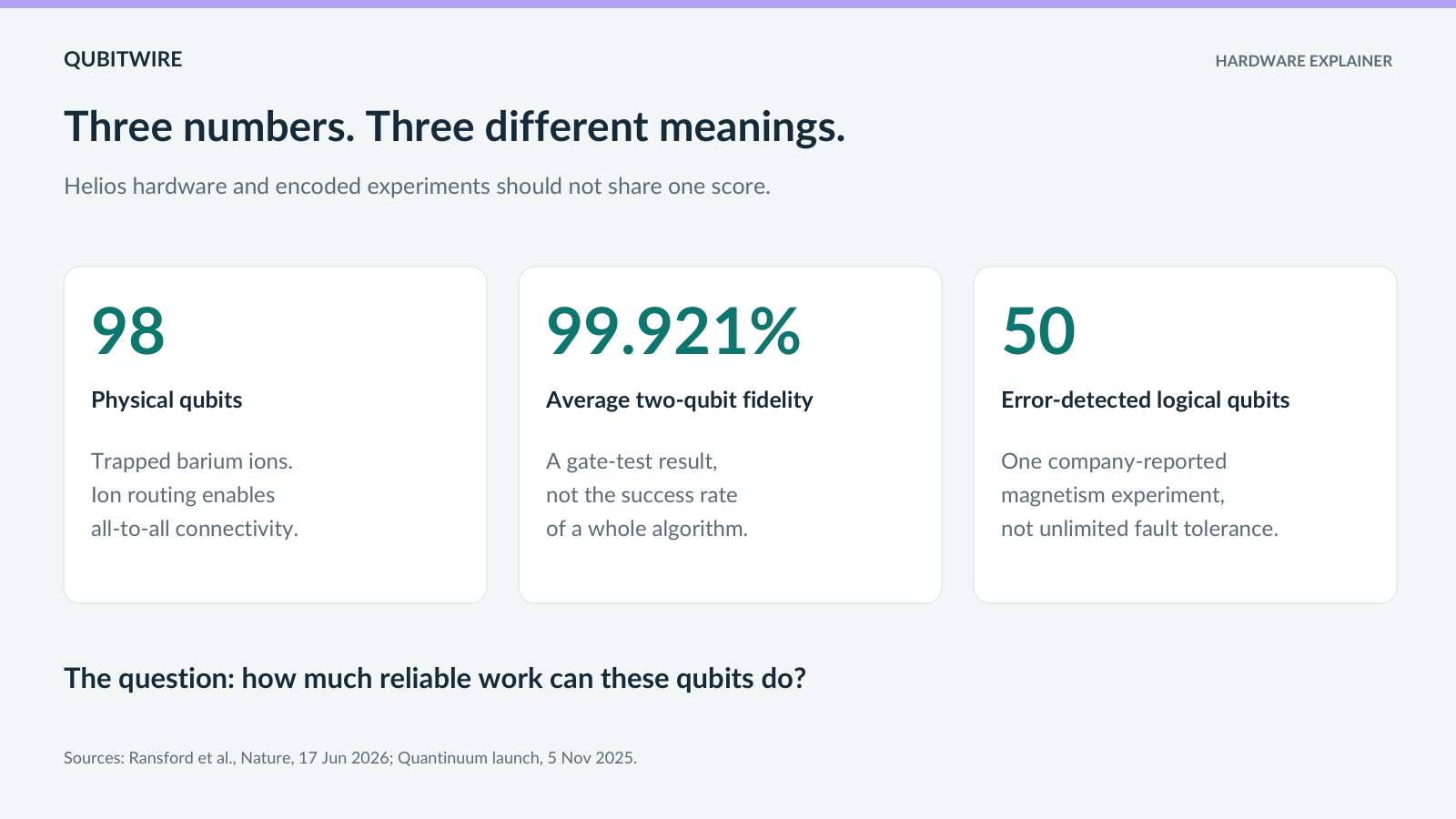
Three different ways to describe Helios: 98 physical qubits; about 99.921% average two-qubit gate fidelity in the hardware paper; and 50 error-detected logical qubits in a company-reported magnetism experiment. These metrics are not interchangeable. Sources: Nature and Quantinuum.Original editorial graphic supplied by QubitWire in LLL.pdf. Facts are attributed to the linked primary sources; this is not photography. QubitWire · View full-size graphic · Original QubitWire editorial graphicFull image credit
One launch claim needs particular care. Quantinuum described a magnetism simulation using 50 error-detected . That wording matters. Detecting errors in a particular encoded experiment is not the same as delivering 50 logical qubits that can run arbitrarily long, fully fault-tolerant calculations.[2]
Helios launched in November 2025. The subsequent peer-reviewed characterization strengthens the technical basis for discussing its hardware, but it does not prove that 98 qubits beat every larger competing machine. Useful comparisons still depend on the task, circuit depth, error handling and time taken.[1][2]
The next challenge is keeping control as the system grows. More qubits, lower errors and practical operating speed all have to improve together. The question is not simply how many qubits a company has built. It is how much reliable work those qubits can do.

.jpg)