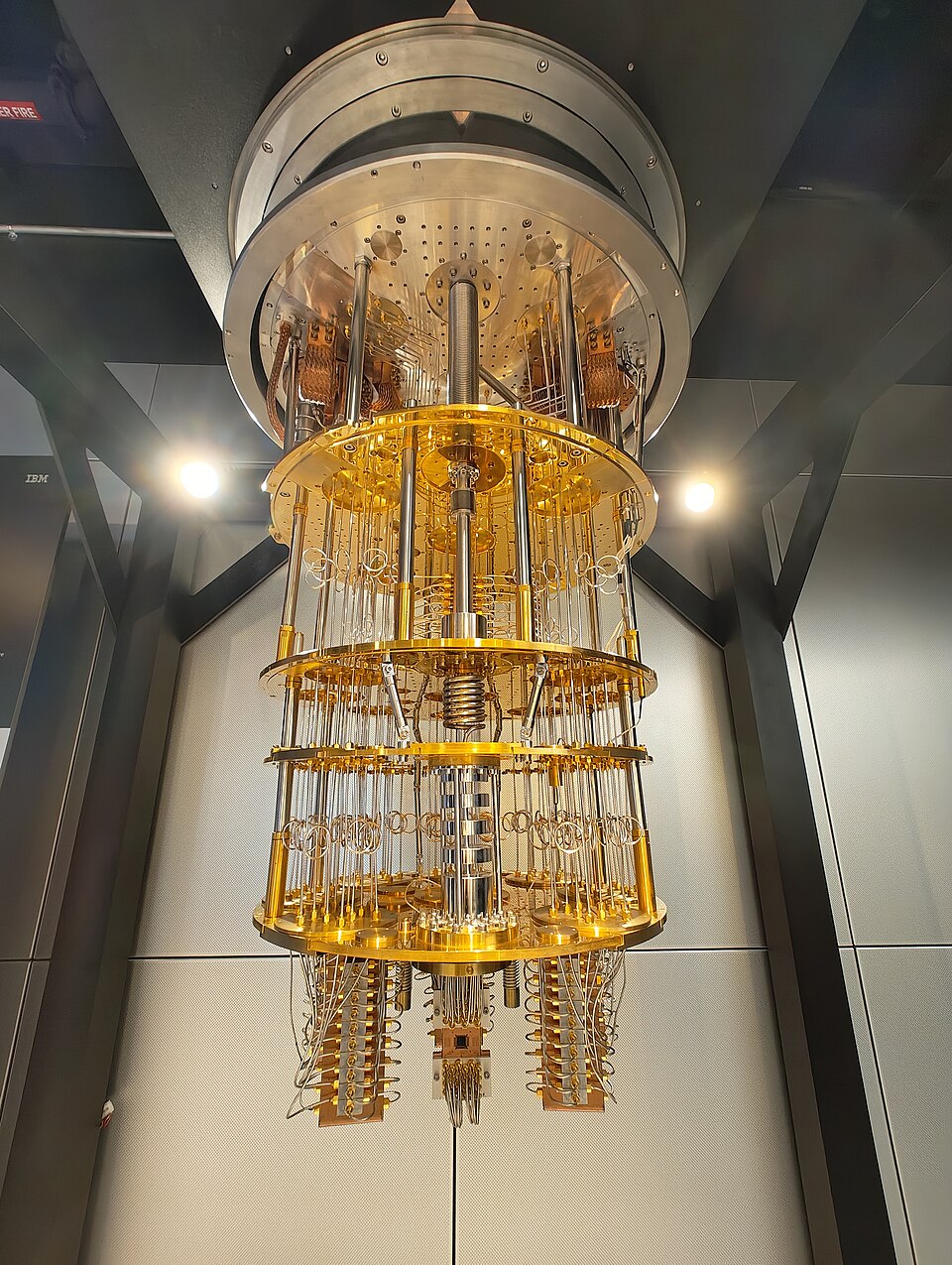
IBM Quantum System One at the Thomas J. Watson Research Center in Yorktown Heights, New York, photographed in 2024. Context image for IBM quantum hardware—not Nighthawk r2 or a verified Nighthawk installation.Photo: Onri Jay Benally / OJB Quantum · CC BY 4.0Full image credit
Sometimes the way to make a computer faster is to stop making it wait.
IBM’s Nighthawk r2, announced on August 31, 2026, targets the pause between quantum circuit runs. Its 120 programmable each have a dedicated reset element that helps return them to a known starting state before the next run.[1]
That matters because a quantum experiment is rarely one calculation followed by one definitive answer. Researchers often repeat circuits many times to estimate a result. Time spent preparing for the next repetition adds up.[1][2]
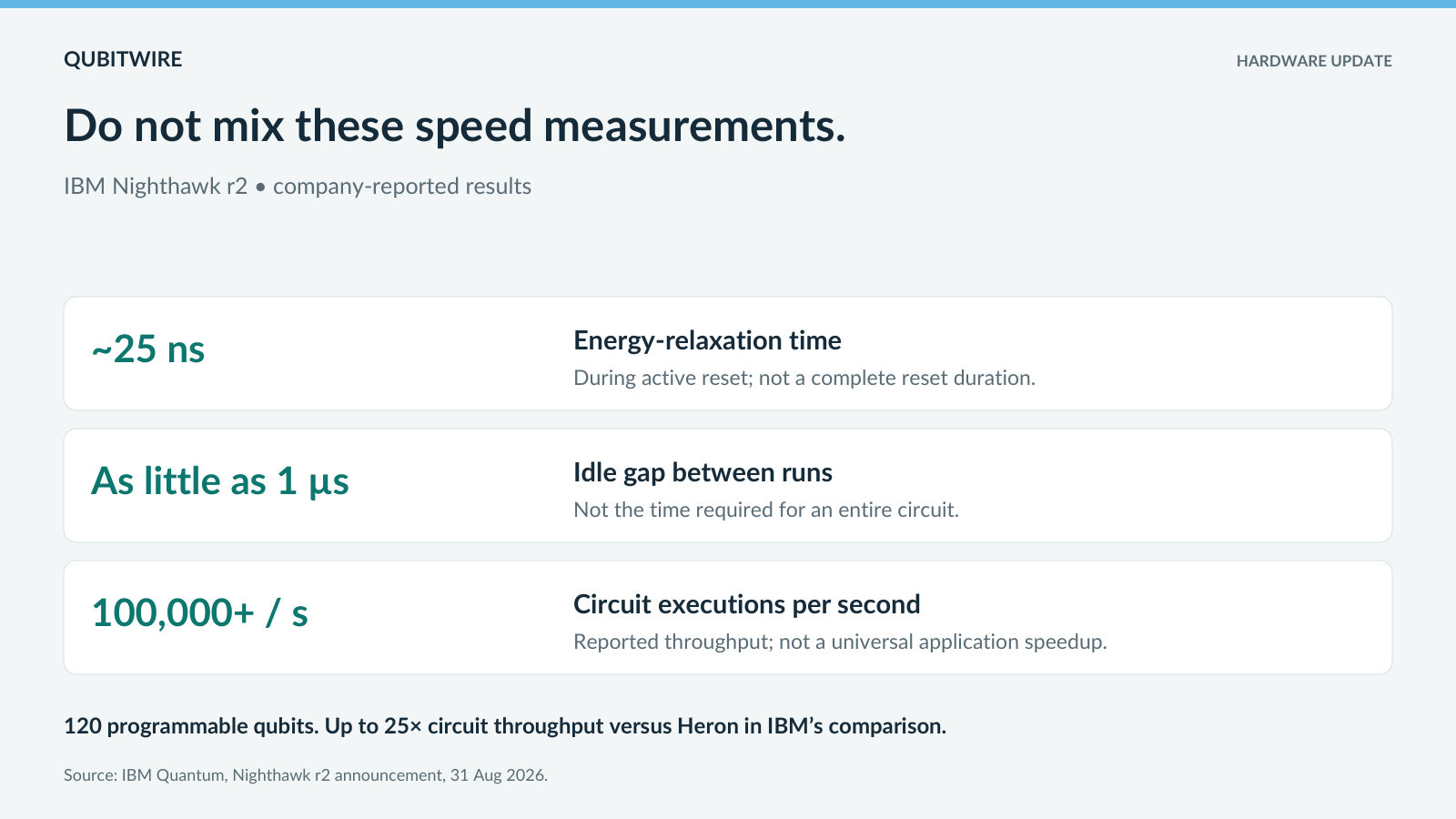
IBM reports more than 100,000 circuit executions per second, compared with roughly 4,000 on its Heron fleet: up to 25 times the circuit throughput in the company’s comparison. This is a repetition-rate claim, not a promise that every application finishes 25 times faster.[1]
The eye-catching 25-nanosecond number needs a separate explanation. It is the qubit’s effective energy-relaxation time while active reset is enabled, not the duration of a complete reset or a whole circuit. IBM says the idle gap between runs can fall to as little as one microsecond.[1]
Three separate Nighthawk r2 measurements reported by IBM: about 25 ns effective energy-relaxation time during active reset, as little as 1 microsecond idle time between runs and more than 100,000 circuit executions per second under the reported conditions. These are not three ways to state a whole-application runtime.Original editorial graphic supplied by QubitWire in LLL.pdf. Facts are attributed to the linked primary sources; this is not photography. QubitWire · View full-size graphic · Original QubitWire editorial graphicFull image credit
That distinction is worth keeping even in a headline graphic. A physical relaxation time, the delay between repetitions and completed circuits per second are three different measurements. Combining them into a single “quantum speed” number hides what the engineering actually changed.[1][2]
Faster repetition could make measurement-heavy research and experiments more practical. But useful performance still depends on the circuit, control system, error rates and the rest of the workflow. IBM’s reported retention of Heron-class matters because faster unreliable results would not solve the problem.[1][2]
Nighthawk r2 is a reminder to look beyond the most photogenic number on a specification sheet. Adding qubits is one route forward. Removing avoidable waiting is another. The real test is how quickly the whole system can produce an answer worth using.