
A quantum sensor could get sharper by getting quieter
A Weizmann Institute study predicts two ways to improve precision near a phase transition: amplify a signal or suppress the noise that hides it.
Reading tools for text size, copying, printing and your reading list
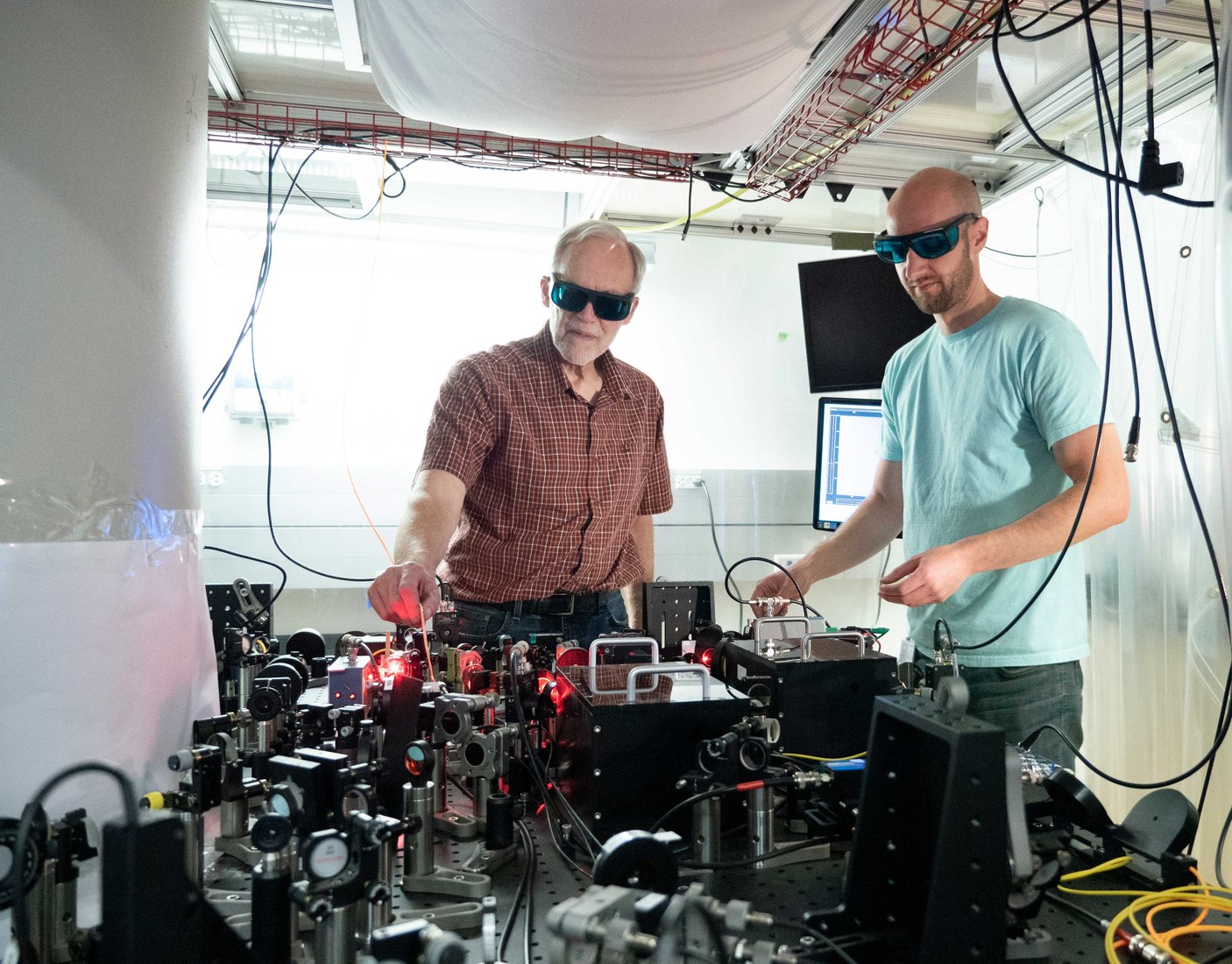
A sensor can pick up a smaller change if the signal gets stronger or if the background gets quieter. In a new preprint, researchers at the Weizmann Institute of Science show how the same type of quantum system could do both, depending on what you measure. Near a point where a group of particles changes its collective behavior, one measurement improves despite growing noise. A second improves because quantum correlations quiet the noise, not because its signal gets stronger. Neither improvement has yet been demonstrated on hardware in this study.[1]
Same improvement, different reasons
Nikita Leppenen, Shaked Levy and Ephraim Shahmoon study particles with two internal states that act like tiny magnets called spins. Instead of reading each one separately, the proposed measurements read the group. An important distinction is between how sharply the reading changes when you adjust the quantity of interest, and how much the reading fluctuates if you leave that quantity alone. Both are needed to judge how small a change the instrument can detect.[1]
For one measurement, the quantity of interest behaves like a dial for the strength of the drive acting on the spins. Near the transition, a small turn produces a larger change in the collective reading. Noise also increases, but the response increases more, so the error falls. For the other measurement, the dial is a phase, an angle that describes the drive in the proposed spin model. The response does not get a comparable boost. Instead, the particles’ quantum correlations reduce fluctuations in the particular component being read. The phase is part of the system itself, not an outside phase imposed by an interferometer.[1]
At the best operating point in their model, both errors fall in proportion to the number of spins raised to the power −2/3. With independent spins they would fall in proportion to the inverse square root of that count. An eightfold increase in the number of spins would therefore reduce error by a factor of four in the modeled scaling, versus about 2.8 with independent spins, assuming the other conditions remain comparable. That's an illustration of the scaling, not a reported laboratory result.[1]
How to tell which effect is real
The researchers calculate how the scheme could behave in two kinds of hardware: atoms driven inside a light-trapping cavity, and trapped ions with collective interactions. Their models suggest the desired state could be prepared without the usual slowdown near a transition, under the interactions and preparation paths they assume. The paper does not claim that a practical device will retain that speed after state preparation, repeated measurements and ordinary lab noise are all counted.[1]
A useful test would measure the response and noise separately as the group grows, then compare precision over equal total measurement time against independent spins. That would show whether the quieter reading translates into a better sensor, and whether it still helps once the instrument has to prepare and read the system repeatedly.[1]