
Skip to content
RESEARCH · DIAMOND SPIN DYNAMICS

Measurements prolong spin correlations in diamond

A preprint probes measurement-induced localization in a solid-state experiment, with an important limit at high measurement rates.
Published Source report Sources checked
My reading list
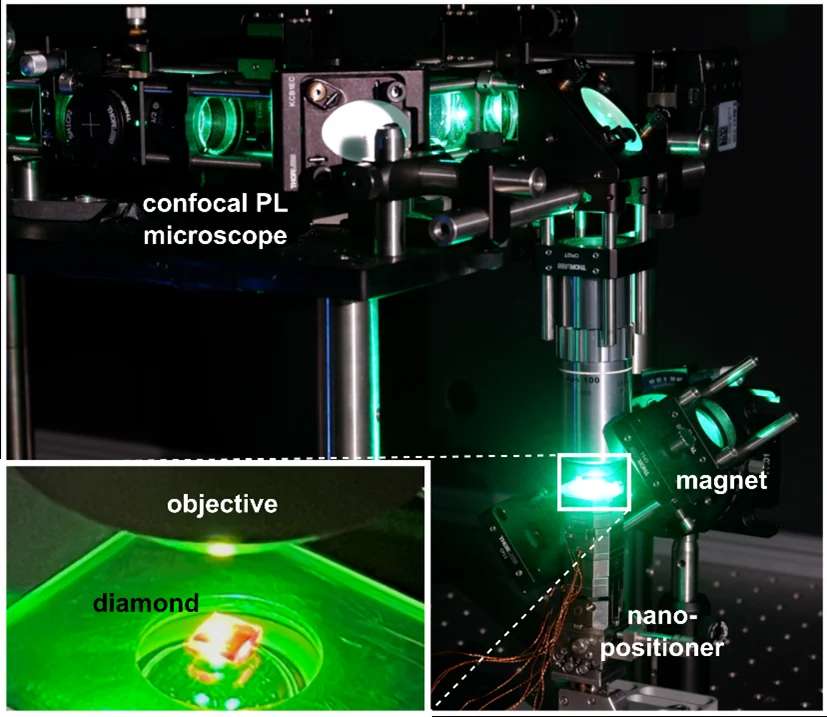
Annotated photograph of green-illuminated microscope optics, a magnet and nanopositioner, with a magnified diamond inset.
NIST’s quantum diamond microscope, with labeled optics, magnet and positioning components. Source uploaded November 2024; photograph date is not established. Archival diamond-research context; this is not the spin-correlation apparatus described in the article.Image: Quantum Diamond microscope · NIST · NIST public information reuse termsFull image credit

Researchers report that repeated measurements can prolong spin correlations in interacting carbon-13 nuclei surrounding a nitrogen-vacancy center in diamond. Their October 25 preprint tests both projective measurements on one spin and weaker measurements across a spin network.[1]

More frequent measurements extend the measured autocorrelation time within the tested regime. Excessively frequent measurements instead accelerate relaxation through an anti-Zeno effect. Experiments and simulations support a measurement-induced localized regime, but the subsystem mutual information used to interpret the crossover was calculated rather than directly measured.[1]

The result concerns a particular many-body platform, not a practical quantum memory. It illustrates measurement as a physical intervention whose frequency changes the experiment’s dynamics. The useful question is how the measurement is implemented and which observable persists, rather than whether observation universally freezes a quantum system.[1]

QubitWire analysis

Our assessment is that extending a measurable correlation is a different objective from storing an arbitrary computational state. A useful follow-up would state which information survives, how it is recovered and whether the intervention changes the observable being studied. Without those distinctions, a longer-lived signal can acquire an interpretation that the experiment was never designed to establish. The measured quantity should stay visible in any comparison with other protection methods.

The measurement process also belongs inside the resource account. Researchers and readers would benefit from knowing how often it occurs, what equipment it needs and whether its performance changes across repeated preparations. A matched control should isolate the intervention from other changes in the setup. That would clarify both the physical mechanism and the conditions under which another laboratory might reproduce the effect with a different sample or environment.

Keep your reading trail

Your Updates →

Evidence & context

1 linked source

Preprint · source published 2026-10-25. Primary source checked October 27, 2026.

How to read the evidence and dates

An announcement records what an organization stated. An experiment reports an observation. A simulation or resource estimate depends on its assumptions. QubitWire’s analysis connects these sources; the labels are not quality scores.

Published is the article’s first QubitWire publication. Updated marks a substantive content change. Sources checked records a review of the underlying evidence. An older paper can support a new explanation, and another press release about the same work is not independent replication.

Sources

  1. Observation of measurement-induced localization phenomena in a solid-state spin system

    Full primary HTML experimental methods, projective and weak measurement protocols, anti-Zeno limit and numerical mutual-information interpretation reviewed.

READ NEXT

Continue exploring

All Research stories
  1. Explore the related question

    A diamond sensor switches a laser off. Sensitivity is the next test.

    The published experiment achieves full optical contrast. Its sub-400-femtotesla figure is a photon-shot-noise limit, with technical noise still separating that limit from a practical instrument.

    Published · Source report · Sources checked
  2. Explore the related question

    A Quantum Memory Scored 98.6%. Here’s the Other Number That Matters.

    An October 6 preprint puts quantum-memory tests on a common footing. Its experiment shows why high conditional fidelity can coexist with low retrieval efficiency.

    Published · Source report · Sources checked
THE QUANTUM BRIEFING

A clearer signal.
Read the latest edition.

A little perspective on a fast-moving field.

Read the on-site briefing →

Read selected quantum coverage in the on-site briefing, or register your interest below.