
Electrons near gold test a decoherence model
An electron–gold experiment tests a quantum Brownian-motion model. The reported loss of coherence does not settle quantum measurement.
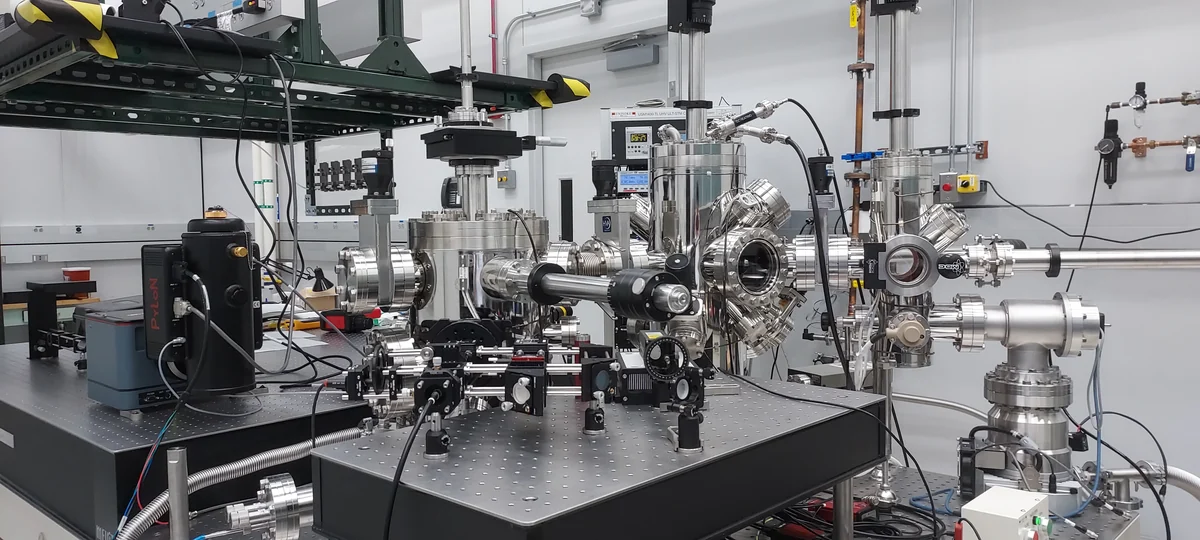
An electron experiment near gold reports loss of coherence consistent with the Anglin–Paz–Zurek description of quantum Brownian motion. The October 27 preprint examines changes in diffraction after electrons interact with a gold-coated microchannel. Its claim concerns a model of environmental decoherence, not a resolution of quantum measurement.[1]
The apparatus uses 1.67-kiloelectronvolt electrons. Changing the channel tilt alters their interaction with the surface; the analysis compares the resulting diffraction signatures with calculations. This is a test in a specified material and geometry, not a universal demonstration that every environment behaves identically.[1]
Coherence describes the phase relationships that allow alternatives in a quantum state to interfere. If information about those alternatives becomes linked to an uncontrolled environment, the interference available in measurements of the electron can diminish. That explanation does not require describing an electron as literally transforming from a wave into a tiny classical ball.
There is also an important difference between observing a broadened pattern and identifying its cause. Several mechanisms can blur a measurement. A persuasive decoherence experiment therefore needs controls and a model connecting the proposed interaction to the particular change being measured.
The surface provides a controlled way to ask how an electron’s surroundings affect interference. What matters is whether a model predicts the changing observations as the interaction is adjusted. Agreement at a single setting would be a weaker test than an account that follows a systematic change.
The result is useful as a test of how an environment changes observable quantum behaviour. Its broader significance depends on where the model remains predictive as experimental conditions change. That is a sharper question than whether this experiment has settled the boundary between the quantum and classical worlds.
The gold surface and the measured diffraction changes make this a concrete test of decoherence in one setting. Further comparisons across materials and electron energies could establish where the same description remains predictive and where its assumptions begin to fail. Those comparisons would be separate results.