
A Better Quantum Measurement Can Start With How You Read the Detector
A recent homodyne study uses the structure of measurement noise to improve an estimate. It is a reminder that a clearer answer does not always require a different quantum state.
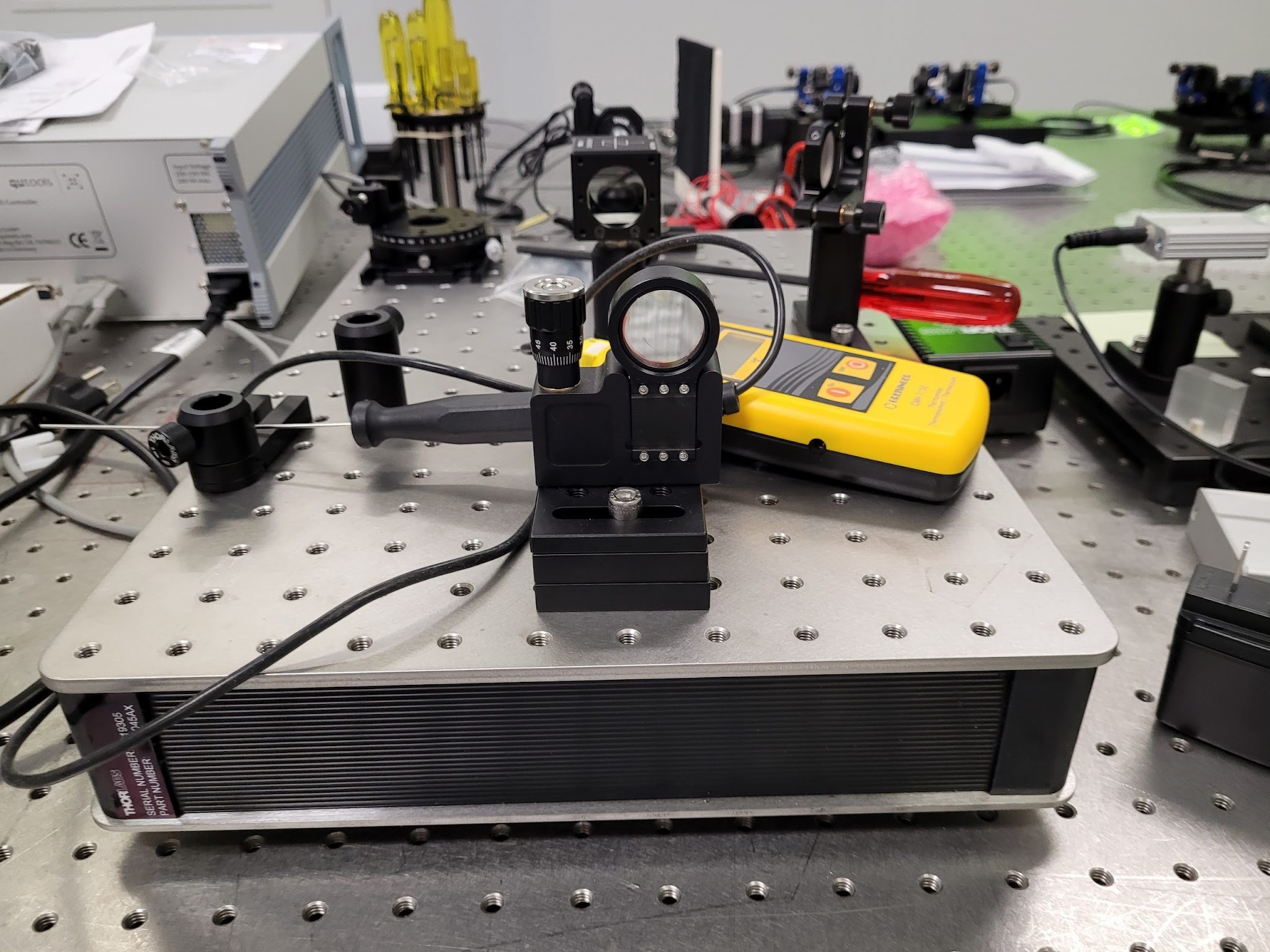
A detector can produce a complicated trace: a signal spread across time, mixed with fluctuations that are not equally informative at every moment. Treating every part of that trace in the same way can leave useful information on the table.
Research on ultrafast homodyne measurement, posted as a preprint in May and published in Communications Physics on 2 October 2026, investigates how measured noise correlations can inform the way a detector output is processed. The change is in the estimation procedure. It should not be described as removing every source of quantum noise or creating a quieter state by software alone.[1][2]
A detector still needs an estimator
A measurement apparatus converts a physical interaction into observations. The observations still have to be interpreted through a model and a procedure. Choices about timing, filtering and weighting can affect the precision and bias of an estimate.
In homodyne measurement, a signal is compared with a reference field in a way that makes selected properties accessible through interference and detection. The exact experiment determines which quantity is being estimated and which noise contributions matter.
That effectiveness has conditions. A model that is wrong, calibrated on the wrong setting or applied after the apparatus drifts can produce a misleadingly confident answer.
A deliberately simplified example
Consider a deliberately simplified, non-quantum example. Two independent instruments estimate the same fixed quantity. One has a standard deviation of one unit; the other has a standard deviation of two units. If their errors are unbiased and their uncertainties are known, the noisier reading should not receive the same statistical weight as the cleaner one.
For readings of 10 and 12, inverse-variance weighting gives an estimate of 10.4, compared with an unweighted average of 11. The weighted standard deviation in this simplified model is about 0.89 units. This is arithmetic from an educational model, not data from the homodyne experiment.
The example illustrates the principle: not all observations carry equal information. A real time-resolved detector is more complicated because the noise at different times can be correlated. Treating those samples as independent can exaggerate how much information they contain.
Correlated samples carry less new information
Suppose two readings tend to move up and down together because they share a disturbance. Averaging them does not cancel that shared disturbance in the same way it would cancel independent fluctuations.
In a simple equal-variance model, the variance of the average depends on the correlation as well as the number of readings. Two nearly identical noisy observations do not provide twice the independent information.
That is why measuring the noise structure matters. A covariance model describes not only how much each part of a trace fluctuates but also how the fluctuations relate to one another. A weighting rule can then be designed for the quantity of interest under that model.
Better processing and a better state
A reader might see a smaller uncertainty bar and conclude that the quantum system itself became less noisy. That conclusion does not follow automatically.
An improved estimator can extract a quantity more effectively from the same underlying observations. A physical intervention can change the state or the measurement interaction. Both may be valuable, but they answer different questions and require different evidence.
Check calibration on new observations
A weighting procedure needs information about the noise. That information usually comes from calibration or characterization. A fair test separates learning the model from judging how well it works on new observations.
If a method is tuned and evaluated on the same unusually favourable data, its apparent improvement may not carry over. A useful comparison therefore includes held-out or independently acquired observations, an appropriate baseline and an account of how sensitive the result is to drift.
Precision is not the same as accuracy
An estimate can be repeatable and wrong. More observations can reduce random variation while leaving a systematic bias intact. A narrow uncertainty bar is meaningful only if the uncertainty model includes the important sources of error.
In a simple synthetic calculation, an estimator with a fixed half-unit bias does not become unbiased by collecting more samples. The random term shrinks, but the bias remains. The exercise is elementary; the lesson is operationally important.
A strong follow-up would show both the gain under the intended conditions and the limits when those conditions change. A method that knows when it is outside its calibrated regime is more useful than a confident number without a warning.