
Unwanted drive paths help suppress quantum-chip crosstalk
A small superconducting circuit suppresses microwave crosstalk through interfering drive paths. Residual coupling limits the model’s agreement.
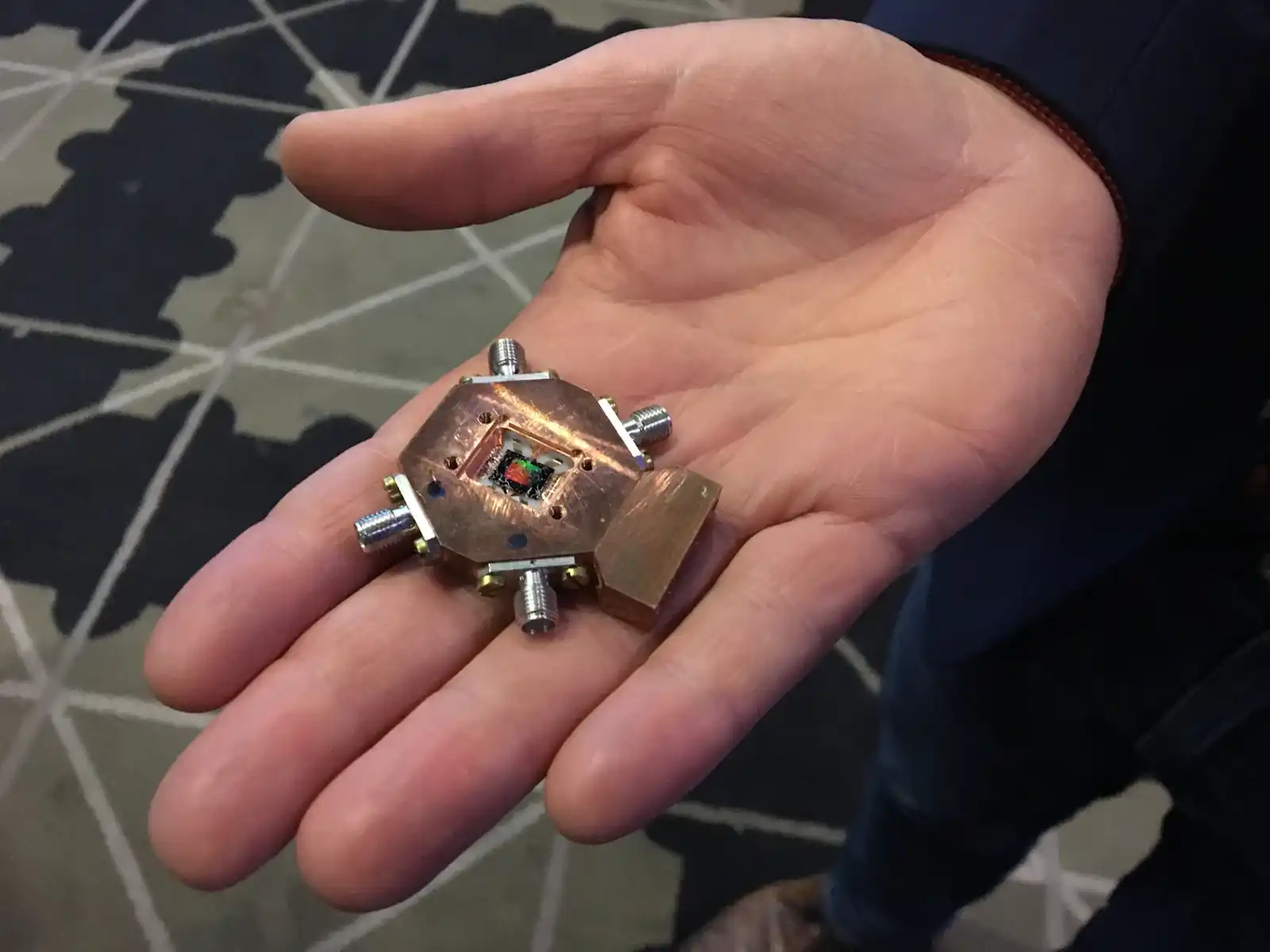

A two-transmon superconducting circuit uses interference among parasitic drive paths to suppress microwave crosstalk, according to an October 26 preprint. The experiment includes a tunable coupler. Its circuit model captures measured cancellation behaviour, but one branch retains more residual crosstalk than the model predicts.[1]
The authors propose engineering drive capacitances so that microwave-crosstalk suppression can coincide with reduced static ZZ interaction. That joint operating point is a design proposal here, not a measured many- processor result.[1]
The counterintuitive idea is that an unwanted path need not only be blocked. If two contributions arrive with the right relative amplitude and phase, they can cancel at a particular destination. This is interference applied to control wiring: the relevant quantity is the combined field seen by the device.
That makes “parasitic” an engineering description, not a verdict that a coupling can never be useful. A contribution that causes trouble at one operating point might help at another. The practical question is whether the useful cancellation survives changes in frequency, device parameters and the surrounding circuitry.
A minimum on a measured curve also needs careful language. A deep reduction is not automatically zero, and agreement around one minimum is not proof that every coupling in a package has been modelled. Residuals are valuable because they identify where a design explanation remains incomplete.
For readers comparing processors, the distinction between a microwave-control result and a gate-error result matters. Better isolation can support better operations, but a complete error budget also includes other imperfections. Multiplying a crosstalk improvement into a claimed overall processor improvement would skip that accounting.
This is a strong engineering story precisely because it supplies an actionable design question: can a layout deliberately balance unwanted drive paths while preserving other operating requirements? Demonstrating that balance across a larger device would be a meaningful extension of the small-circuit result.