
A faster quantum gate still has to keep the qubit in bounds
Gao and colleagues report 6.8-nanosecond single-qubit gates with tightly controlled leakage. The result belongs to a calibrated transmon, not an entire processor.

Yuan Gao and colleagues report a way to make superconducting single- operations faster while limiting leakage into unwanted states. Their Nature Communications paper was published on October 23. The experiment was previously public in a November 27, 2025 preprint, making publication the current milestone. Jülich’s account confirms that testing used one isolated qubit.[1][2][3][4]
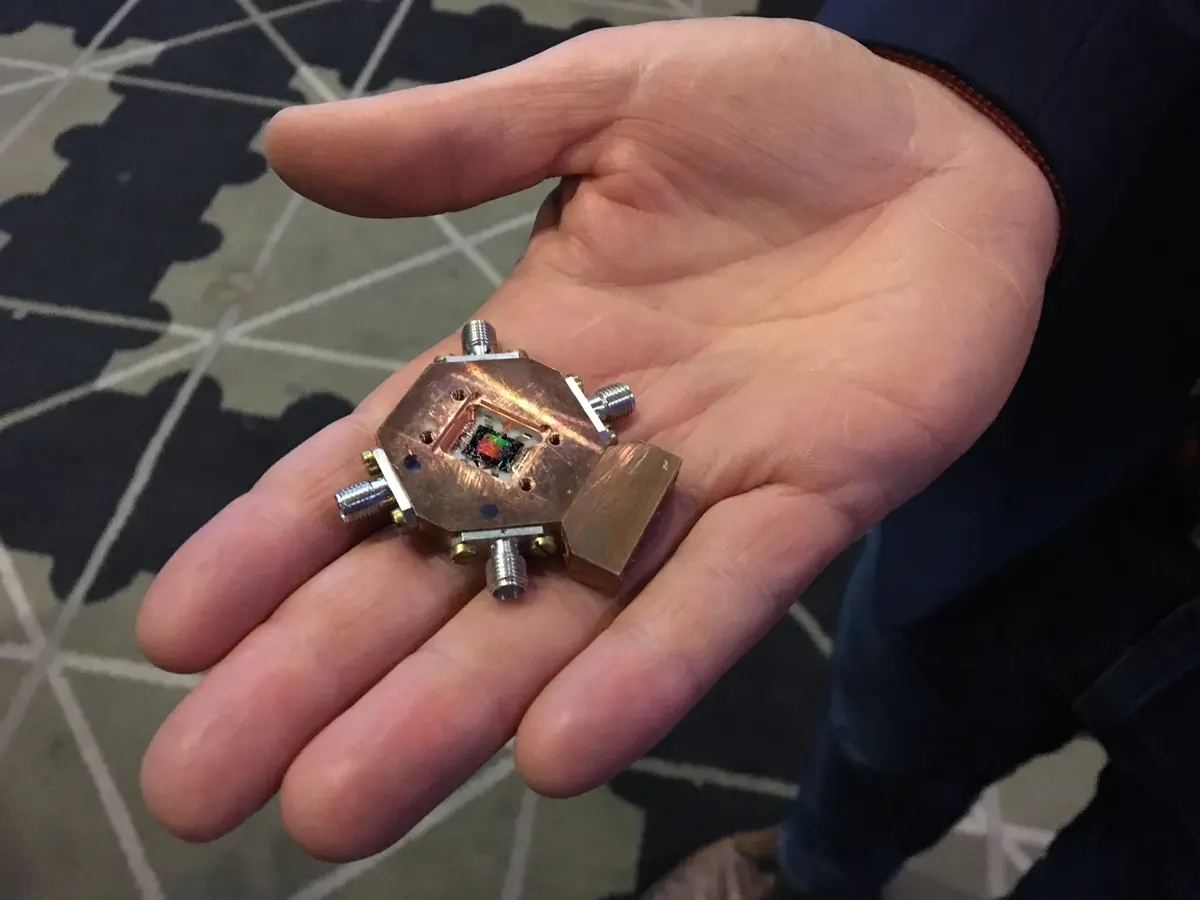
The researchers report X and X/2 gates lasting 6.8 nanoseconds, with fidelities above 99.98% and total leakage below 2.0 × 10⁻⁵ per operation. These figures describe particular operations on the tested transmon. The archival photograph shows a different device: a three-qubit processor fabricated at Chalmers in 2017, rather than the apparatus used for this result.[1][2][4]
A transmon supplies the two computational states called zero and one, but it also has higher energy levels. Strong, short microwave pulses can populate those unwanted levels. The team’s pulse-shaping method suppresses multiphoton transitions that can become important under fast driving. Leakage is therefore a physical destination for error, not simply another name for every wrong answer.[1][3][4]
The paper uses randomized benchmarking to estimate total gate error, leakage benchmarking to track population outside the computational states and purity benchmarking to separate decoherence contributions. Keeping those quantities distinct matters: a leakage probability is not interchangeable with gate infidelity, and neither is the success rate of a complete application.[1][3][4]
Shortening one operation only helps the larger computation if the control remains accurate in its working environment. Simultaneous operations, interactions with neighbouring qubits and two-qubit gates introduce questions that an isolated single-qubit test cannot settle. Jülich explicitly identifies testing larger processors and two-qubit operations as further work.[2]
The next useful result would carry the method into those conditions and report the full error budget alongside the timing. That would show how much of the gain survives integration. For now, this is a measured improvement in fast control with leakage accounting, rather than a demonstrated application speedup.