
More entanglement can take longer to prove
A levitated-particle theory makes the time needed to establish entanglement part of the experimental design.
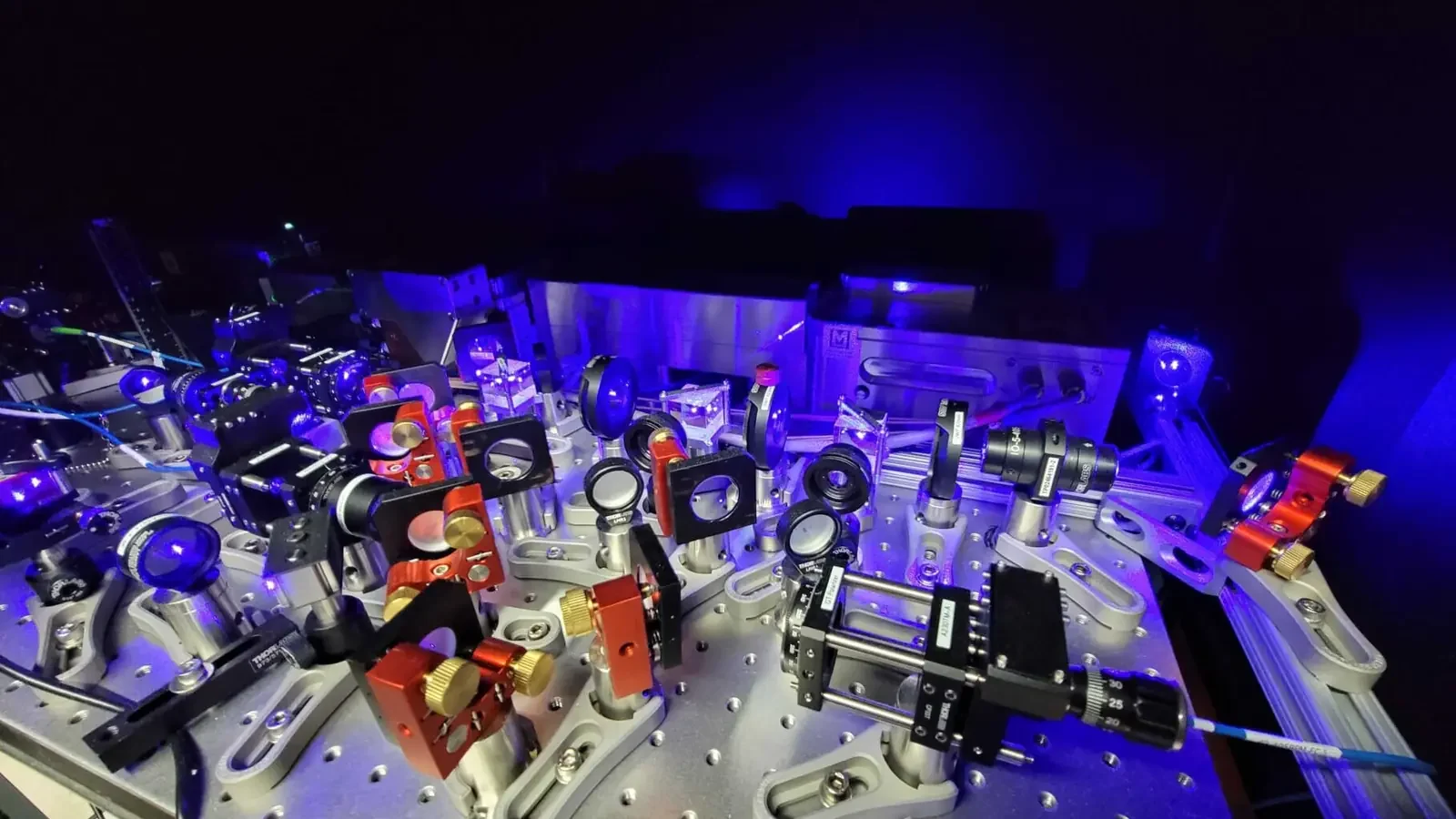

Creating a stronger quantum effect and proving that it exists can pull an experiment in different directions. An October 27 preprint examines that tension for generated by weak forces between levitated particles, treating the measurement record itself as a finite resource.[1]
The authors calculate how many observations are needed to certify Gaussian entanglement at a chosen confidence. States with the same entanglement can have different certification costs. Local squeezing can preserve the entanglement while making the evidence harder to extract from noisy measurements.[1]
An illustrative consequence is easy to see in the paper’s sampling expression. If the relevant entanglement gap is halved while the noise factor and confidence are fixed, the required sample count grows fourfold. With an unchanged measurement cycle, collecting those samples would also take four times as long. This is arithmetic from the model, not a measured laboratory result.[1]
The study also compares release-and-recapture with continuous monitoring and finds substantially different access to weak interactions under its assumptions. It is a theoretical comparison of detection strategies; it does not report an observation of gravity-mediated entanglement.[1]
The practical implication is a change in the optimization question. Imagine two proposed preparations: one produces a larger resource but requires a long acquisition, while another yields a smaller resource with cleaner evidence. An experimental team would want to compare their total certification times before committing its available instrument time. The more impressive state description alone cannot answer that scheduling question.
That makes the measurement protocol part of the result a reader should ask about. How was confidence specified? Which noise assumptions enter the estimate? How long does each repeat take? A useful follow-up would put those quantities beside the entanglement measure, so another laboratory could judge whether a proposed signal is realistically distinguishable during its own run.