
Google wants AI to make quantum computers do less work
A new circuit challenge rewards shorter calculations that still pass a correctness test. The verification conditions matter as much as the savings.

The next useful improvement in quantum computing might involve asking a machine to do less. Google Quantum AI announced a Kaggle competition on October 21 that challenges participants to use AI to find more economical quantum circuits. Its kickmix software, part of Qualtran, provides a way to check candidates efficiently on an ordinary computer.[1][2]
A circuit is the sequence of operations used for a quantum calculation. Removing operations can reduce the resources it needs, but a shorter recipe is no improvement if it changes the answer. This challenge puts a verifier beside each reference task so that proposed shortcuts have something concrete to pass.[1]
The approach targets a structured family of circuits built from reversible classical logic, phase operations and measurement-based uncomputation. That structure makes randomized checking practical. Under the stated assumptions, the tests support approximate correctness with bounded error. They do not prove exact equivalence for every possible quantum circuit or every possible input.[1][2]
The three benchmarks concern subroutines relevant to fusion-related simulation, optimization and chemistry. They are targets for reducing future computational requirements. The competition is not evidence that AI has already solved fusion or fertilizer production, or that a quantum processor has demonstrated a new industrial speedup.[1][2]
For readers, the useful comparison is between two complete recipes for the same task. Which errors are allowed? Which gates are counted? How many are needed? Does reducing one resource increase another? A leaderboard score becomes informative when those trade-offs and the test conditions are visible.
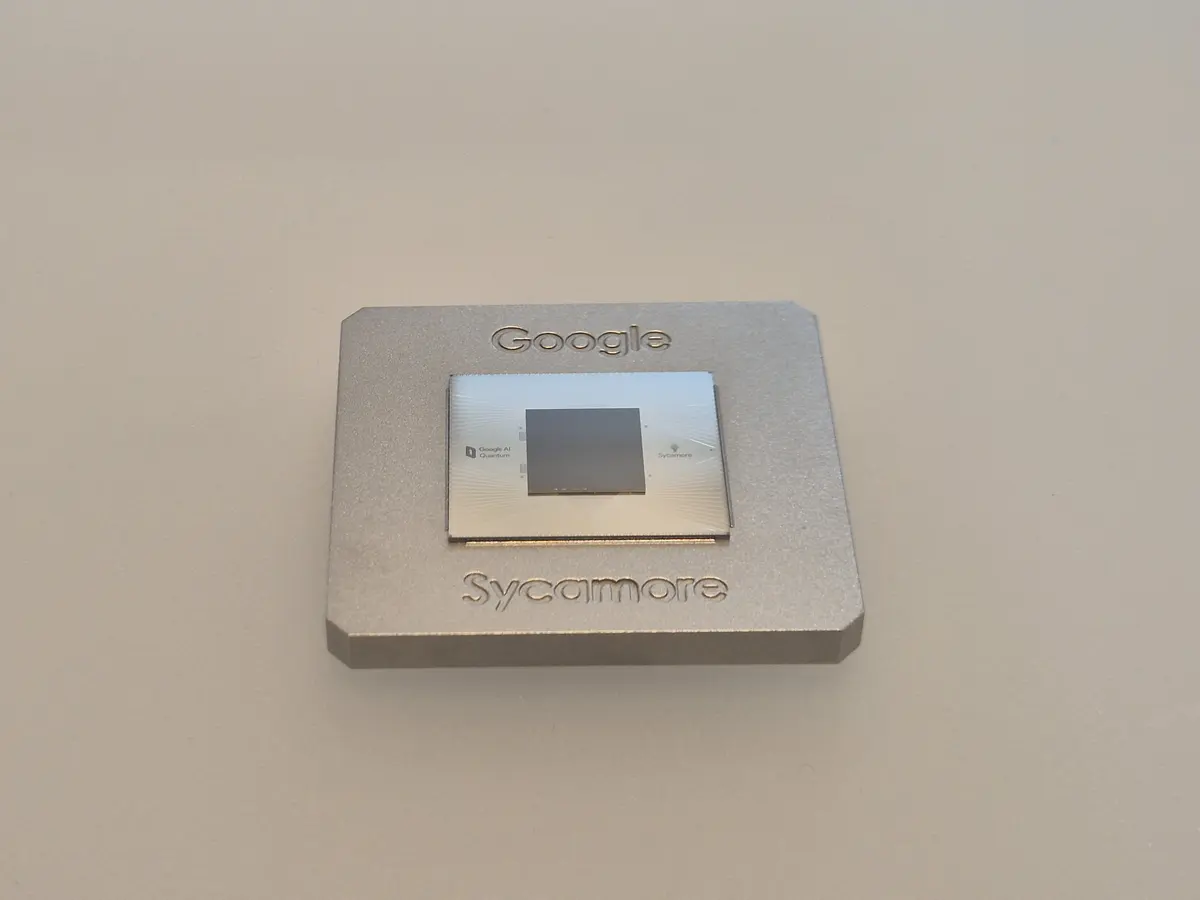
The next meaningful milestone is a reproducible improvement against a published baseline, with its assumptions intact. The accompanying paper remains a preprint, first posted October 16 and revised October 21. This is a software competition and a verification method, not a new quantum chip. The photograph shows historical Sycamore hardware in a museum.[1][2]