
Google’s Quantum Error Records Could Get a Second Life After the Run
An October 8 simulation preprint proposes virtual error cancellation using stored syndrome records. The useful question is how much accuracy offline analysis buys after its full cost is counted.
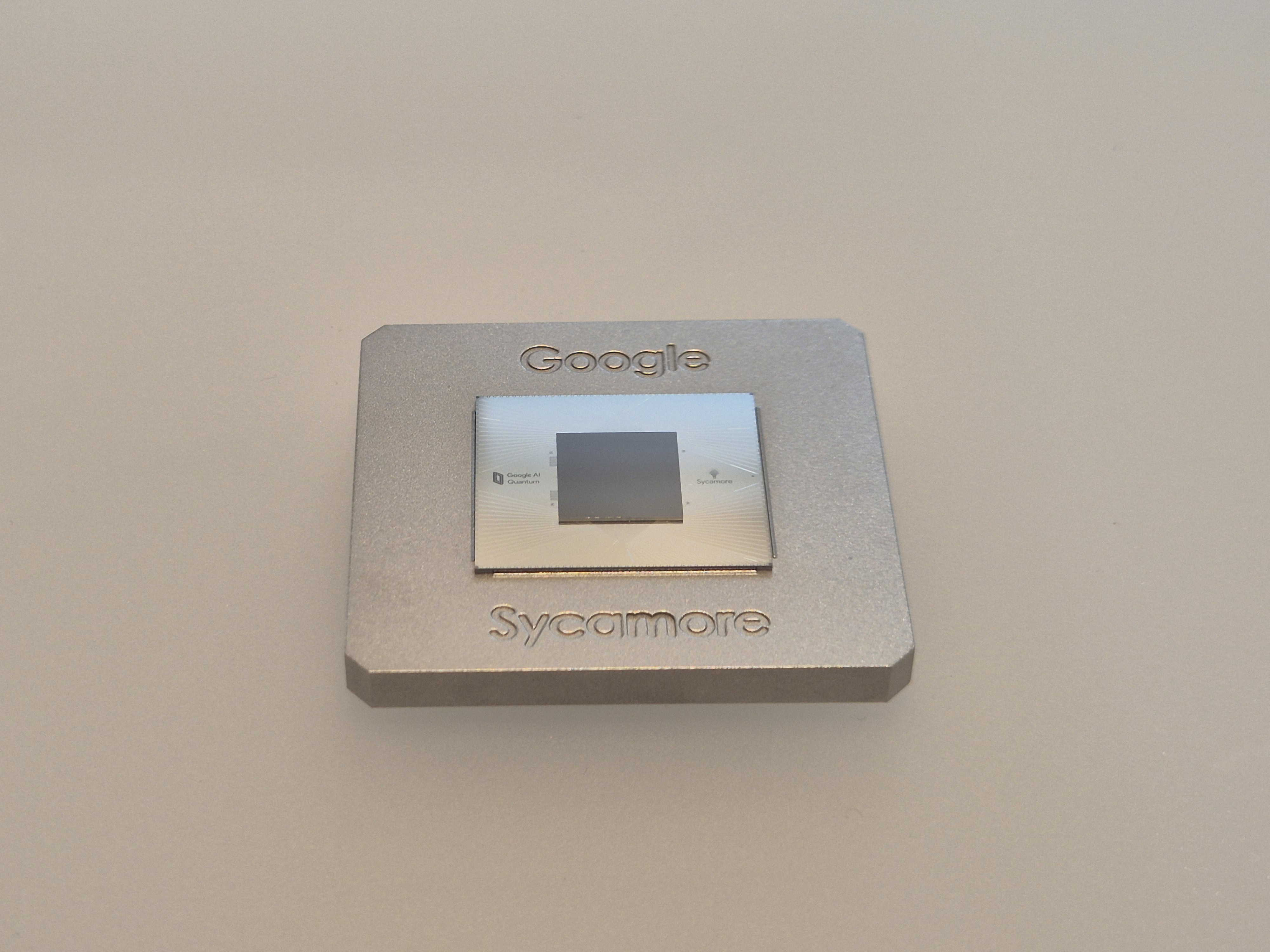

A quantum experiment can leave behind two useful things: its answer and the record used to diagnose errors along the way. Google-affiliated researchers now propose getting more from that second output. Their October 8 virtual error cancellation preprint asks whether stored records can improve an estimate after the processor has finished. Its evidence is simulation and theory.[1][2]
Two clocks, two kinds of evidence
The practical distinction is between protecting a calculation while it runs and improving the estimate drawn from its results afterward. Google’s earlier Willow study directly measured protected quantum memories on hardware. It also showed why classical decoding has a timing problem: decisions must keep pace with repeated error checks. The VEC proposal explores what a slower second analysis can contribute once that deadline has passed.[2][3]
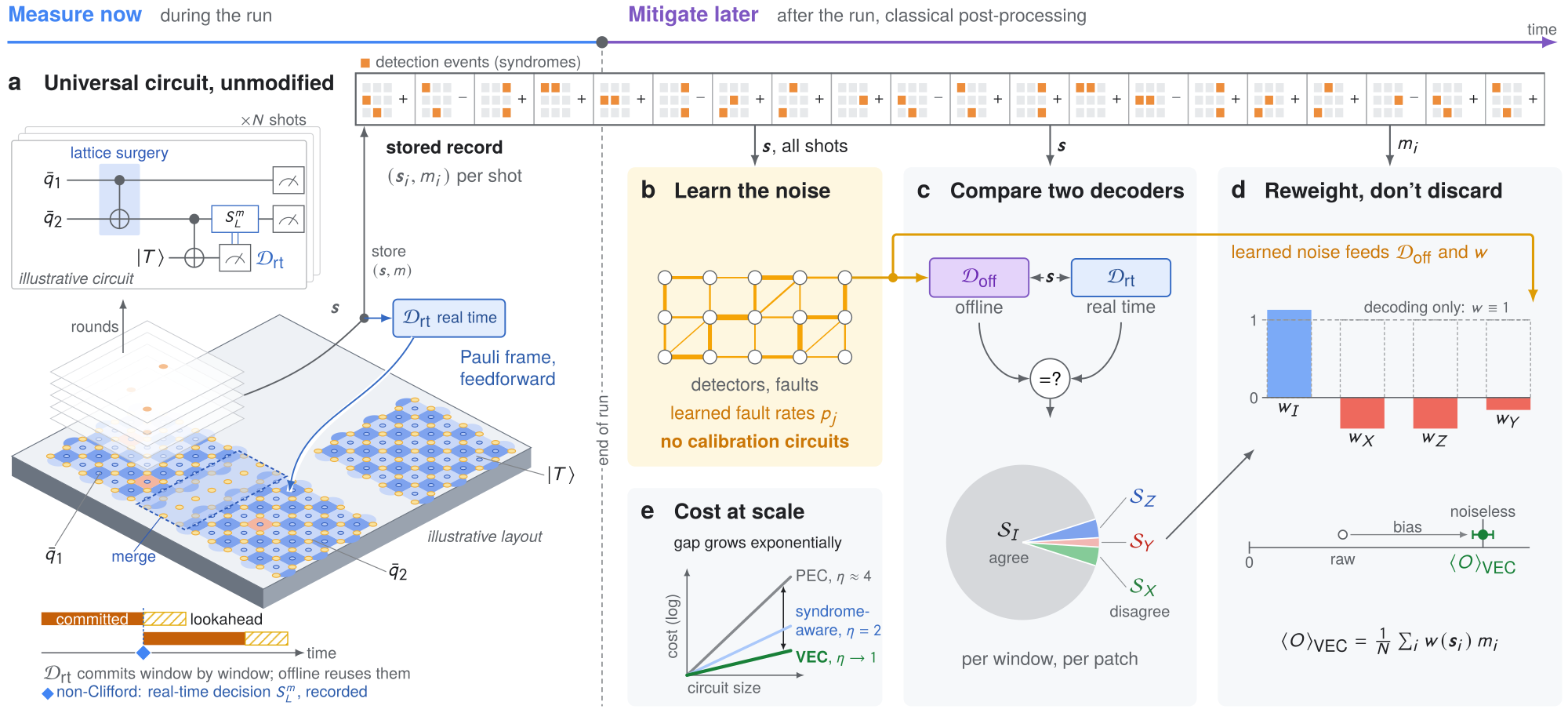
VEC stores the syndrome record, the error checks associated with each run, alongside the final measurement outcome. A fast decoder serves the running circuit. An offline decoder revisits the records, and their agreement or disagreement groups the runs. Classical weights then change how much each group contributes to the final estimate.[2]
Keep the disputed runs
Some contributions receive negative weights. This is a statistical cancellation step, not a negative measurement or a repaired . The estimate can reduce logical bias without discarding every disputed run. The authors also learn noise information from the stored records, avoiding separate calibration circuits in their proposed workflow.[2]
Figure 1 lays out this proposed sequence. Every panel is schematic, including its circuit, processor layout and cost curves. The archival Sycamore photograph above provides Google hardware context only; the preprint does not report running VEC on that displayed chip.[2]
What the headline number measures
The reported end-to-end distance-seven surface-code simulations suppress residual logical error by more than three orders of magnitude relative to the decoded logical error rate. That is a comparison between estimators under a specified model. It is not a thousandfold processor speed-up, an application advantage or a newly demonstrated logical computer.[2]
Cancellation has a sampling cost: reweighting can increase statistical uncertainty, requiring more repetitions for a chosen precision. The numerical benchmarks use code-capacity depolarizing noise. The paper identifies testing realistic circuit-level noise as a next step. Errors accumulated through a complete noisy execution therefore remain an important boundary on what these simulations establish.[2]
Price the answer in work, not adjectives
QubitWire’s analysis: the decision metric should be total work per trustworthy answer. A smaller bias can be valuable even if post-processing takes longer, but those improvements need a shared accuracy target. Otherwise a reader cannot tell whether a more impressive error number reflects a more useful computation or simply a larger analysis budget.[2][3]
A useful comparison would give standard decoding, postselection and VEC the same target accuracy, then report repetitions, stored-data volume and offline compute time. Noise-learning data should count toward that budget too. These are proposed evaluation criteria, not measurements supplied by this article or a claim that one method already wins on a real processor.[2]
The next test
The next revealing test is to move beyond the paper’s code-capacity benchmark, then test hardware records while reporting the complete resource bill. Can the gain survive circuit-level faults and changing noise? Does the second decoder still help when its time and memory use count? Those questions would connect an attractive estimator to an experimentally useful workflow.[2]
For teams collecting data, the broader lesson is to treat the diagnostic record as a possible research asset. For everyone assessing the result, keep the claims separate: Willow’s measured memory protection is historical hardware evidence; VEC is a new proposal for using classical work after execution. Neither makes the other result more experimentally complete.[1][2][3]