
A 98-qubit computer simulated colder spins without adding circuit layers
On Quantinuum's Helios-1, changing the settings of the same circuit reproduced most of a noiseless model's low-temperature spin correlations.
Reading tools for text size, copying, printing and your reading list
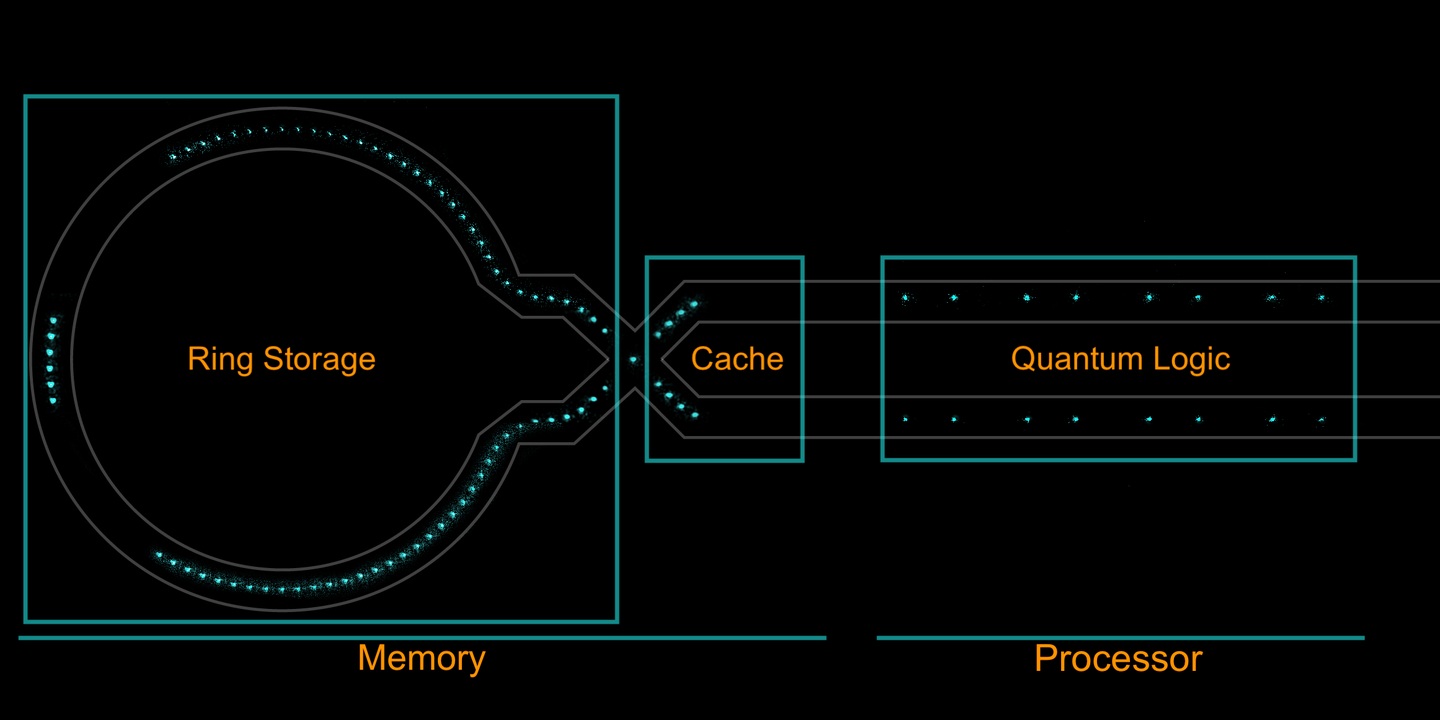
Cooling a magnet in a lab changes how its spins line up. Simulating that change on a quantum computer can mean running a longer circuit, which gives errors more time to build up. A new preprint reports another way: researchers used the same circuit layout at different simulated temperatures and changed only its settings. On Quantinuum's Helios-1, their largest experiment captured low-temperature ordering across a seven-by-seven grid of interacting spins.[1]
Cenk Tüysüz and colleagues used 98 for the 49-site grid and 96 for a separate 48-site chain. In each case, half the qubits represented the simulated spins and half were helpers. The device itself was not cooled to new temperatures for each run. Rather, a classical calculation supplied different rotation angles to the quantum circuit, preparing a model at each target temperature without adding a new round of gates.[1]
The helper qubits let the researchers represent a mixture of possible spin configurations, rather than choosing a single configuration to stand in for a temperature. When they look only at the qubits representing the spins, they can estimate quantities such as the energy or how strongly spins at different distances tend to align.[1]
What 42 layers bought
The lattice circuit ran in at most 42 sequential layers of two-qubit operations after compilation. At one low-temperature setting, the measured correlations across different distances were about 94% to 96% as strong as those predicted for the same circuit without hardware noise. The number describes one set of measurements, not the fidelity of the entire quantum state. The separate chain experiment recovered the tendency of neighboring spins to form pairs even though competing interactions made the chain harder to model.[1]
The fixed layout also had a cost. At intermediate temperatures, the method produced less ordering than the independent thermal reference predicted; the noiseless circuit had much the same problem. That points to a limitation of the circuit design rather than simply noise in the processor. At the lower temperatures tested, the predicted ordering caught up with the reference and the hardware retained most of that pattern.[1]
Fewer layers are not the same as a faster calculation
For the frustrated chain, the authors report roughly a twofold to tenfold reduction in depth compared with the specific circuits they built from classical tensor-network calculations. For the grid, one comparison method produced lower energy errors with fewer total gates, but needed more sequential layers. The study does not establish that the quantum workflow took less time overall or beat all classical alternatives. It appeared in the November 25 arXiv listing as a preprint, and one co-author is affiliated with Quantinuum.[1][3]
A shorter preparation circuit could leave more of the processor's usable time for the next step: watching how a simulated material changes after the state has been prepared. This experiment tested the preparation, not that follow-on calculation.[1]