
Infleqtion puts its quantum clock through a sea test
A reported maritime trial tests the practical side of quantum timing. The next question is how accurately the clock kept time.
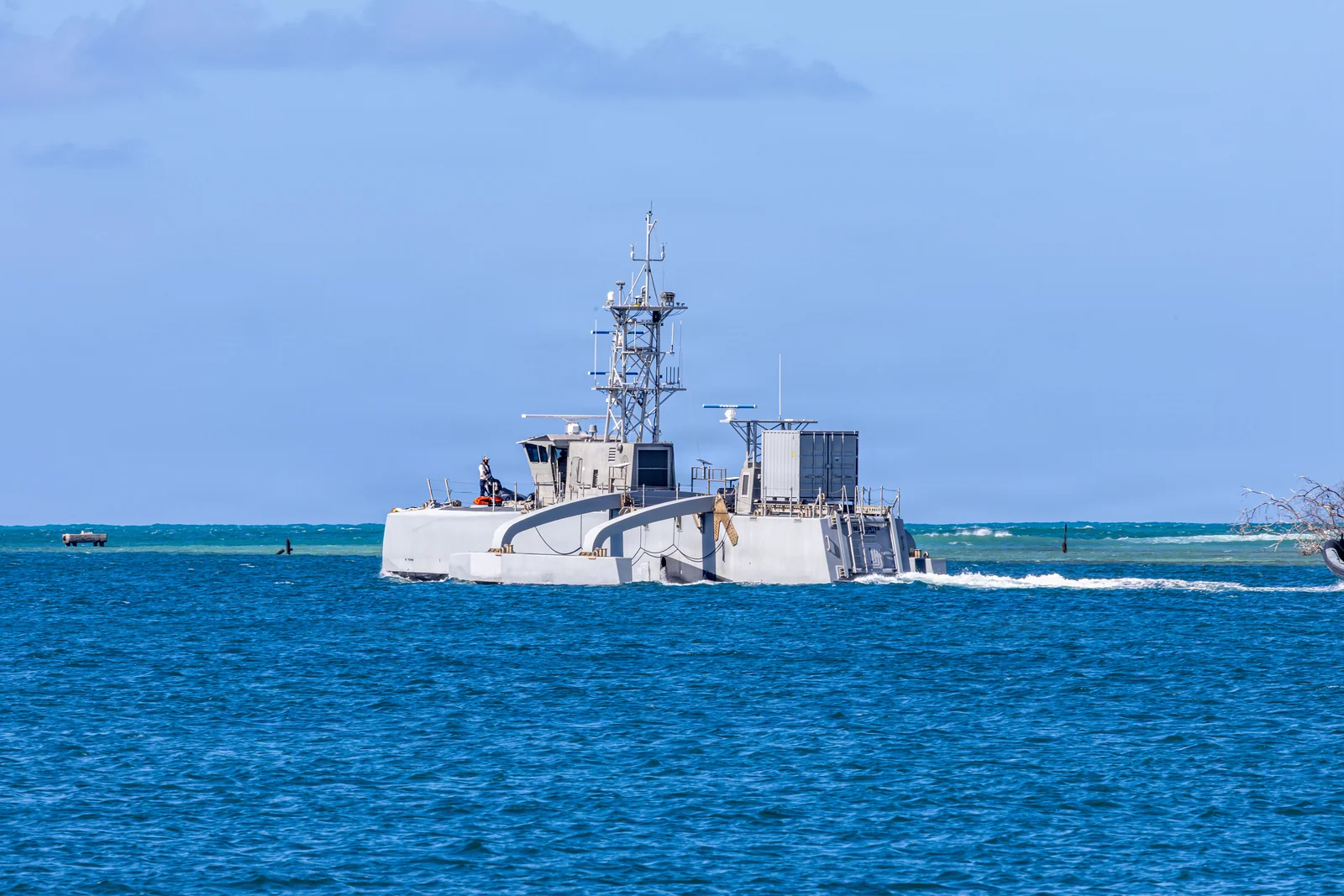


Infleqtion says its Tiqker optical atomic clock ran continuously for more than two weeks aboard RV Merlin, a U.S. Navy support vessel, during the Maritime Big Play Pacific exercise off Southern California. The October 30 announcement describes operation through temperature changes and sustained vibration, with the demonstration also supporting BARB-26. It is a practical field-testing milestone for quantum timing, reported by the company.[1]
The public release does not give the trial's exact dates, measured timing drift, or an independent Navy performance assessment. It also announces no procurement decision. Those omissions define what readers can conclude: this is evidence of a reported deployment and sustained operation, while the quality of time delivered at sea remains unquantified in the announcement.[1]
What staying operational tells us
An atomic clock uses a repeatable atomic transition to discipline an oscillator. Counting that oscillator's cycles supplies a time reference. The quantum element is the atom's allowed energy transitions; useful output still depends on engineering that interrogates the atoms and turns their response into a reliable signal. NIST's explanation of atomic time makes that chain clear: atomic physics provides the reference, and an instrument has to keep tracking it.[3]
Tiqker's own product documentation draws an essential boundary around the application. It supplies local time and frequency when satellite timing is unavailable. Position and navigation require other equipment and integration. Its optical reference and frequency comb produce signals that external systems can use. A ship carrying the clock therefore should not be described as having demonstrated an entire replacement for GPS merely because the clock remained operational.[2]
Three different questions about a clock
The distinction becomes clearer when performance is separated into questions. Availability asks whether an instrument kept operating. Accuracy concerns agreement with the reference it is meant to realize. Stability concerns how consistently its ticking rate behaves over a stated interval. NIST treats the latter two as different properties. A long uninterrupted run addresses an operational question, but it cannot supply missing measurements of the others.[4]
Three different questions about a clock
- Availability
- Did it keep operating?
- A continuous operating record answers this question.
- Accuracy
- How close was it to the reference?
- A suitable reference comparison needs offsets and uncertainty.
- Stability
- How much did its rate change?
- Measurements need a stated averaging interval.
Consider a hypothetical test report that establishes continuous operation but gives no numerical accuracy result. An evaluator would still want to know how the output changed during the run, how it was compared with a trusted reference, and whether any adjustments were required. That is a useful way to read a field announcement: identify the observation actually reported, then ask which additional measurements would connect that observation to the intended application.
There is relevant laboratory work behind the product. Britain's National Physical Laboratory describes separately evaluating Tiqker's frequency accuracy, stability, phase noise and environmental sensitivity against references traceable to UTC(NPL). Its case study includes checks involving temperature, humidity and magnetic fields. That work explains the types of measurements worth asking about; the case study does not establish the outcome of this particular U.S. sea trial.[5]
There is earlier maritime context too. A December 2025 account from the UK's Ministry of Defence and Submarine Delivery Agency confirms a Tiqker trial aboard the experimental uncrewed underwater vessel XV Excalibur. That is a separate, older event. Keeping the two deployments distinct matters: the latest announcement adds a reported U.S. exercise experience to an existing testing history.[6]
The next useful result
The most informative follow-up would connect timekeeping data to the conditions recorded during the deployment. A published trace, a stated comparison method and a clear account of calibration would let readers assess what the trial established. If a claimed benefit concerns an outage of external timing, the evidence should identify that interval and the resulting error. These are suggested evaluation questions, not allegations that the system failed them.
The maritime trial makes a practical question easier to ask: can the instrument deliver useful time under conditions its intended users actually face? A public comparison of its output with a trusted reference would connect the reported endurance to that question. That is the next result that could turn an engineering milestone into a stronger case for use at sea.