
Manganese gives fast electrons a second wind in quantum dot films
Los Alamos researchers measured unusually high electron mobility at room temperature. Their results suggest that manganese can repeatedly return slowing electrons to a fast-moving state.
Reading tools for text size, copying, printing and your reading list
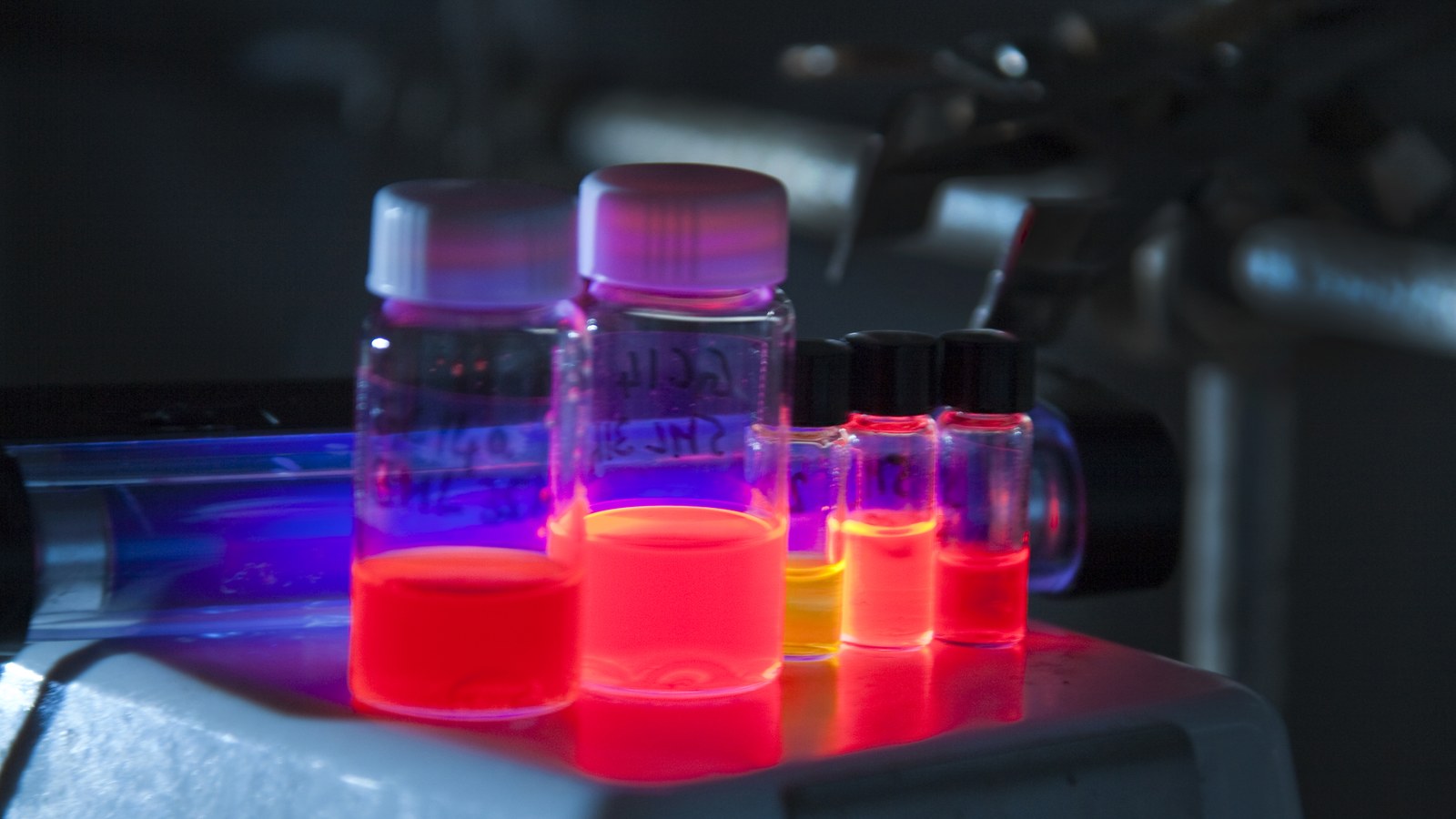
Light can give an electron more energy than it needs to carry current. In most materials that extra energy disappears almost immediately into vibrations. A Los Alamos National Laboratory team reports a different outcome in a film made of semiconductor quantum dots: when the dots contain manganese, energized electrons can move far more freely, and the film can give them another boost as they start to slow. The study appeared in Nature on November 25.[1]
Quantum dots are semiconductor crystals so small that their size changes the energies their electrons can occupy. In a liquid they can glow in different colors, depending on their size. Making a solid film from those dots is a different challenge. It's not enough for a dot to absorb light: if a device is meant to collect charge, electrons also have to move through a crowded assembly of separate crystals.[1][2]
Separating a long drift from a fast flash
The researchers used short light pulses to excite the film and tracked the electrical response. Changing where the light hit changed how long the signal took to arrive. Making the electric field stronger shortened that time. Those two checks are what let the team distinguish charge moving through the film from a brief burst of current confined near an electrode.[1]
At room temperature the team obtained an average drift mobility of about 150 square centimeters per volt-second, compared with the 10 to 20 that the paper cites as typical for strongly coupled, device-grade quantum dot films. Mobility measures how readily a charge responds to an electric field. From the measured speed and the fitted lifetime under one set of conditions, the researchers estimated a drift range of about 0.15 millimeters. That's not a direct measurement of an electron traveling that exact distance, nor a steady-state result.[1]
What the manganese changes
The team's explanation is that excited manganese ions pass energy to electrons before vibrations carry it away. Those electrons can enter states that extend beyond an individual dot, where the electric field can move them more easily. If they partly relax and get caught again, another energy transfer can return them to that fast-moving band. An earlier study found a short-lived mobility boost in undoped quantum dot films. The new result is about sustaining transport, not simply seeing a larger current right after the flash.[1][3]
The work points to a way of getting useful electrical signals out of materials that absorb light, a problem shared by light detectors and some solar energy research. But the film was tested with controlled light pulses and an applied field. It did not demonstrate a more efficient solar cell or a finished detector. The next question is whether a real device can capture enough of that extra energy to matter under its normal operating conditions.[1]