
Four fibre cores carry a quantum-key experiment across a campus
Researchers tested four-dimensional encoding in installed fibre in Concepción. The physical links and a separate detector benchmark answer different questions.
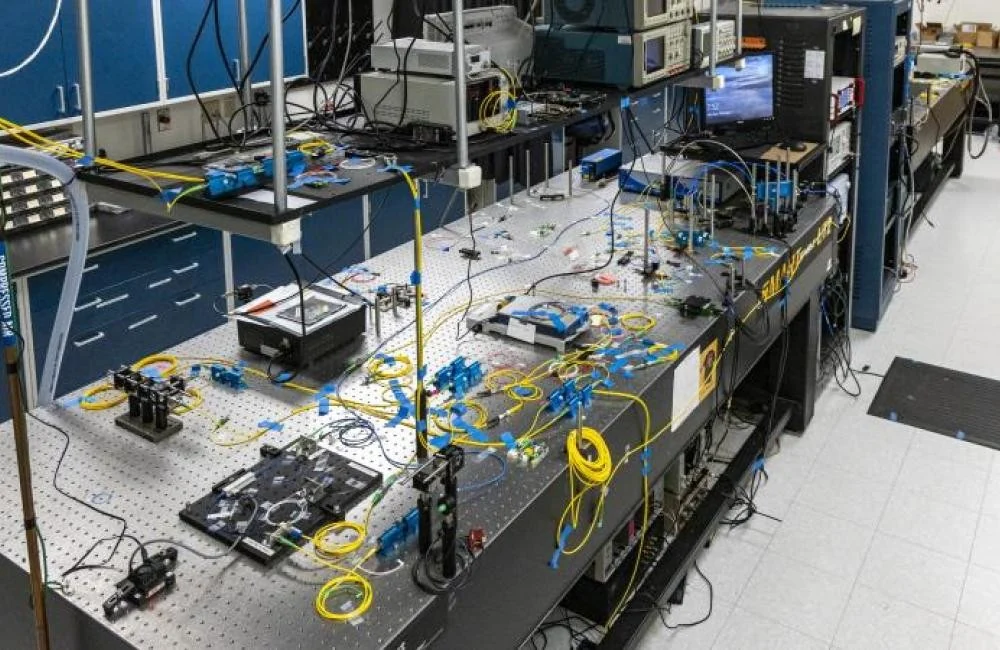

An October 19 PRX Quantum paper reports four-dimensional quantum key distribution through installed multicore fibre at Universidad de Concepción, Chile. It encodes states across four cores, with claims tied to particular configurations and security assumptions.[1][2]
Campus measurements include 200-metre and 1,300-metre round-trip optical lengths. These are not one-way route lengths; attenuation-equivalent distances likewise describe loss rather than physically deployed fibre.[2]
A separate superconducting-detector benchmark reports 0.00619 secure bits per pulse at 10 decibels of loss under finite-key analysis. Its 2 megahertz clock gives 12.4 kilobits per second. That rate does not describe every campus configuration.[2]
Installed fibre makes the story interesting because a communications method must eventually meet infrastructure that was built, connected and maintained outside a tightly arranged optical table. The presence of that infrastructure is a meaningful test condition. It is still one condition among several needed to understand whether a complete service would be useful.
The extra dimensions should also be read carefully. A four-dimensional encoding gives the protocol a particular state space to use. It does not mean four independent services have each been secured, or that every system benefit grows fourfold. The question is how the encoding changes performance and requirements in the configuration actually studied.
One practical way to read a network paper is to trace its units. A result per pulse describes a different quantity from a result per second. A conversion needs the relevant clock and configuration, followed by any processing assumptions. Attaching those conditions is part of the result, rather than optional detail that can be dropped from a headline.
A deployment decision would then ask for a second layer of evidence. How long did the system run? What happened when environmental conditions changed? How frequently did it require adjustment? These are proposed service-evaluation questions, not a claim that the paper presents a commercial uptime guarantee. They keep experimental achievement and operating reliability in view together.
Security needs the same complete view. A quantum link establishes key material within a protocol’s model; applications still depend on the surrounding authentication, storage and handling arrangements. An organization comparing a proposed installation would need to identify those boundaries before treating the link as a comprehensive answer to its information-security needs.
An everyday comparison is a new transport route. Demonstrating that a vehicle can cross it is valuable evidence, but a scheduled service also needs operating rules, recovery plans and dependable connections at either end. The analogy does not describe quantum security. It explains why a field experiment and a usable service are different milestones.
For readers comparing announcements, the best compact record would preserve the installed route, round-trip length, loss, detector type, clock and rate definition together. That allows a stronger comparison than collecting the largest distance and highest rate from different configurations. It also makes a later improvement easier to recognize without overstating the earlier result.
The Concepción experiment contributes geographically and technically specific evidence to that record. It shows how higher-dimensional encoding was investigated in installed infrastructure. The detector benchmark supplies another piece of the study, with its own conditions. Keeping the two connected but distinct gives both results their proper value.
The paper is therefore worth following as a networking experiment, rather than a declaration that a general quantum-secure service is ready. Its practical lesson is how much clarity can be gained by preserving the configuration around a number. Four cores, an installed campus link and a rate benchmark tell a better story when none is asked to stand for the others.