
Noise can speed cooling when it leaves the ground state alone
A theoretical model redirects excited-state population toward faster decay while preserving the target ground state.
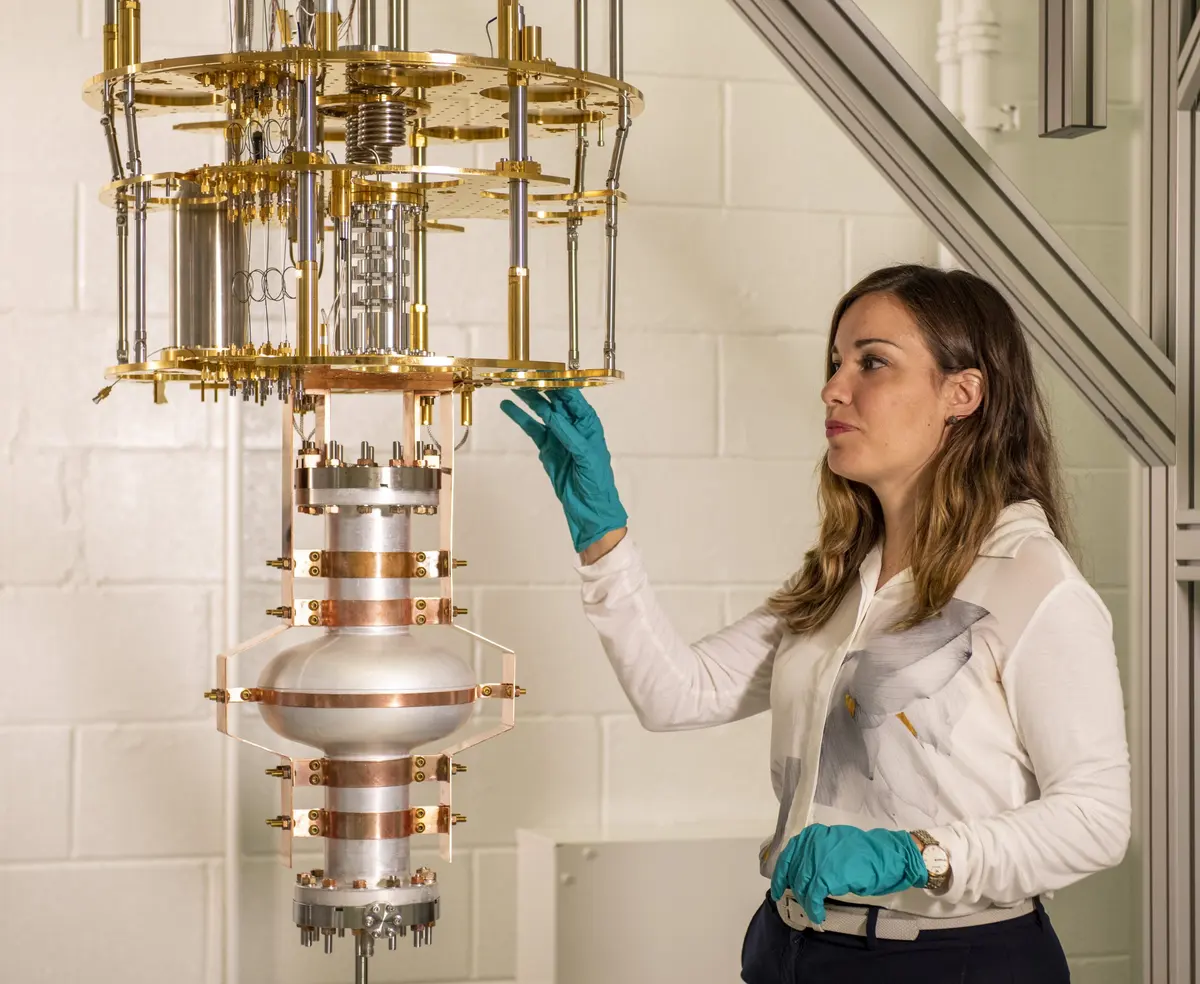
An October 15 theoretical preprint studies classical noise acting alongside a zero-temperature reservoir. The added noise mixes excited states while leaving the ground state unaffected. Under the analyzed conditions, fast mixing can replace different decay rates with an effective average, which may accelerate or decelerate the approach to the ground state. A three-level numerical model supports the analysis. This is a selective-noise proposal, not a demonstration that arbitrary heating improves refrigeration. The protected ground state is essential to understanding why the apparently counterintuitive effect can occur.[1]
Cooling a quantum system is not always a smooth slide through a sequence of equilibrium temperatures. Population can become trapped in a state that couples weakly to the route by which energy escapes. Another excited state may decay much faster. If the initial state strongly occupies the slow channel, the late-time approach to the ground state can be governed by that bottleneck. Changing how population moves among the excited states can alter the bottleneck even when the cold reservoir itself remains unchanged.
An original rate example makes this mechanism visible. Suppose excited state A decays to the ground at one per second and excited state B at nine per second. Assume an additional process mixes A and B much faster than either decay, without acting on the ground. The excited population then spends approximately half its time in each channel, giving an effective loss rate near five per second. This simplified population model is illustrative; it is not a numerical result from the paper or a proof covering every quantum noise generator.
The same example also shows why the initial condition matters. Population starting in slow state A can reach the ground faster after mixing opens access to B. Population starting in fast state B can instead be held back by repeated visits to A. A claim of universally faster cooling would ignore that distinction. The relevant comparison fixes the initial state and the target condition, then asks how long the two protocols take to reach it. A faster asymptotic mode is informative, but the complete trajectory can determine the answer at a practical tolerance.
Leaving the ground state alone is what prevents the extra mixing from undoing completed cooling in this simplified picture. If the added process also promotes ground-state population back into excited states, a nonzero excited population can persist. That becomes a different steady-state problem. A physical implementation must therefore show how selectively it addresses the excited manifold and how much unwanted coupling reaches the ground. The mechanism is not that heat disappears. It is that carefully structured agitation can redirect population toward a more effective route into the cold reservoir.
Energy and ground-state probability are related but distinct observables. Redistribution among excited levels can temporarily increase average energy while improving the rate at which the remaining excitation later escapes. A system outside equilibrium need not possess one temperature that summarizes all its populations and coherences. Measuring only an energy curve could therefore miss part of the dynamics. A useful test would resolve the populations relevant to the bottleneck and state clearly whether the goal is low average energy, high ground-state occupation or a particular preparation tolerance.
The resource account must include the added noise source and its selectivity. Generating a controlled fluctuating field can require power, calibration and bandwidth, and maintaining a cold reservoir has its own cost. Faster state preparation is a different objective from lower total energy expenditure. Either can be valuable, but they should not be conflated. The natural engineering question is whether a controlled redistribution step saves enough preparation time or improves enough final-state quality to justify the resources needed to produce and stabilize it.
This proposal is most informative as a study of pathways through a state space. A process conventionally associated with disorder can be useful when it reshapes the route to a protected target. The next experimental evidence should isolate that route by comparing initial states, measuring unwanted ground-state excitation and testing the predicted rate changes. Readers can then assess a specific mechanism rather than a slogan about noise helping quantum technology: the benefit depends on which states the noise connects, which state it leaves untouched and which decay channel was limiting the original process.