
Quantum software has a scale problem before a machine ever runs
Pandora brings database techniques to enormous circuit descriptions. Its new publication is a software milestone with specific benchmark limits.
Reading tools for text size, copying, printing and your reading list
The signal
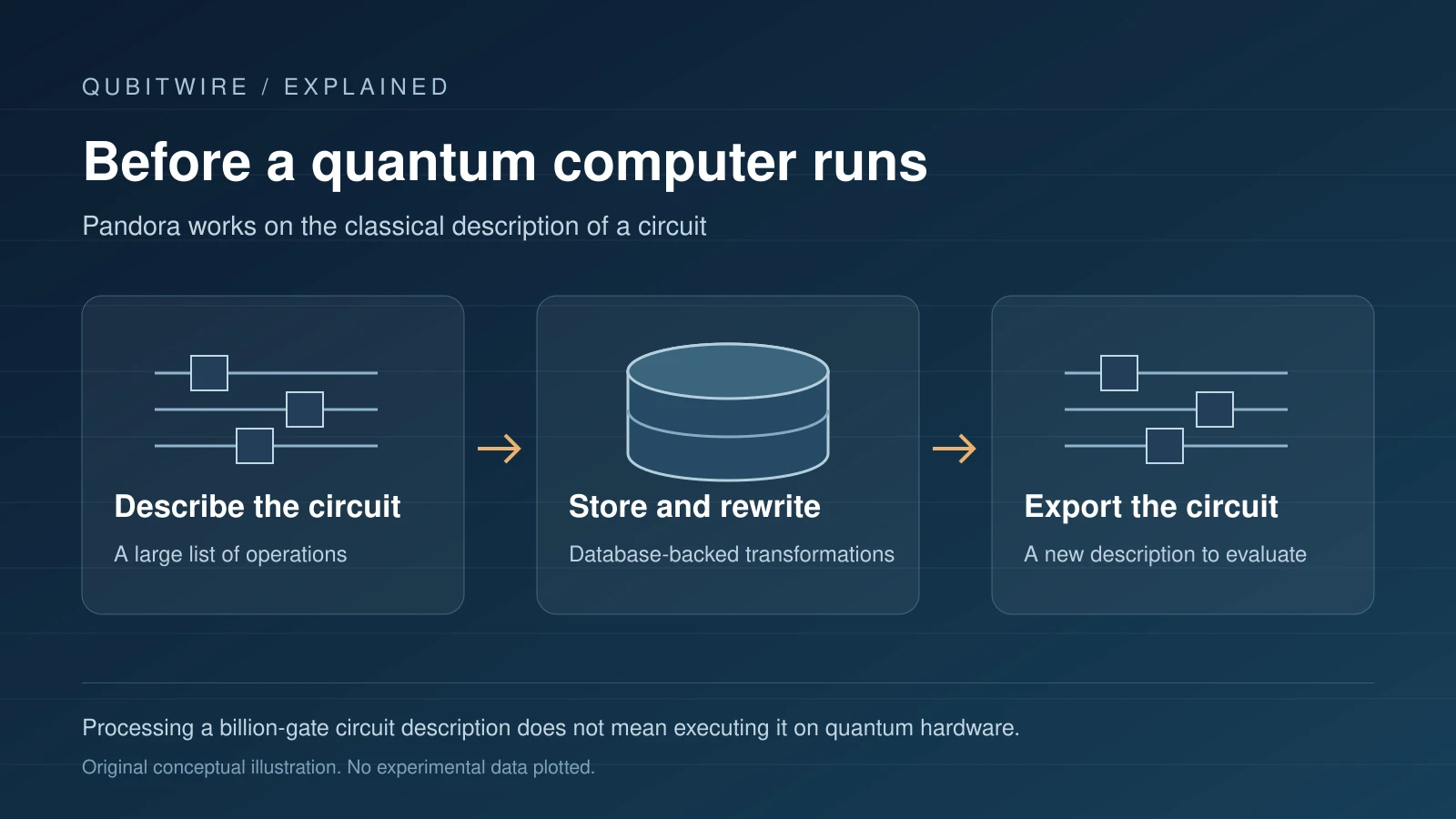
A quantum program can become difficult to handle before a quantum computer ever runs it. Pandora tackles that preparation problem: it is a classical software engine for storing and rewriting very large quantum circuits. The work by Ioana Moflic and Alexandru Paler reached an early accepted publication in npj Quantum Information on October 30, 2026, following an August 7, 2025 preprint. Its reported scale concerns processing circuit descriptions. It is not a demonstration that a quantum machine has executed a billion-gate application.[1][2]
First, what is a circuit?
A quantum circuit is an ordered description of operations on . A programmer may start with a compact instruction that stands for a large calculation. Preparing it for a machine can require expanding that instruction into many smaller operations. Imagine a short recipe that repeatedly refers to another recipe: the document is brief until someone writes out every repeated step. The quantum state and the written circuit are different objects.
Prepare the instructions before running the machine
Describe an application
A compact program may expand into a very long gate list.
Store and rewrite the circuit
Database-backed software organizes circuit transformations.
Evaluate the preparation job
Check output requirements, resources and workload-specific performance.
Three terms to know
- Circuit
- An ordered description of operations on qubits.
- Compilation
- Transforming a program into a representation suited to its target or task.
- Rewrite rule
- A specified replacement of one circuit pattern with another.
Managing a very long instruction list can become a serious classical computing task even without simulating the quantum state.
What Pandora changes
The full 2025 preprint describes a PostgreSQL-based system. It represents circuit gates in database tables and applies rewrite rules through transactions, with locking to coordinate concurrent workers. Importing and exporting gates in batches limits how much data must be held in memory at once. That makes the architecture interesting beyond a larger storage container: it gives researchers a way to organize changes to a circuit while multiple workers are operating on it.[2]
These implementation details were checked in the preprint, rather than a full accepted-manuscript comparison.[2]
Read the benchmark conditions
The preprint compares a particular rewrite task on synthetic random CNOT circuits of 10,000 to 100,000 gates, with selected pattern frequencies. Its equivalence experiments use identical circuits or copies with a gate removed; the authors do not present a complete general equivalence checker. It also describes a roughly 7.7-billion-gate Fermi-Hubbard example. Those are distinct tests of manipulation, checking and compilation. They do not establish that Pandora is faster for every compiler task, or that any of those circuits ran on quantum hardware.[2]
Large does not mean free
The author repository estimates approximately 100 GB of storage per billion gates in Pandora format. Its documentation also describes interfaces with other quantum software and a workflow for splitting some decomposition work across computing nodes. This is useful practical context for the scale claim. Moving a workload out of a single in-memory object changes the resource budget; it does not erase the budget.[3]
Readers evaluating the tool should ask about available storage, input generation, data movement and the complete processing pipeline alongside the headline gate count.[3]
Analysis: measure the whole preparation job
A useful comparison begins by deciding what the user actually needs at the end. Counting instructions, simplifying a circuit and producing machine-ready instructions are different deliverables. A tool can improve one stage while another stage still dominates elapsed time. For a fair evaluation, keep the input, required output and computing resources visible. Then measure the complete job as well as the individual operation. This is also why a storage milestone deserves attention without turning it into a prediction about when useful quantum hardware will arrive.
What to watch next
The October publication is a new peer-reviewed milestone for work already public in 2025. Nature identifies its current article as an early accepted version awaiting the final Version of Record. The direct accepted manuscript was unavailable during this review, so detailed benchmarks above remain attributed to the accessible preprint. The next useful evidence would be independently reproduced, matched comparisons on varied practical workloads. For a newcomer, the durable takeaway is simple: larger quantum applications need capable classical preparation software as well as capable quantum processors.[1][2]
Keep exploring
Continue with Learn quantum computing or Explore the quantum computer model. For another part of the software workflow, read our quantum simulation verification explainer.