
One panel shaped 48 radio frequencies at once
A microwave experiment borrowed the mathematics of a qubit to control the way 48 frequency components oscillate. It did so with ordinary electromagnetic waves, not a quantum computer.
Reading tools for text size, copying, printing and your reading list
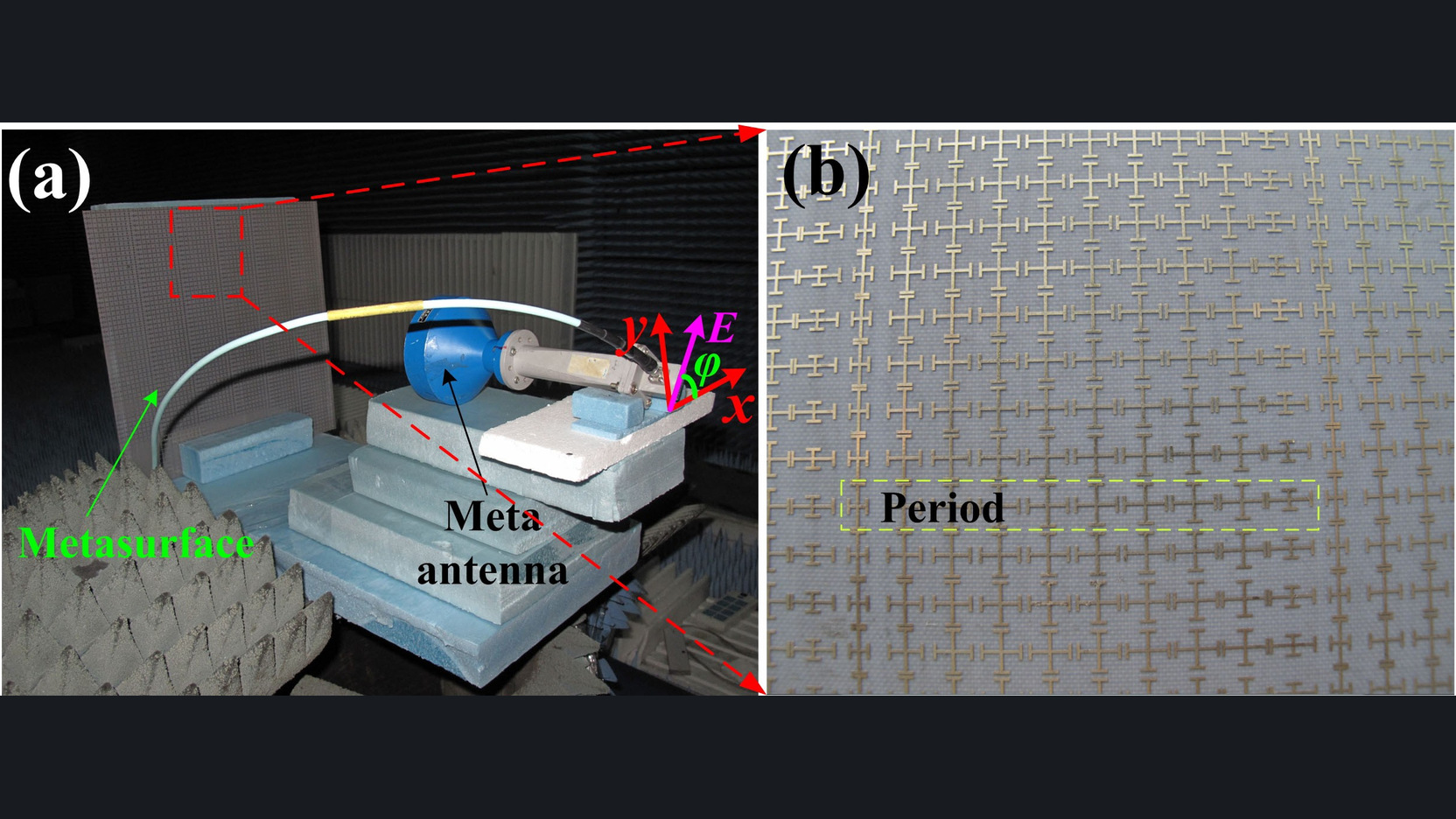
Tune a radio and you separate stations by frequency. Turn an antenna and you change which direction of the incoming wave it picks up best. A new experiment brings those two knobs together. Researchers at Southeast University used a panel roughly a meter across to produce 48 measurable frequency components, each with a prescribed polarization. The striking part is that the panel used the same pair of repeating control sequences for all 48, rather than changing the program separately for each frequency.[1]
Polarization describes how the electric field of a wave moves. If it wiggles along a line, that line can be horizontal, vertical or somewhere between. If the field rotates as the wave travels, its tip can trace an ellipse. By controlling the strengths of two perpendicular components and how far out of step they are, the researchers could give different parts of the spectrum different tilts, shapes and directions of rotation.[1]
One signal, many addresses
The panel was a metasurface: an engineered sheet patterned with 1,024 individually addressable cells. Each cell offered four calibrated reflection settings for each of two polarization branches. Changing those settings periodically created frequencies on either side of the incoming carrier, much as regularly varying a musical tone can add nearby notes. What mattered was how the reflected contributions added together. A code that puts one frequency component in the desired state can also affect the others.[1]
Long Chen and colleagues optimized the two control sequences together, one for each polarization branch. They measured 24 nonzero orders below the carrier and 24 above it in the same spectral preparation, then reconstructed the polarization at each order from the amplitudes and relative phase of the two components. The study also simulated a pattern spanning more than 200 orders. That wider result was numerical, not something the hardware demonstrated.[1]
The work builds on an earlier experiment by members of the team that used reconfigurable surfaces to prepare classical states described with the same mathematics. In the new study, a local polarization is only the starting point. The team also programmed how polarization changed across its reflected field and among frequencies, including maps where the polarization wrapped in opposite senses across the field. These are distinct demonstrations of the same control idea, not three capabilities measured simultaneously in one signal.[1][2]
What makes it quantum-inspired
A state can be described using two basis states with a relative amplitude and phase. Two coherent, perpendicular components of an ordinary wave can be described using the same kind of geometry. That makes the panel useful for studying how imperfect controls nudge a prepared state off target. It does not mean the researchers made 48 quantum bits, produced or gained a quantum computational speedup. Their instruments measured a classical electromagnetic field.[1][2]
The preprint points to a possible communications use: encode information in the pattern across frequencies, then see how much of that pattern a receiver can recover. The experiment shows that the transmitter can create and measure the pattern under lab conditions. It does not yet show better data rates, reliable decoding through a real channel or an advantage over existing radio designs. That is the test that would turn a clever way of shaping waves into a claim about communications.[1]