
Quantinuum H2 Demonstrates Gates by Braiding and Fusing Anyons
A 54-qubit experiment creates a topologically ordered state and uses its anyonic excitations to demonstrate a universal gate toolkit.
Braiding and fusion provide a gate-set demonstration
- Reported
- Lo and colleagues report a universal topological gate set using braiding and fusion on Quantinuum H2.
- Supported observation
- The checked v2 preprint prepares a 54-qubit S3 topologically ordered state, encodes logical qutrits and demonstrates magic-state preparation.
- Conditions
- The experiment combines braiding with charge measurements. Magic-state preparation postselects specified fusion outcomes, so accepted shots are conditional results. The record concerns demonstrated operations within a programmed trapped-ion system, not a comparison with commercial fault-tolerant computers.
This proof of principle does not establish scalable fault tolerance or an application advantage. The journal version was inaccessible; this assessment is limited to the inspected preprint.
- Universal Gates from Braiding and Fusing Anyons on Quantum HardwarearXiv · Primary research preprint, version 2 · Source published Source checked
.jpg)
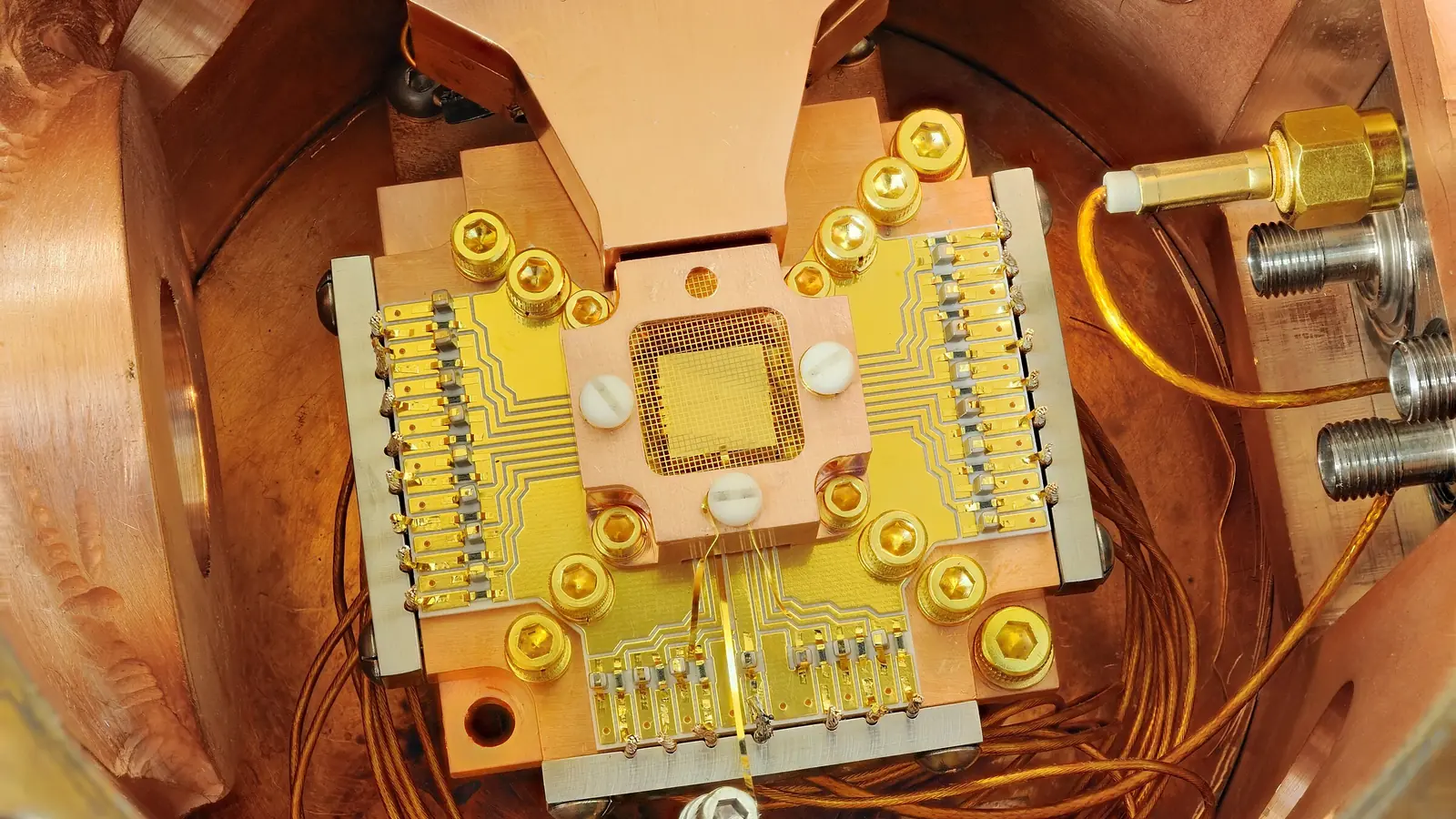
Researchers used Quantinuum's H2 trapped-ion processor to prepare a 54- topologically ordered state and demonstrate gates by braiding and fusing its anyonic excitations. These emergent excitations offer a way to encode and manipulate information through the global properties of a quantum state.
The Nature paper describes a state based on the quantum double of S3, a non-Abelian group. Braiding, fusion and magic-state preparation together demonstrate a universal gate set.
The experiment is a proof of principle inside a programmed quantum system. It does not establish a large, commercially fault-tolerant topological computer. The case for sustained logical computation will depend on larger demonstrations that measure noise protection, gate accuracy and the resources required.