
A Quarter of an Electron’s Charge, Without Splitting an Electron
A gallium-arsenide experiment reveals how a crowd of electrons can carry charge in unexpected portions. It is not a photograph of an electron being cut up.
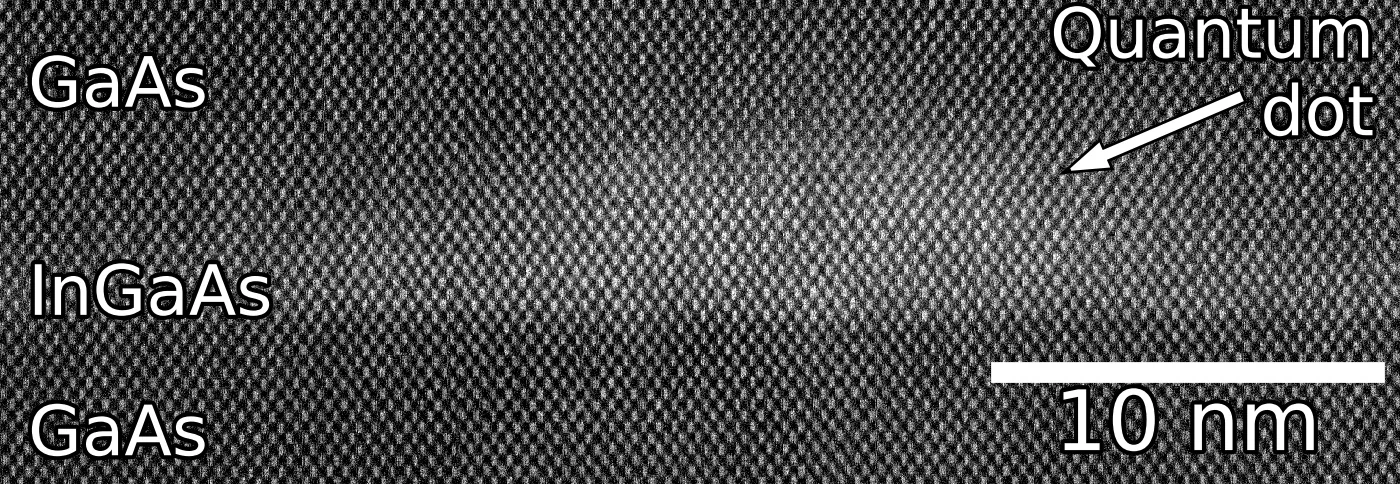

No one took a tiny knife to an electron. Yet two experimental setups detected charge behaving in units close to one quarter of the electron’s charge.
The result, published in Physical Review Letters on 22 September, comes from a wide gallium-arsenide quantum well. It concerns a collective electronic state, not pieces chipped off an elementary particle. That distinction is the key to the story.[1][2]
How a crowd creates something new
A useful comparison is a wave moving through a crowd. The wave is real and measurable, but it is not an extra person. In a material, interacting electrons can produce collective excitations called quasiparticles. Their properties need not match those of one isolated electron.
The analogy has limits: it explains emergence, not the mathematical origin of the charge. The experimental claim is quantitative. These collective excitations transport a fraction of the elementary charge under the conditions of the studied quantum Hall state.[2]
Researchers already know fractional charge from other quantum Hall systems. The news is the evidence in this particular wide-well state at filling factor one-half. The filling factor describes the electronic state in a magnetic field; it is not the same quantity as the one-quarter charge.[1][3]
The measurement listens to fluctuations
The team inferred the charge from shot noise: tiny fluctuations in electrical current. The size and statistics of those fluctuations can reveal information about the charge being transported, rather than requiring a camera that somehow sees a fraction of an electron.[2]
Two devices, measured in independent setups, gave fitted charges of 0.250 ± 0.013 and 0.249 ± 0.018 times the elementary charge. Agreement strengthens the experimental case, although the interpretation still depends on the shot-noise measurement and physical model used.[1][3]
The challenge is to distinguish a collective charge from other explanations for the observed fluctuations. That is why the setting matters: a carefully fabricated electronic system, controlled temperature and magnetic field, and a measurement interpreted against a physical model. The surprising number is not meaningful without that experimental structure.[3]
Why quantum-computing readers care
Certain collective quantum states are investigated because their properties could support ways of encoding information that are less vulnerable to some disturbances. That makes unusual quantum Hall states relevant to the broader search for robust quantum hardware.[3]
But a charge measurement alone does not establish the exchange behaviour needed for a particular topological-computing scheme. The authors discuss candidate states that can share the same fractional charge while differing in other important properties. This is evidence about charge, not a completed demonstration of protected computation.[1]
It is tempting to turn every unusual material result into a promise of a new computer. A better question is what uncertainty the experiment removes, and what experiment would distinguish the remaining explanations.
Here the next scientific interest lies in identifying more of the state’s character. For readers, the lasting idea is broader: a material is not merely a container filled with independent particles. Interactions can give the collective system behaviours that its ingredients do not possess on their own.
The electron did not become smaller. The system became more interesting.