
A Quantum Message Beat a Classical Privacy Limit—Under One Strict Rule
A new theorem gives constant expected error for private two-party distance estimation, but only when each participant returns the prescribed quantum message and completes the protocol.
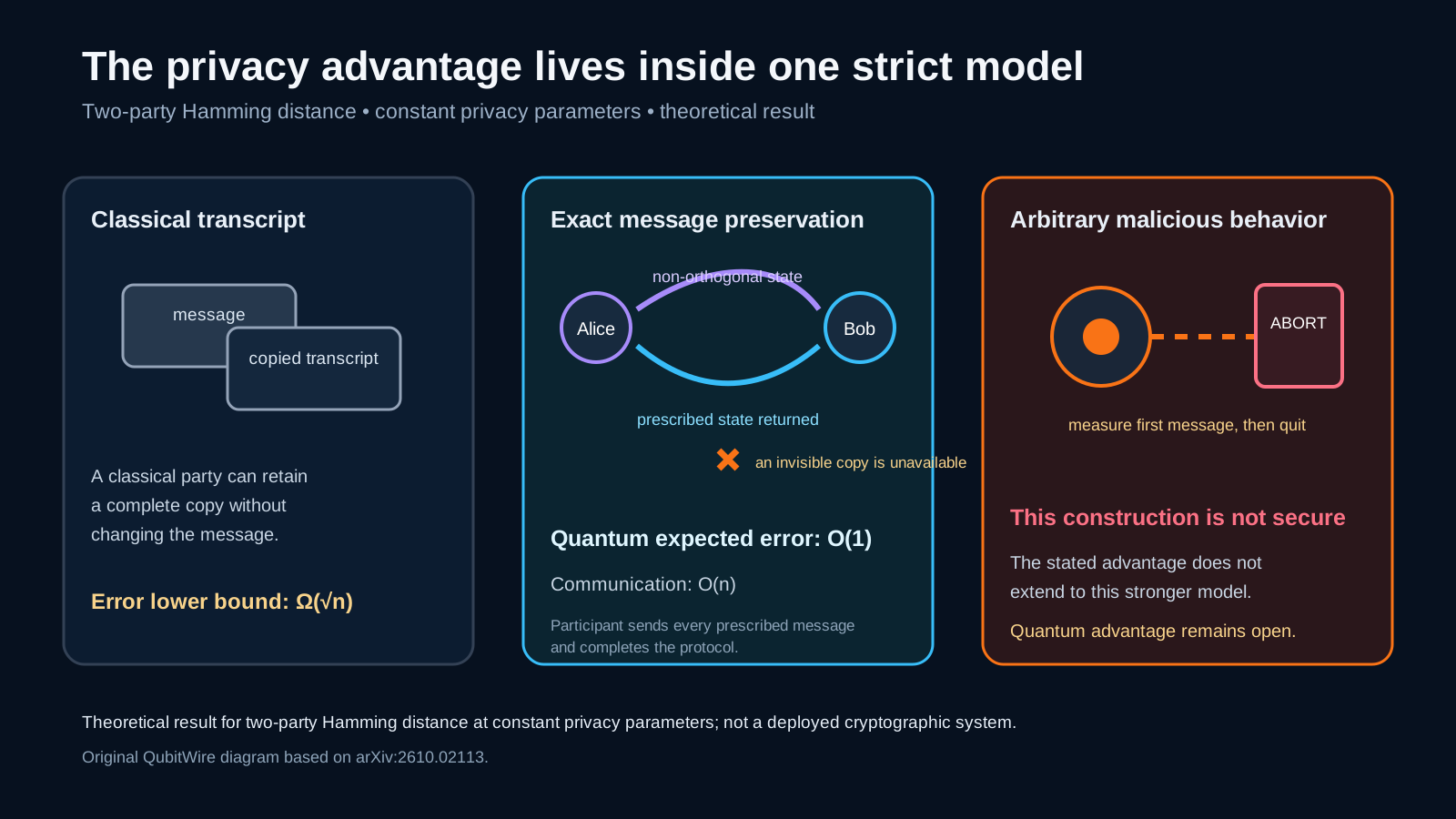
Two people can estimate how many positions differ between their private bit strings more accurately with quantum communication—but the advantage depends on a strict honesty rule. A new theorem gives constant expected error for fixed privacy parameters using linear quantum and classical communication.[1][2]
Under the same information-theoretic privacy model, classical protocols incur error growing at least as the square root of the input length. The quantum protocol therefore recovers accuracy that classical parties can otherwise obtain only by adding computational-security assumptions. This is a mathematical separation, not a measured speedup or deployed privacy system.[1][2]
The resource is not faster arithmetic but a message that cannot be copied invisibly. The protocol sends non-orthogonal quantum states on a guarded round trip. A participant required to return the prescribed state exactly cannot also keep an input-dependent copy, whereas a classical participant can preserve a complete transcript without disturbing the messages.[2]
That requirement defines the result's boundary. The participant may retain private systems but must send every prescribed message and finish every round. If arbitrary measurement, message changes or aborts are allowed, a receiver can measure the first message and quit, defeating this construction. Quantum advantage under that stronger retention-robust model remains open.[1][2]
The preprint also assumes exact local unitaries and real-valued private randomness, without counting local computation or finite-precision synthesis. A practical successor would need tests that reveal whether a returned state was disturbed and quantitative guarantees for near-honest behavior. Until then, the theorem identifies a precise privacy resource rather than a ready cryptographic product.[2]
The task being estimated is Hamming distance: the number of coordinates on which two private bit strings disagree. It is a basic statistic behind comparisons of records and binary data, but the theorem concerns the communication problem itself. It does not claim that arbitrary analytics become private merely by sending quantum states, and it does not remove the need to define what each participant may retain.[1][2]
The separation is especially sharp because both sides are information-theoretic. The classical lower bound is not a complaint about slow computers or a particular encryption scheme; it describes what is possible without computational assumptions in the stated model. The quantum protocol changes that tradeoff by making the prescribed message physically noncopyable while preserving the protocol's differential-privacy guarantee.[1][2]
A route toward practice would have to relax exact obedience without collapsing the guarantee. That could mean disturbance tests, explicit abort handling, finite-precision circuits and a quantified penalty when behavior is only approximately message-preserving. The authors leave the stronger malicious setting unresolved, so the immediate value is a clean boundary: quantum communication helps here, and the theorem states precisely which behavioral promise makes that help possible.[2]