
A Smarter Qubit Router Cut Modeled Network Traffic by 24%
A conference benchmark reports lower EPR-pair use than QuComm, but only in simulation and under a matched communication protocol.
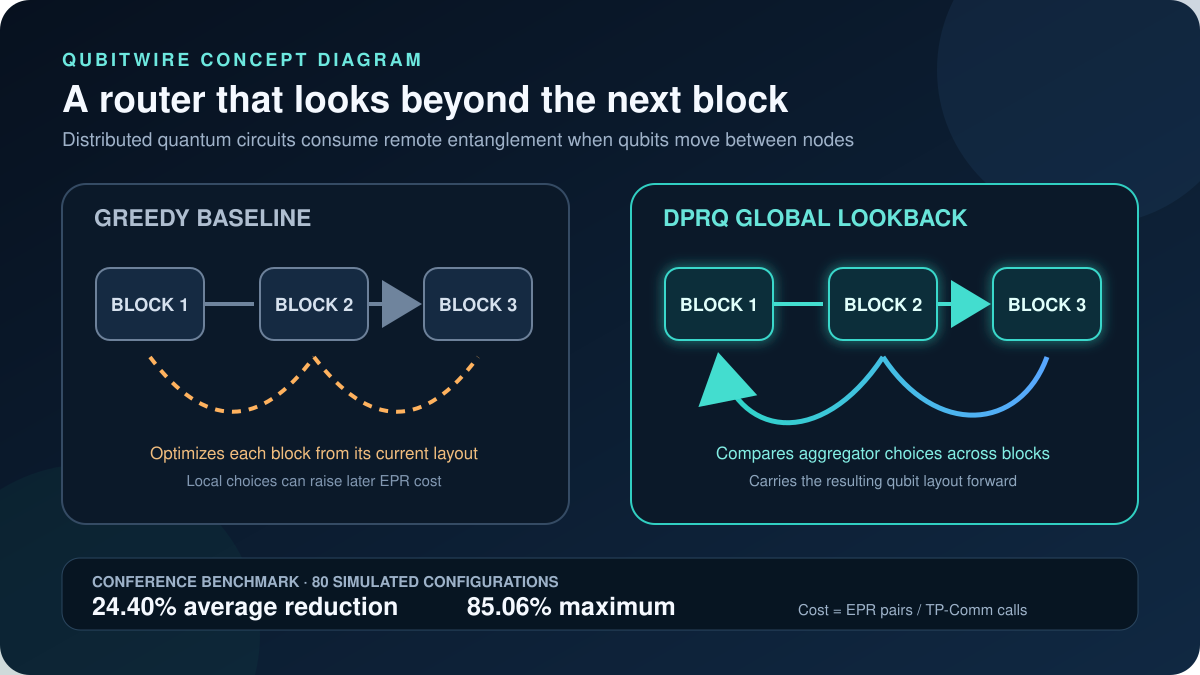
Two North Carolina State University researchers have proposed DPRQ, a compiler algorithm for deciding where distributed quantum-computing nodes should gather for multi-qubit operations. Instead of optimizing each collective-communication block in isolation, it looks across the circuit before choosing routes. Moving a qubit between processors consumes remote , represented in this study by an EPR pair and one teleportation call. A poor choice in one block can leave the circuit in an expensive layout for the next, so routing decisions compound.
In 80 simulated configurations spanning four circuit families, the authors report 24.40% lower EPR cost on average and as much as 85.06% versus their QuComm reproduction. DPRQ compared possible aggregator nodes across consecutive blocks while carrying each resulting qubit layout forward; its advantage grew in larger, less connected networks.
No linked quantum processors ran these circuits. The comparison counts modeled EPR pairs, assumes constant neighboring channels and uses only TP-Comm on both sides; QuComm's buffer stage was omitted as out of scope. The gain also shrank on fully connected networks, and DPRQ's worst-case classical runtime rises steeply with network size and the number of shortest paths.
A stronger test would compile the same workloads for real modular hardware, include entanglement-generation failures, fidelity, latency and buffer constraints, then compare end-to-end execution—not only routed EPR count. Larger networks may also need heuristics that keep DPRQ's global view without its worst-case search cost.