
Skip to content
RESEARCH · FOUNDATIONS / RESEARCH

A quantum test across time, with no time machine required

An accepted physics paper uses a qubit probe to test nonclassical behaviour. Its conservation-law and measurement conditions are essential to the result.
Published Source report Sources checked
My reading list
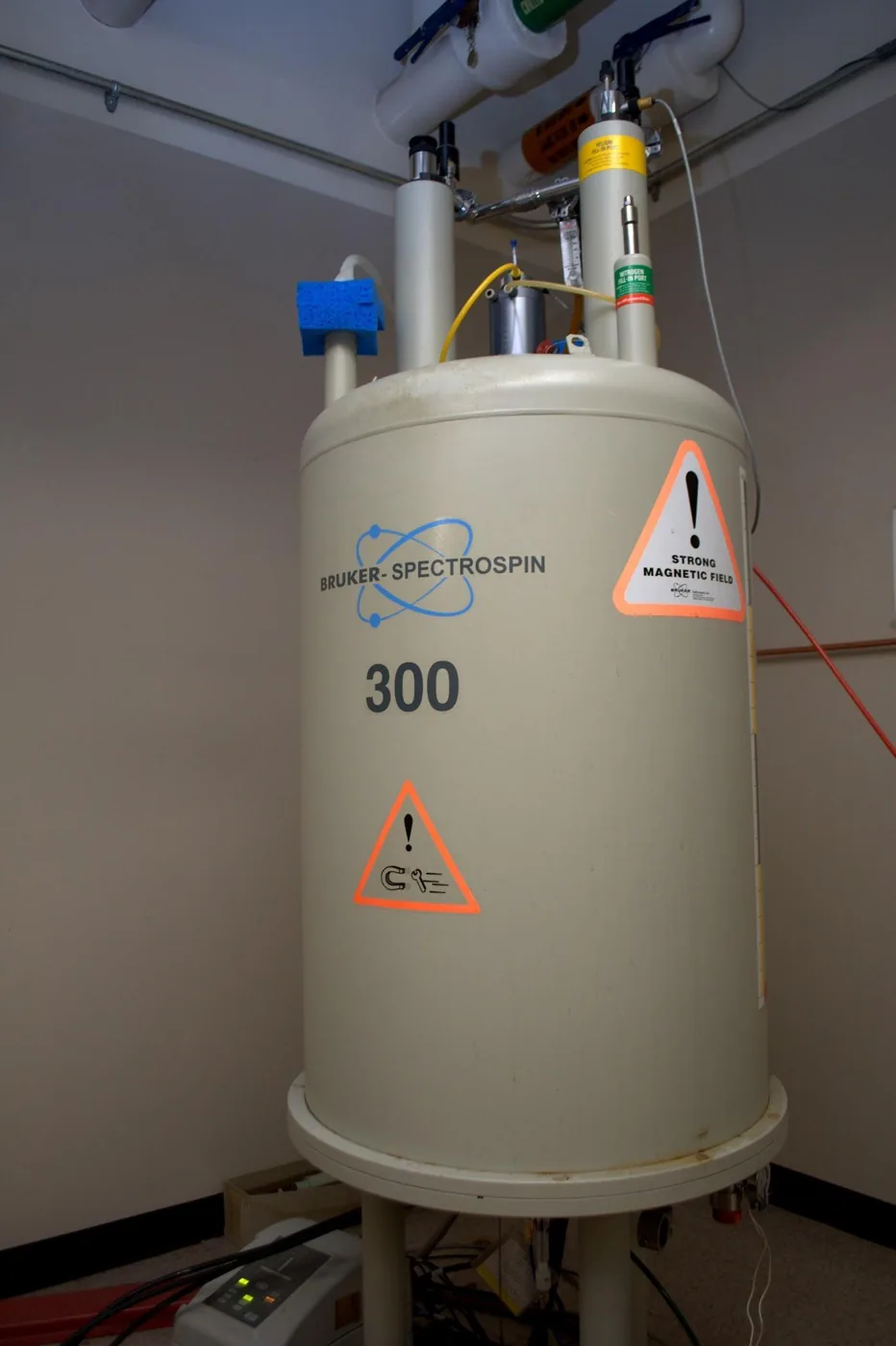
A tall Bruker 300 MHz NMR spectrometer stands in a laboratory at Columbia University.
A Bruker 300 MHz NMR spectrometer at Columbia University, photographed May 19, 2011. Historical NMR context, not the temporal-witness study’s apparatus.Lihan Yao · CC BY 2.0 · CC BY 2.0Full image credit

“Temporal ” can sound like a way to send a message into yesterday. This paper reports something more precise: a test of nonclassical behaviour using a probe. Physical Review Letters accepted the work on October 21. An earlier version has been public since June 18, 2025, so the news is a publication milestone rather than a newly revealed idea.[1][2]

The question is how measurements of one small quantum system can tell us about another system interacting with it. A witness is a test whose result rules out a specified classical description under stated assumptions. It is not a general invitation to attach every quantum mystery to the same experiment.[1][2]

Here the inference depends on a general conservation law. The accepted abstract also requires one of the measured observables to be the local conserved quantity. Under those conditions, a violation of temporal Bell inequalities on the qubit probe implies nonclassicality of the investigated system. Dropping either condition would change the scientific claim.[1]

The authors report proof-of-principle experimental emulations on a three-qubit nuclear magnetic resonance quantum computer. That is the demonstrated setting. The paper discusses possible uses in broader fields, but it does not report a quantum-gravity experiment, a biological demonstration or communication into the past.[1][2]

For a newcomer, the useful distinction is between a promising test and a new observation made with that test. The first establishes a method and its conditions. The second requires a suitable physical system, the right measurements and evidence that the assumptions hold. A successful small emulation does not automatically supply those ingredients elsewhere.

A valuable follow-up would show which assumptions become hardest to satisfy in a new application and how experimental uncertainty affects the conclusion. The historical photograph shows an NMR spectrometer at Columbia University in May 2011. It illustrates a type of laboratory equipment; it is not the authors’ apparatus, a new device announcement or a time machine.[1][2]

Keep your reading trail

Your Updates →

Evidence & context

2 linked sources

accepted paper; three-qubit NMR emulation

How to read the evidence and dates

An announcement records what an organization stated. An experiment reports an observation. A simulation or resource estimate depends on its assumptions. QubitWire’s analysis connects these sources; the labels are not quality scores.

Published is the article’s first QubitWire publication. Updated marks a substantive content change. Sources checked records a review of the underlying evidence. An older paper can support a new explanation, and another press release about the same work is not independent replication.

QubitWire take

The witness is interesting because its conclusion is precise: the conservation law and observable condition are part of the result.

Sources

  1. Di Pietra et al.: Temporal entanglement and witnesses of nonclassicality

    Physical Review Letters accepted-paper record, accepted October 21, 2026. The conservation-law and local-conserved-observable conditions must remain attached to the claim.

  2. Temporal Entanglement and Witnesses of Non-Classicality: original preprint

    First submitted June 18, 2025. Proof-of-principle three-qubit NMR emulations; proposed applications do not establish experiments on gravity or biology.

READ NEXT

Continue exploring

All Research stories
  1. Related reading

    One Well-Timed Flip Can Delay Quantum “Sudden Death”

    A photonic experiment shows that the timing of a simple intervention can change when entanglement disappears.

    Published · Source report · Sources checked
  2. Related reading

    A quantum NMR simulation recovers a molecule’s missing spectral detail

    Quantinuum’s H2 reproduces a molecular spectral feature in a 21-spin model. Resolution and full computing cost remain the practical tests.

    Published · Source report · Sources checked
THE QUANTUM BRIEFING

A clearer signal.
Read the latest edition.

A little perspective on a fast-moving field.

Read the on-site briefing →

Read selected quantum coverage in the on-site briefing, or register your interest below.