
The defect that remembers after a qubit has relaxed
Long-lived environmental states make the timing and correlation of errors part of the hardware story.
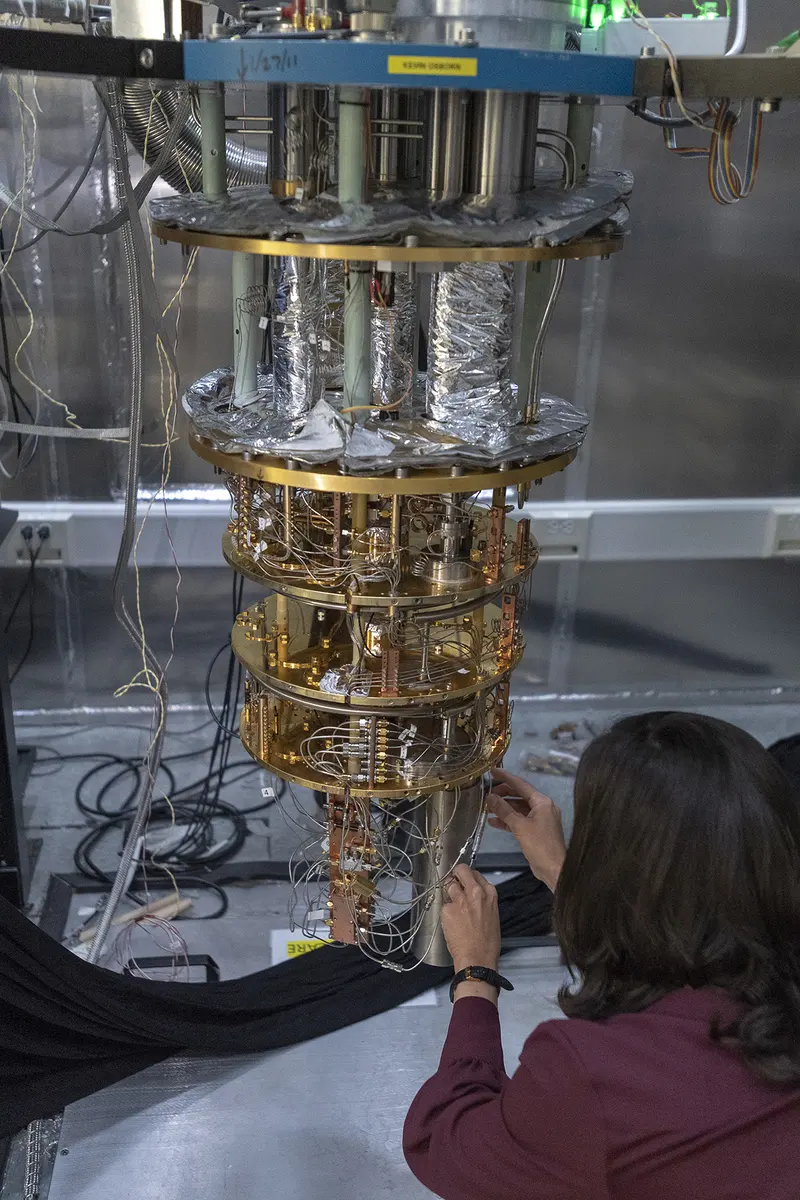
An October 15 preprint reports microscopic two-level systems with intrinsic energy lifetimes exceeding one second in the environment of . The researchers use correlation spectroscopy and a pump–probe method to study the objects through transmons. Their interpretation leaves several microscopic origins open. The result concerns long-lived environmental degrees of freedom; it does not establish a one-second operational transmon or a fully characterized quantum memory. Its immediate importance is the possibility that an apparently finished error can leave a physical trace that affects later operations.[1]
The experiment follows three long-lived two-level systems in two tantalum-electrode transmons. The transmons themselves relax on roughly a 100-microsecond timescale. Two of the environmental systems have inferred intrinsic lifetimes above one second. the qubit during the waiting interval reduces the extra decay channel introduced by the probe. The result makes superconducting circuits sensitive instruments for studying their own microscopic surroundings.[1]
There is a subtle measurement problem here: the probe can shorten the lifetime of the object being probed. Connecting a well-isolated system to a lossy measuring device opens an extra escape route for its energy. One way to investigate intrinsic retention is therefore to prepare the object while coupled, reduce the coupling during a waiting interval, and reconnect for readout. The delay dependence then becomes more informative than repeatedly observing the system under the same strong measurement conditions. The coupling is part of the experiment, not merely a window onto it.
Energy retention and phase retention also answer different questions. A system can keep the population of an excited state while losing the relative phase needed for a quantum superposition. For a memory application, preparation, coherent manipulation, storage and retrieval would all need characterization. A long population lifetime is encouraging evidence about one channel. It is not sufficient evidence about the complete information-bearing operation. This distinction is particularly useful when a scientific title uses the familiar word lifetime without the surrounding measurement protocol.
Consider an original toy record containing 1,000 repeated checks and 20 flagged events. In one version the flags appear as isolated events; in another they occur in one run of 20 consecutive checks. Both records have the same 2% flagged fraction. The clustered record, however, contains 19 adjacent flagged pairs inside the run. Its temporal structure is different even though its average is identical. This example does not model the reported apparatus; it shows why an error budget can need a correlation description as well as a rate.
The relevant timescale depends on the task. A slowly changing environment may look almost fixed during one short circuit and change substantially between batches. A different experiment may sample the same object many times before it relaxes. Those two schedules can produce different apparent noise statistics from the same underlying mechanism. A useful characterization therefore compares the environmental memory time with the timing of measurements, resets and idle periods. Counting operations without their spacing would erase precisely the information this kind of spectroscopy is designed to reveal.
For fabrication research, a persistent defect raises another useful question: which interventions alter its behaviour? A change in material processing, applied field or device geometry could test competing explanations, provided the experiment preserves a clear comparison. Disappearance of one spectral feature alone would not identify its microscopic cause. Repeated observations across controlled changes would be more discriminating. These are proposed routes for learning from the result, rather than additional findings or a claim that a particular manufacturing process has already solved the problem.
The story therefore reaches beyond a striking lifetime. It offers a way to ask whether yesterday's interaction, on the timescale of a quantum experiment, remains inside today's noise. That question matters to anyone trying to turn repeated physical operations into a reliable calculation. The useful follow-up is a connection between the measured environmental dynamics and an independently characterized operating sequence. Readers should look for that connection before translating the long lifetime into either a ready-made memory or a quantified failure rate for an error-corrected processor.