
Toyota and UChicago ask what a quantum sensor could tell a car
Five research projects will explore vehicle sensing, protected data links and the materials engineers could use to monitor stored energy.
Reading tools for text size, copying, printing and your reading list
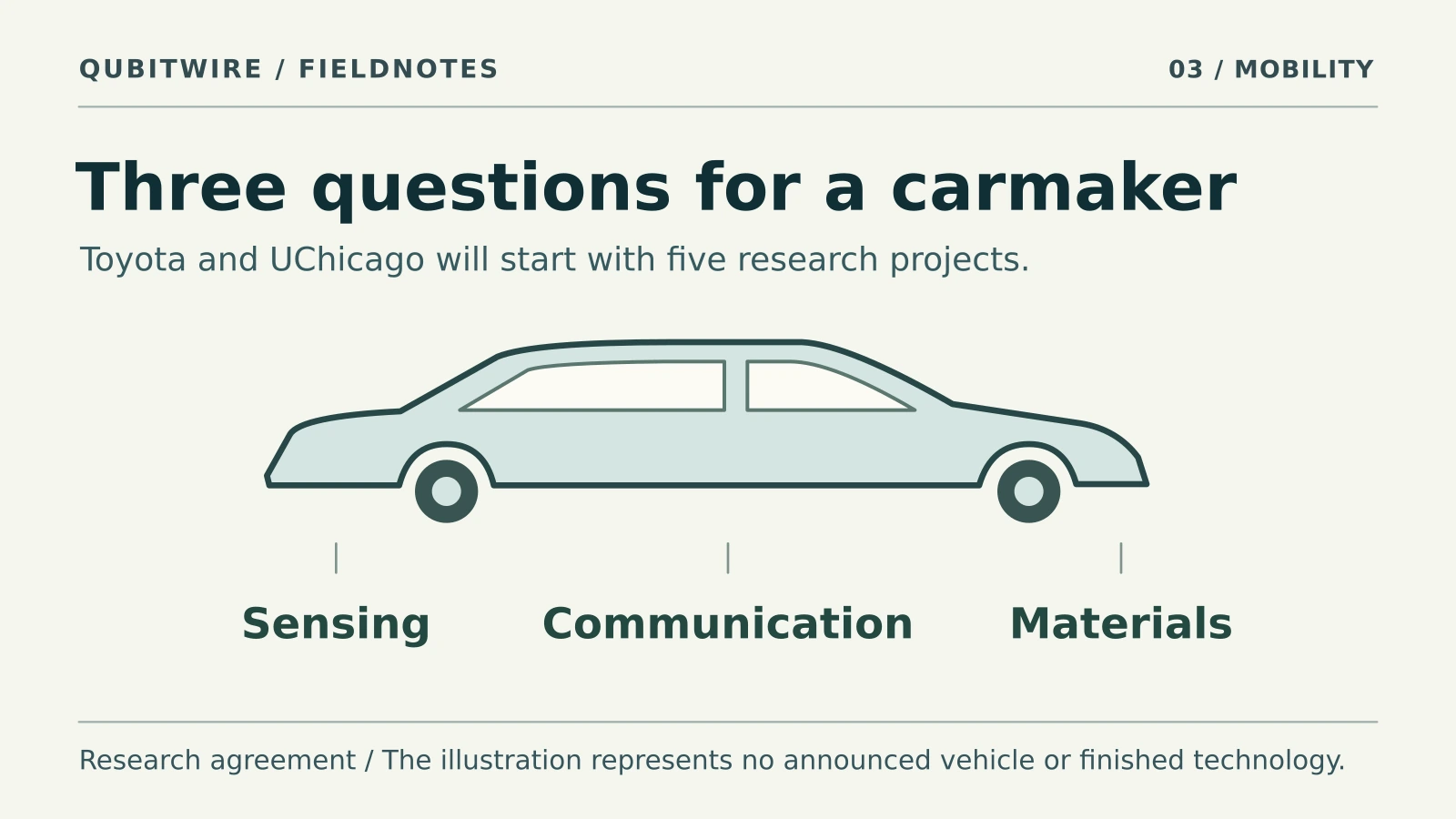
Could engineers learn more about an energy storage system by changing what its sensors are made of? That is one of the questions behind a multiyear research agreement Toyota and the University of Chicago announced on November 3. Five projects will open the program. Two Toyota scientists are already working in the university’s labs.[1][2]
Some of the work starts outside the vehicle. The partners want to investigate whether quantum sensors sensitive to small changes in a laboratory could help a car sense its surroundings. A useful road test would need to establish both the smallest change a sensor could detect and how quickly it could detect it. The announcement gives neither measurement.[1]
Another project area concerns the messages a vehicle exchanges with roadside equipment and control centers. The researchers will study ways to protect those transmissions. Even a sensor that measures its surroundings perfectly still needs a reliable way to pass on a reading. The partners have identified the places they want to connect, but have yet to specify a protocol for protecting those links.[1][2]
Research agreement · November 3, 2026
Three questions behind Toyota’s quantum research
The partners described what they plan to investigate. Open each question for an example of the evidence that could answer it.
Vehicle sensing · Planned research
What could a car detect outside the lab?
Toyota and UChicago want to explore whether the sensitivity of a laboratory quantum sensor could be useful in a vehicle.
What evidence would count?
Give a prototype and an existing sensor the same changing signal. Report the smallest change each can detect and how long it takes as the surroundings vary.
Communications · Planned research
How could a car protect a message on its way to the roadside?
The researchers will study ways to protect data as vehicles, roadside equipment and control centers exchange messages.
What evidence would count?
Specify the threat and test the link against it. A result about detecting an altered message answers a different question from a result about keeping its contents private.
Sensing materials · Planned research
Which material could tell engineers more about stored energy?
Giulia Galli’s team plans to model electronic properties of materials that might be useful in sensors for monitoring energy storage.
What evidence would count?
Choose a material from the simulation, make a sample and measure the property the model predicted. Then test whether a sensor made from it can pick up the intended signal.
QubitWire’s examples describe possible tests. Toyota and UChicago have yet to report results for these vehicle applications.
For materials scientist Giulia Galli, the energy storage question begins with the sensor itself. Her team wants to model how electrons behave in candidate materials to identify ones that could make energy storage systems easier to monitor. Galli places that research on a 20-year horizon. She was describing how engineers might study stored energy, without setting a release date for a Toyota battery.[2]
The first phase will support up to eight graduate students in theory and experimental labs. Toyota and the university say they hope to build a portfolio with as much as $1 million a year from Toyota. The university identifies Galli’s lab and the lab of project lead David Awschalom as hosts for the Toyota visitors. Their work will give students a chance to test ideas from the carmaker alongside university researchers.[1][2]