
What a Braket Spending Limit Does Not Cover
Amazon Braket can reject quantum tasks before they exceed a device limit, but that control is not a ceiling on the whole cloud bill.
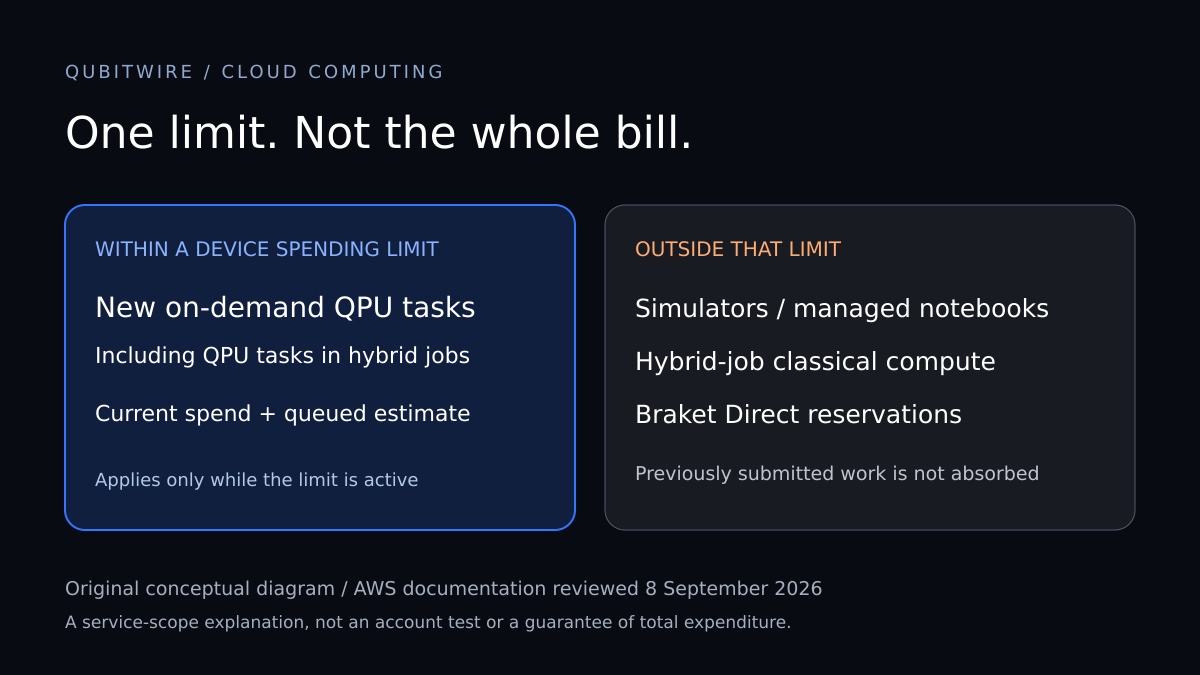
A spending limit sounds like a simple promise: set a number and the bill stops there. Amazon Braket's control is narrower. Introduced in November 2025, it governs new tasks on a selected quantum processor, not everything a cloud experiment consumes. That distinction matters because quantum work often combines several services. A project can pay for processor access, classical simulation, notebooks and the computers coordinating a hybrid workflow. Braket's pricing separates these resources; restricting one category does not automatically constrain the others.
According to the current developer guide, an enabled device limit checks estimated task cost against the allowance remaining after current and queued spending. Requests exceeding that balance are rejected. This covers on-demand quantum-processor tasks, including those inside hybrid jobs, but excludes those jobs' classical EC2 instance costs.
Simulators, managed notebooks and Braket Direct reservations also sit outside this control. Nor does creating a limit absorb work submitted earlier. Lowering a limit or reaching its end time does not terminate already submitted tasks, so it should not be mistaken for an emergency stop.
For a team planning a trial, the useful budget is therefore a map of the whole workflow. Identify the processor, surrounding compute and existing commitments separately. The practical question is which costs a control prevents, which it merely reports and which remain outside its scope.
What the limit actually covers
Braket’s optional limit checks new QPU task requests for a particular device. It does not cap every service on an AWS bill.
| Work being requested | Counted by this limit? |
|---|---|
| New on-demand QPU task | Yes |
| New QPU task within a Hybrid Job | Yes |
| Simulator use | No |
| Managed notebook use | No |
| Classical EC2 instance used by a Hybrid Job | No |
| Braket Direct reservation | No |
The remaining allowance subtracts both current spend and estimated queued spend. Work submitted before a new limit was created is excluded from that limit’s accounting. Lowering a limit, or reaching its end time, does not terminate tasks already created, queued or running.
Use the table to separate QPU admission control from the surrounding costs. Check those costs separately; a rejected new task is not evidence that every charge has stopped.
Original QubitWire reference table. Checked against AWS documentation on 2 October 2026: Setting spending limits, remaining budget and edge cases. No prices or account-specific estimates are shown. The article’s original publication date is unchanged.