
Why one photon at a time can make stripes on a screen
New lecture notes explain a counterintuitive result: the pattern depends on the optical setup, not on assigning every photon a personal phase.
Reading tools for text size, copying, printing and your reading list
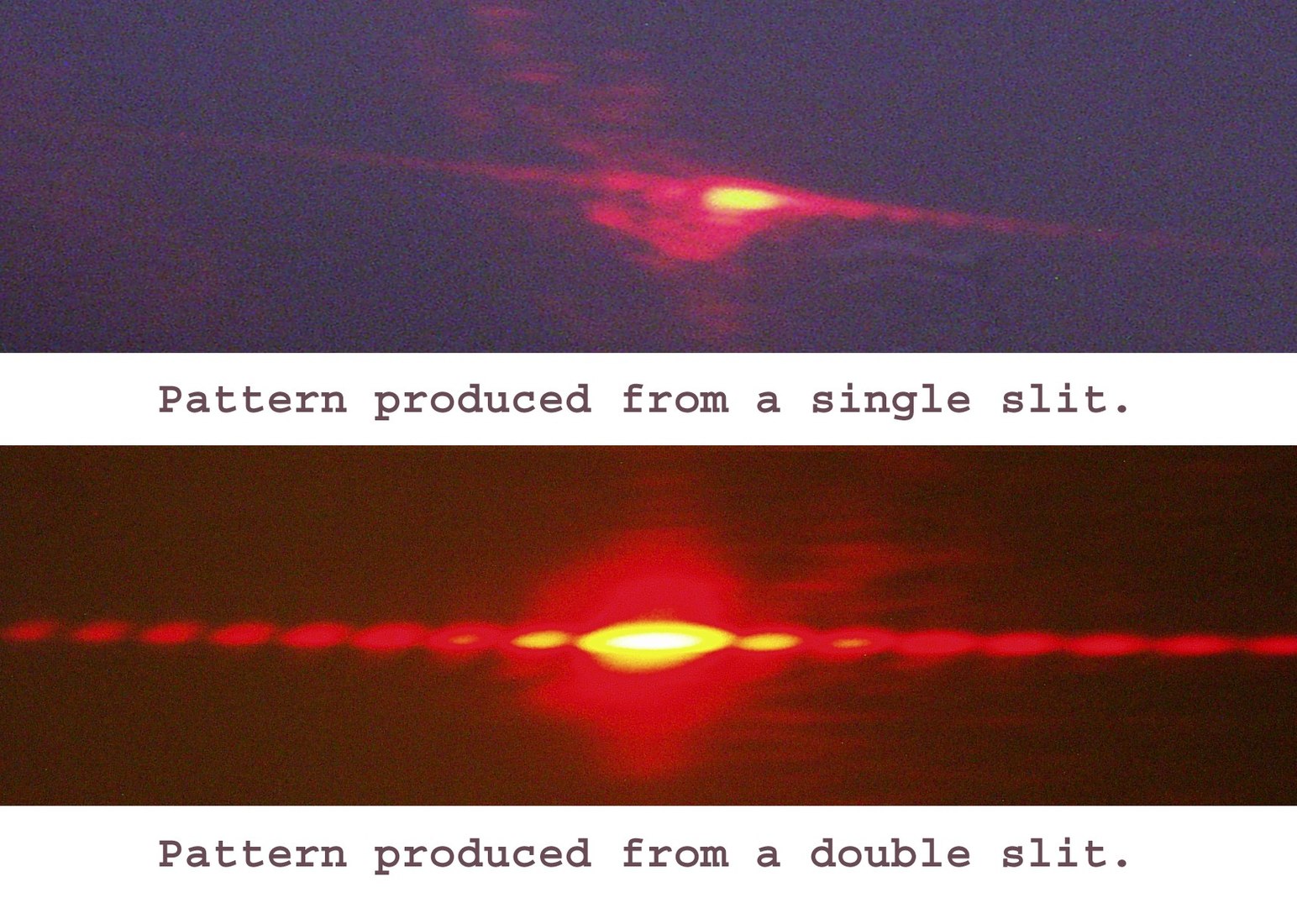
Send photons through a two-slit setup one at a time and a detector records separate dots. Collect enough dots and bright and dark bands emerge. That can sound impossible if you have also learned that a state with exactly one photon has no definite optical phase. Newly posted lecture notes by Andrea Aiello of the Max Planck Institute for the Science of Light explain why there's no contradiction. The two statements are about different kinds of phase. This is a new explanation of established physics, not a new demonstration.[1]
Which phase are we talking about?
Think of the two slits as two possible contributions to a detection at one point on the screen. One route can be a little longer than the other. At some positions the two contributions add; at others they largely cancel. Those changes come from the geometry, which fixes how far one part of the light wave is through its cycle relative to the other part. You can change that relationship by changing a path length without changing the number of photons.[1]
Aiello calls this a property of the optical mode. A mode is a pattern the light can occupy, including its shape and polarization. The relevant phase is the phase of that pattern from place to place. A single photon in that mode still arrives in one detector event. The mode tells you where, over many such events, the dots are more or less likely to accumulate. The photon does not need its own independently set phase to produce the bands.[1]
What you would see if you changed the setup
A simple thought experiment is to center the detector on a bright band and make one route about half a wavelength longer while holding the other steady. In an ideal setup with equally strong contributions and matching polarization, what was bright at that point becomes dark. The lamp does not have to emit more photons to move the bands. In a classic 1986 experiment, Philippe Grangier, Gérard Roger and Alain Aspect observed interference with single-photon light in an interferometer, which separates and recombines optical paths rather than using two slits.[1][2]
The notes also explain why this doesn't make every phase irrelevant. If two independently prepared modes contribute and their relative phase wanders, repeated measurements can wash out the bands. And a brightness pattern on its own cannot establish that light arrived one photon at a time: ordinary light can make similar stripes. To tell the two apart, you need evidence about the individual detection events, not just a picture of the final pattern.[1][2]