
Skip to content
RESEARCH · QUANTUM SENSING

This Tiny Pyramid Brings a Quantum Sensor Closer to the Action

A wireframe SQUID on a cantilever tackles the geometry of measuring very small magnetic signals.
Published Source report Sources checked
My reading list
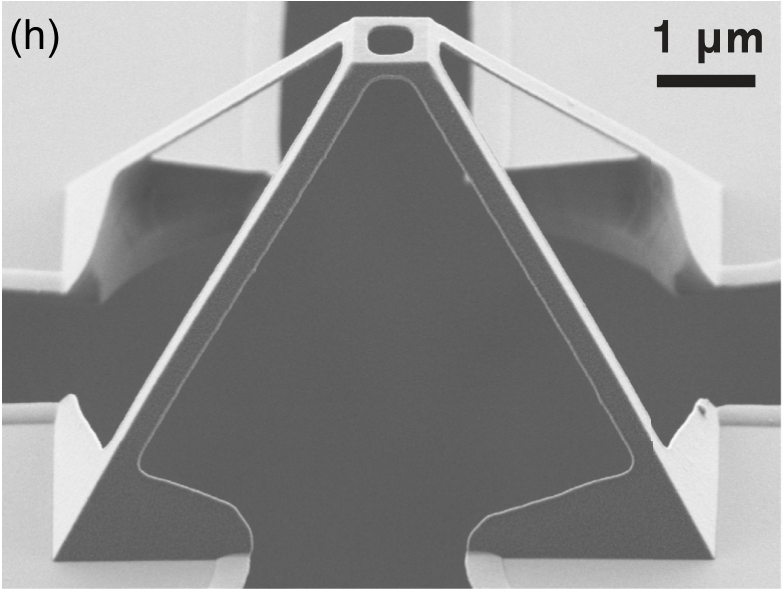
Scanning electron micrograph of a pyramidal wireframe ending in an open square loop; the original 1-micrometre scale bar is visible.
Scanning electron microscopy of a silicon-rich nitride wireframe after superconducting coating, with an open loop at its apex. This fabrication-stage view precedes the focused-ion-beam step that creates the SQUID's weak links. Scale bar: 1 μm. Panel extracted from the published figure; complete panel and scale bar preserved.Photo: Nanoscale wireframe SQUID on a cantilever by corner lithography, Physical Review Applied 26, 034054 (2026), Figure 2(h) · Thijs J. Roskamp et al. · CC BY 4.0Full image credit

When the thing you want to measure is tiny, the shape of the measuring device starts to matter. A large sensor can miss the spatial detail even when its underlying physics is exquisitely sensitive.

Researchers at the University of Twente have developed a wireframe superconducting sensor on a cantilever. The structure resembles a miniature pyramid, with a small sensing loop near its apex. The study appeared in Physical Review Applied on September 23, following an author preprint in January.[1][2]

The device is a SQUID: a superconducting quantum interference device. Its response to magnetic flux makes it useful for sensitive measurements. Here, the engineering question is how to bring a small active region close to a sample while giving the rest of the probe a workable physical structure.[1]

The fabrication combines corner lithography with additional processing to produce a niobium-coated silicon-rich nitride wireframe. The journal abstract reports effective SQUID diameters from several micrometres down to 100 nanometres and operation in magnetic fields up to one tesla. These are device-specific observations, not guarantees for every future sensor made with the method.[1]
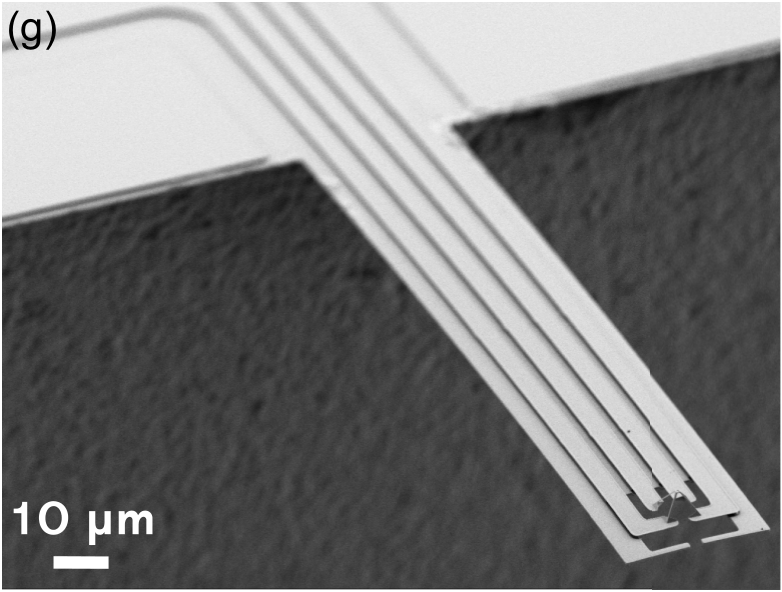
Scanning electron micrograph of a cantilever extending from a chip, with four parallel tracks and a small wireframe at its end; the original 10-micrometre scale bar is visible.
A scanning electron micrograph shows the silicon-rich nitride cantilever probe after superconducting coating, with four tracks leading to the wireframe tip. Scale bar: 10 μm. Panel extracted from the published figure; complete panel and scale bar preserved.Photo: Nanoscale wireframe SQUID on a cantilever by corner lithography, Physical Review Applied 26, 034054 (2026), Figure 2(g) · Thijs J. Roskamp et al. · CC BY 4.0Full image credit

The vertical geometry is the interesting part of the story. It aims to put the useful sensing region where the sample is, rather than treating sensitivity as a number detached from the distance and arrangement of the measurement.[1][3]

Magnetic sensing still requires superconducting operation and cooling; the separate room-temperature test used the probe for atomic force microscopy. The authors report 80–90% intact wireframe tips and nearly all ion-beam-fabricated SQUIDs functioning. Those are different manufacturing stages, and neither figure alone establishes the yield of fully calibrated scanning instruments.[1]

The lesson reaches beyond quantum sensors: sometimes a better measurement begins with a better shape.

Keep your reading trail

Your Updates →

Evidence & context

3 linked sources

Peer-reviewed device study; fabrication-stage yields do not establish complete scanning-instrument yield.

How to read the evidence and dates

An announcement records what an organization stated. An experiment reports an observation. A simulation or resource estimate depends on its assumptions. QubitWire’s analysis connects these sources; the labels are not quality scores.

Published is the article’s first QubitWire publication. Updated marks a substantive content change. Sources checked records a review of the underlying evidence. An older paper can support a new explanation, and another press release about the same work is not independent replication.

QubitWire take

Geometry belongs beside sensitivity: judge the sensing region, sample distance and calibrated performance together.

Sources

  1. Roskamp et al. | Nanoscale wireframe SQUID on a cantilever by corner lithography

    Physical Review Applied 26, 034054 (September 23, 2026), doi:10.1103/3qfq-4458. Final paper; device-specific results and separate fabrication stages.

  2. Author preprint | Nanoscale wireframe SQUID on a cantilever by corner lithography

    First submitted January 16, 2026. Earlier version of the same study; measurements here follow the published paper.

  3. Superconducting quantum sensor goes vertical

    University of Twente, September 24, 2026. Institutional context; the final journal paper supplies the publication date.

READ NEXT

Continue exploring

All Research stories
  1. Related reading

    A New Brain Scanner Is Listening With Atoms

    Stanford's magnetic brain-imaging system uses quantum-sensitive sensors close to the scalp. Better measurement is the aim; this is not a mind-reader.

    Published · Source report · Sources checked
THE QUANTUM BRIEFING

A clearer signal.
Read the latest edition.

A little perspective on a fast-moving field.

Read the on-site briefing →

Read selected quantum coverage in the on-site briefing, or register your interest below.