
A New Brain Scanner Is Listening With Atoms
Stanford's magnetic brain-imaging system uses quantum-sensitive sensors close to the scalp. Better measurement is the aim; this is not a mind-reader.
The brain makes electrical signals. Those signals produce extraordinarily faint magnetic fields. Detecting them is a measurement problem so demanding that even the environment outside the laboratory can get in the way.
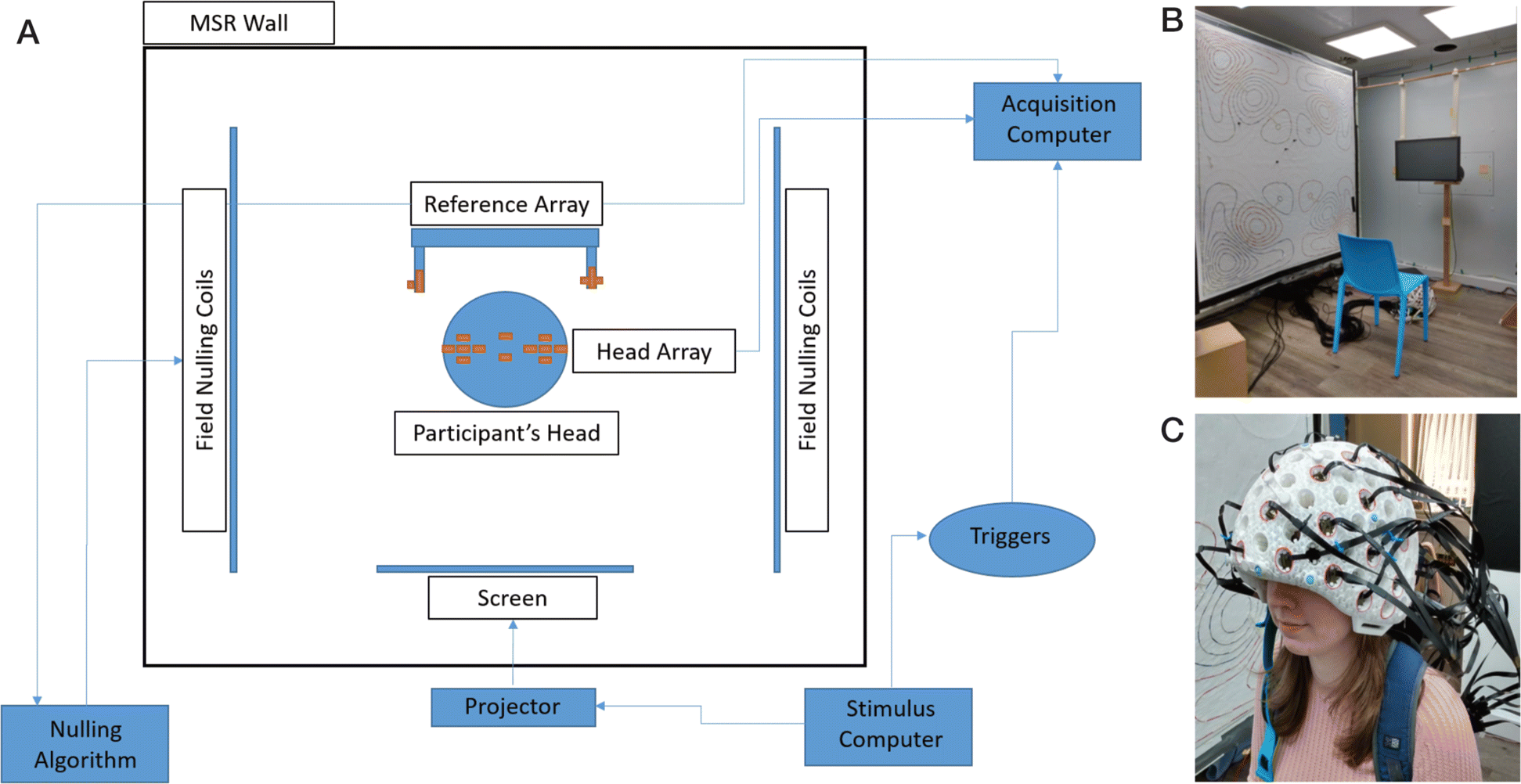
Stanford has introduced a brain-imaging facility that uses optically pumped magnetometers, or OPMs. These sensors exploit the magnetic sensitivity of atoms to measure activity close to the scalp. In a September 8 feature, the university described a 144-sensor system for whole-cortex research at the Koret Human Neurosciences Community Lab.[1]
The scanner is a quantum-sensing instrument. Rather than running an algorithm on , it uses well-controlled atomic behavior to detect a physical signal.[1][3]


Conventional magnetoencephalography systems can use cryogenically cooled sensors held farther from the head. OPM-based approaches allow smaller sensors to sit closer, with arrangements adapted to different head sizes. Earlier research has explored wearable OPM-MEG configurations; the Stanford opening adds a research facility rather than inventing the entire technique.[1][3]
Closeness is valuable because the signals are weak. But the environment still matters enormously. The facility uses a specially built room with active and passive magnetic shielding, plus equipment suited to that sensitive setting. More wearable sensors do not mean a scanner that works without a carefully controlled room.[2]
The questions researchers hope to study are recognizably human: how speech unfolds, how memory is retrieved and how people respond to music or one another. Those are research possibilities, not clinical results already established by the opening of the facility.[1]
The same caution applies to the phrase brain-reading. A sensitive magnetic recording is not a direct transcript of somebody's thoughts. Scientists still have to design an experiment, separate signals from noise and interpret what the measurements mean.
That is what makes this a useful quantum story for a wider audience. It is about using atoms to listen more carefully to the faint physical traces that the mind leaves behind.