
Wukong Tests a Two-Layer Quantum Memory Router
A ten-transmon experiment routes data by quantum address, while 82.4% two-layer fidelity and discarded runs expose the scaling cost.
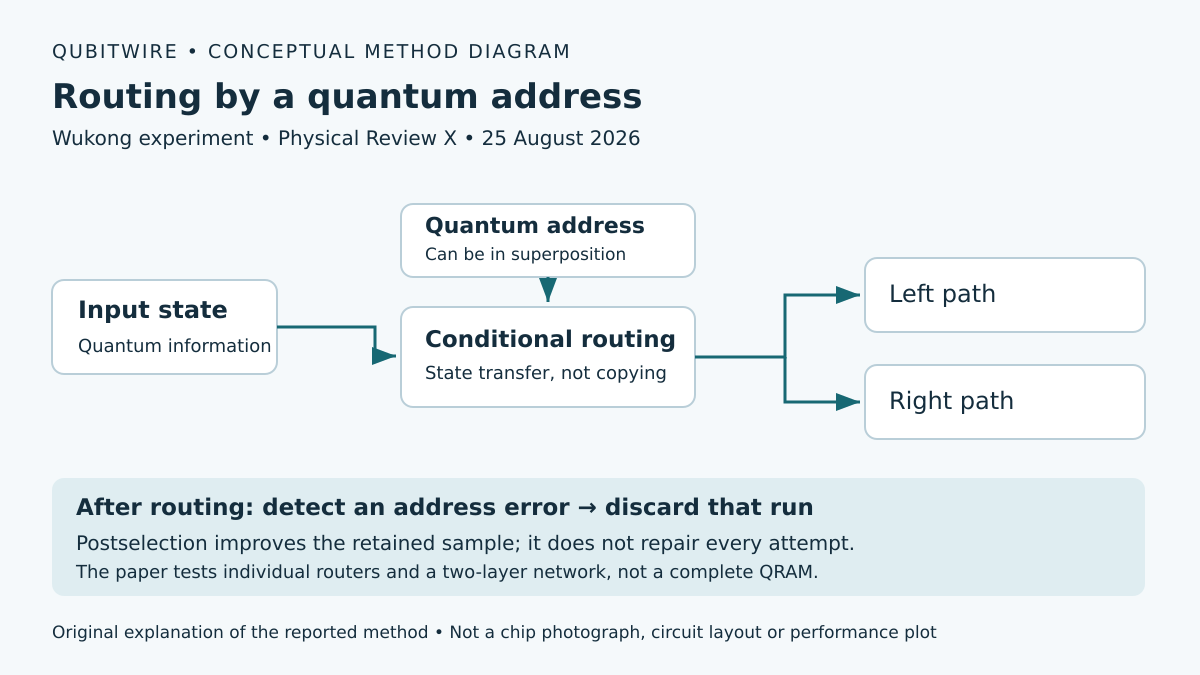
Researchers have demonstrated coherent routing operations for a bucket-brigade quantum random-access-memory design on Origin Quantum's Wukong processor. The experiment used ten physical transmon qubits—not ten —to build three individual routers and a cascaded two-layer network. A quantum router uses an address held in superposition to direct data without reading that address first. In a larger memory, such routing could let an algorithm query many locations coherently. The difficult part is preserving that superposition as more routing layers and noisy operations accumulate.
For three individual routers, the paper reports an average fitted random-access-test fidelity of 94.8% after erasure detection. The integrated two-layer network reached 82.4 ± 0.91%, compared with 81.1 ± 0.30% without erasure detection. Those are fidelity measurements, not the paper's separate transmission-efficiency figures.
Erasure detection improves the quality of retained results by identifying leakage into an intermediate energy level and discarding affected runs; it does not repair every execution. In the authors' worst-case simulation, the rejection fraction rises from about 0.4 at one layer to 0.8 at three. That scaling model is not a three-layer hardware result, and the work demonstrates neither complete QRAM nor an application speedup.
The useful next test is a deeper integrated router with acceptance rate, fidelity and end-to-end query cost reported together. Researchers must also reduce crosstalk, leakage and routing-pulse errors so postselection does not consume most attempts as the address tree grows.