
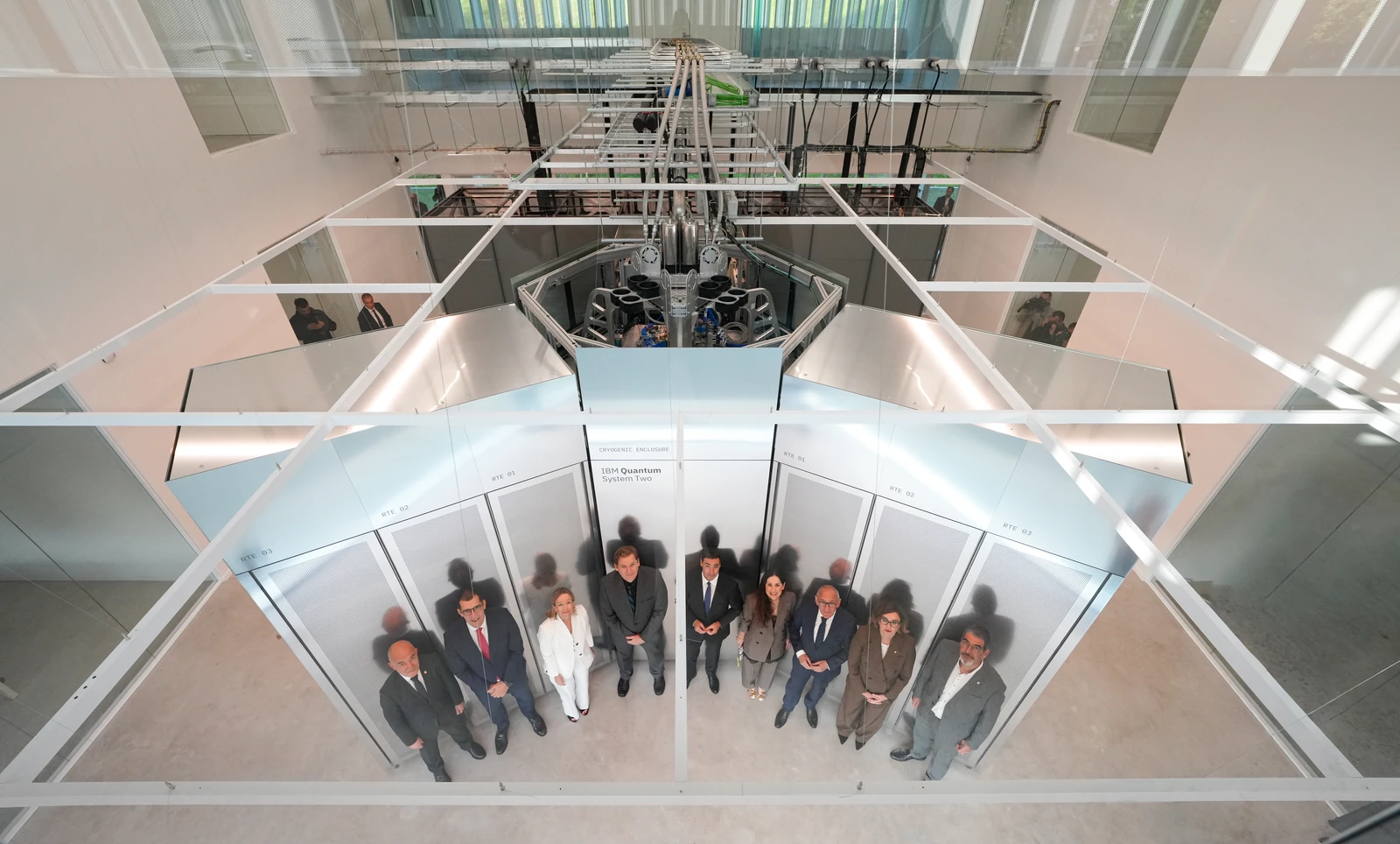
Looking down into the Ikerbasque installation
An elevated viewpoint changes the question from what the machine looks like to how the installation fits together. Reflections, enclosure walls and people make the spatial layout legible without exposing every component. This is useful for readers who imagine a quantum computer as only a chip or only a chandelier. Invite them to distinguish the visible apparatus from its architectural surroundings before adding a schematic. Any explanatory overlay should remain separate from the documentary image and identify inferred functions as interpretation. The source establishes the installation’s identity; operating temperature, processor configuration and performance need their own dated records.
- Organization
- IBM / Ikerbasque
- Image type
- Photograph
- Capture date
- 2025-10-14
- Photographer / creator
- Irekia / Eusko Jaurlaritza
- Reuse terms
- CC BY 4.0
Irekia / Eusko Jaurlaritza — IBM Q System Two Ikerbasque 03.jpg — CC BY 4.0 — https://commons.wikimedia.org/wiki/File:IBM_Q_System_Two_Ikerbasque_03.jpg — https://creativecommons.org/licenses/by/4.0.
Full original frame retained; EXIF orientation normalized where present, resized without enlargement and converted to WebP. No crop or content alteration.
Read the image
An overhead view reveals the space around the machine
Looking down changes which relationships are easy to see. The Ikerbasque photograph includes enclosures, a suspended assembly and people gathered around the installation. The overhead angle emphasizes the arrangement within the room more than the details of an individual component.
That makes the image useful for discussing access and boundaries. An operated instrument needs a relationship with the space around it: people approach it, equipment occupies defined areas and some components are enclosed. The photograph shows one arrangement, while the reasons for each boundary require a verified facilities or system source.
Perspective also changes apparent distances. Objects at different heights can overlap or look closer together than they are. A viewer should therefore treat the image as a documentary spatial view, not a floor plan from which to infer service clearances or reproduce an installation.
What does this angle add to a front view?
It shows more of the room and the relationship between the enclosure and surrounding visitors. It gives less direct access to small component details.
Can the image be used as an engineering layout?
No. Perspective, unknown scale and hidden areas prevent that. A facilities drawing would be needed for dimensions and access requirements.
Why show people in the frame?
They connect the apparatus to its human setting and help orient the reader. Their presence does not prove a particular operation was underway.
An independent QubitWire lesson based on this image and the cited source reading. The image does not establish a performance result.
Keep exploring
More from the same organization or hardware architecture.
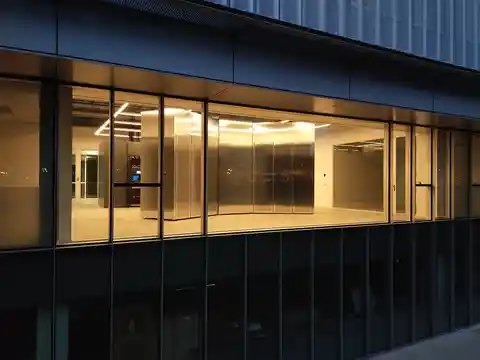 Quantum System Two through the windowLuistxo · CC BY-SA 4.0
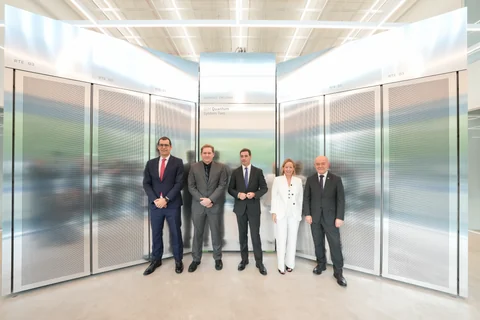 People beside Ikerbasque’s System TwoIrekia / Eusko Jaurlaritza · CC BY 4.0
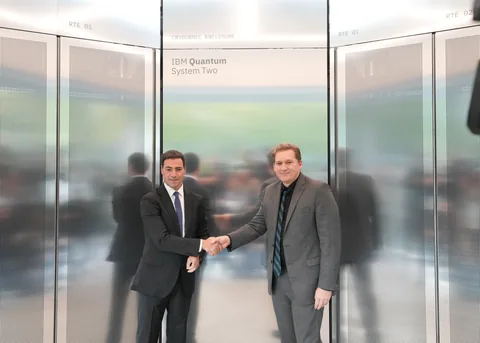 IBM System Two at its Ikerbasque inaugurationÍñigo Sierra / Irekia–Eusko Jaurlaritza · CC BY 4.0
 Quantum System One at ThinkLabOnri Jay Benally (OJB Quantum) · CC BY 4.0
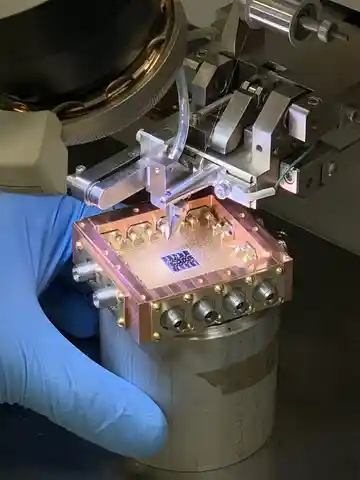 Inside an AQT processor packageAdvanced Quantum Testbed/Berkeley Lab · NQI gallery reuse permission
 Inside the SQMS Quantum GarageRyan Postel / Fermilab · NQI gallery reuse permission
Back to all images · Explore the interactive Model · Image rights and corrections