
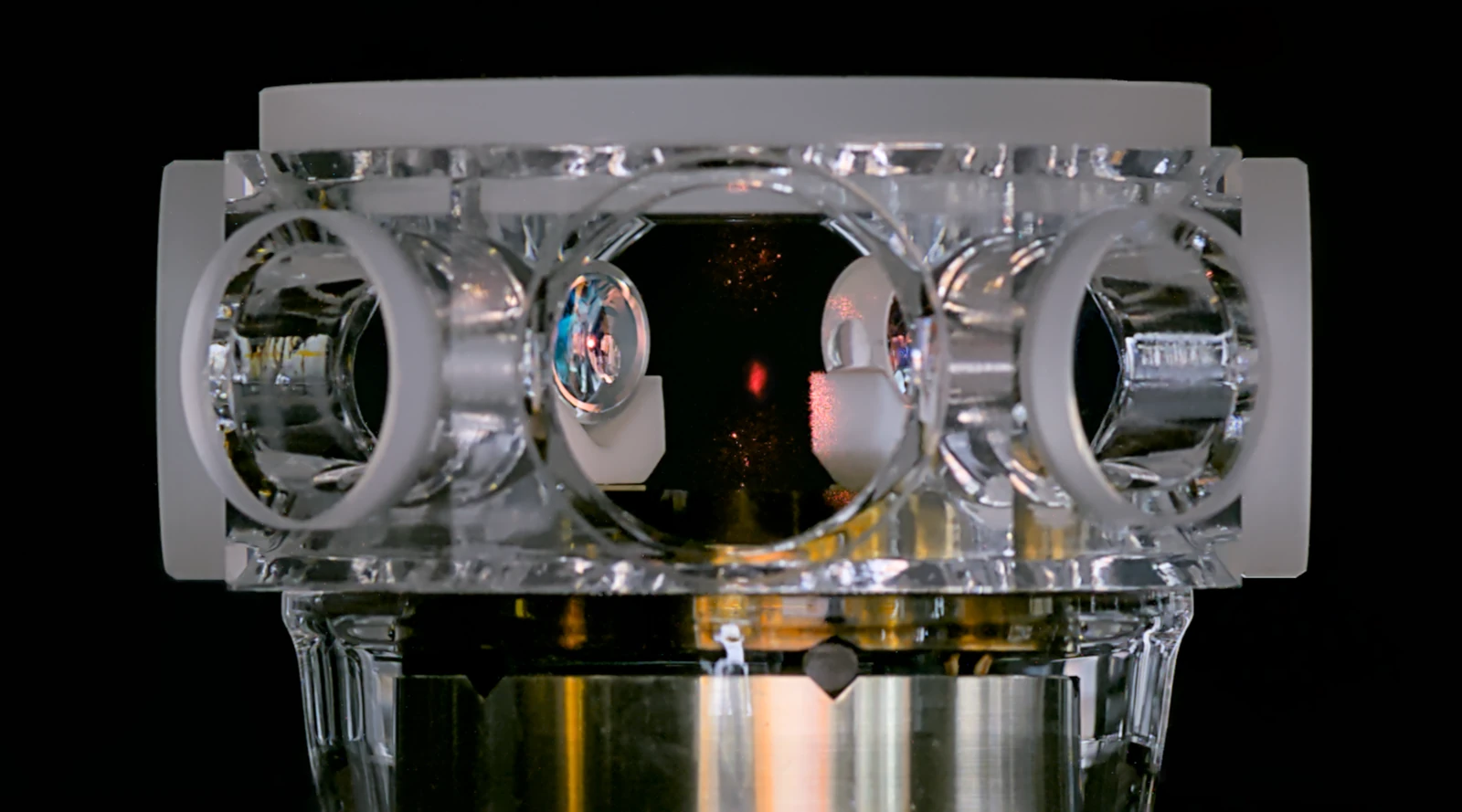
An ultracold-atom apparatus through a glass cell
The faint spot gains meaning from the photographer’s account of the experiment. The source identifies a magneto-optical trap, a glass cell under ultrahigh vacuum and an eight-minute exposure used to register the weak fluorescence. That exposure matters: the photograph is a camera’s accumulated view, not a promise of what an unaided observer would see at an instant. Use it to introduce the role of optical access and isolation in experiments with ultracold atoms. Preserve the distinction between the visible atomic cloud and individually addressed qubits in a later array. The image does not by itself establish a computing benchmark.
- Organization
- Max Planck Institute of Quantum Optics
- Image type
- Photograph
- Capture date
- 2024-08-06
- Photographer / creator
- Balping
- Reuse terms
- CC BY-SA 4.0
Balping — Cloud of ultracold atoms levitated in a magneto-optical trap.webp — CC BY-SA 4.0 — https://commons.wikimedia.org/wiki/File:Cloud_of_ultracold_atoms_levitated_in_a_magneto-optical_trap.webp — https://creativecommons.org/licenses/by-sa/4.0.
Full original frame retained; EXIF orientation normalized where present, resized without enlargement and converted to WebP. No crop or content alteration.
Read the image
A long exposure makes the atom cloud part of the visible scene
The glass cell surrounds a faint red spot above metal vacuum hardware. The photographer records an eight-minute exposure for this image from the Max Planck Institute of Quantum Optics. That detail explains why a small weak signal can appear in the same frame as much more conspicuous apparatus.
A camera collects light over its exposure interval. Increasing that interval can make a faint source easier to record, but it also means the image combines information across time. The photograph is therefore not a claim about the brightness a visitor would perceive instantly.
The source identifies a cloud in a magneto-optical trap. That is a preparation stage in which controlled light and fields help cool and hold atoms. It is useful to distinguish the prepared cloud, its optical fluorescence and the camera’s record of that fluorescence. Each is a different part of how the final picture becomes possible.
Does the red spot resolve individual atoms?
No such claim is supported by the image. It is presented as a cloud, and the photograph’s resolution and exposure do not establish individually addressed qubits.
Why does the glass cell matter?
It provides optical access while forming part of the controlled environment. The photograph makes that boundary between isolation and access visible.
What should remain in the caption?
Keep the source’s eight-minute exposure and 2024 date. They are important context for interpreting the appearance of the faint cloud.
An independent QubitWire lesson based on this image and the cited source reading. The image does not establish a performance result.
Keep exploring
More from the same organization or hardware architecture.
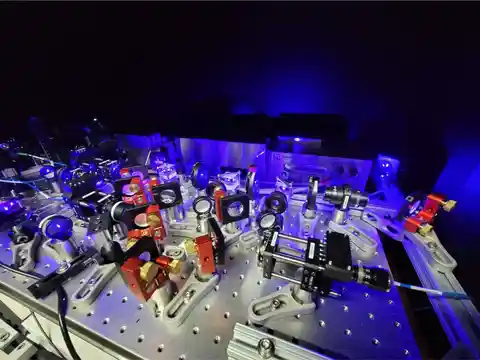 Aquila’s optical tableQuEra Computing, Inc. · CC BY 4.0
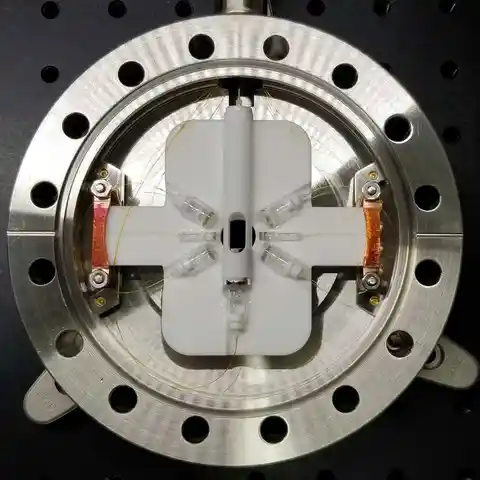 A neutral-atom quantum network nodeMark Saffman (University of Wisconsin Madison) · NQI gallery reuse permission
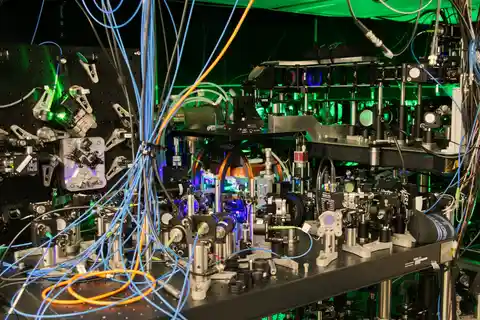 Controlling arrays of strontium atomsKaufman group, University of Colorado Boulder/Quantum Systems Accelerator · NQI gallery reuse permission
 Aligning a neutral-atom experimentKaufman group, University of Colorado Boulder/Quantum Systems Accelerator · NQI gallery reuse permission
 The E8 ultracold-atom experimentKeegan Houser/University of California Berkeley/Quantum Systems Accelerator · NQI gallery reuse permission
 Inside a three-dimensional quantum gas clockG.E. Marti/JILA · NQI gallery reuse permission
Back to all images · Explore the interactive Model · Image rights and corrections