
Quantum in pictures
Eight minutes to photograph a faint atom cloud
A long-exposure photograph from a quantum-optics laboratory shows why seeing a cold cloud and preparing an experiment are different achievements.
Research context: October 19, 2026 · Source review: October 20, 2026
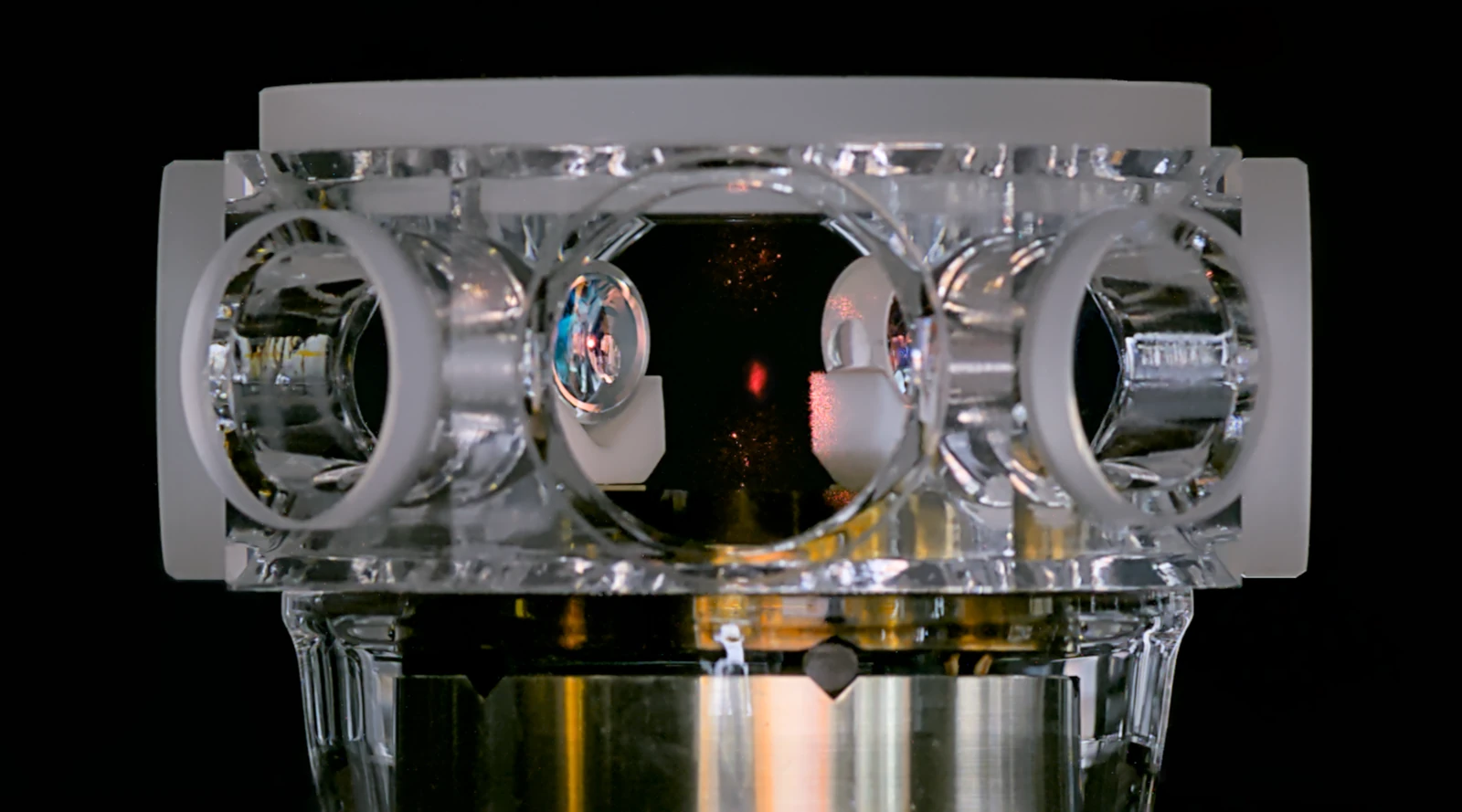
The faint spot gains meaning from the photographer’s account of the experiment. The source identifies a magneto-optical trap, a glass cell under ultrahigh vacuum and an eight-minute exposure used to register the weak fluorescence. That exposure matters: the photograph is a camera’s accumulated view, not a promise of what an unaided observer would see at an instant. Use it to introduce the role of optical access and isolation in experiments with ultracold atoms. Preserve the distinction between the visible atomic cloud and individually addressed qubits in a later array. The image does not by itself establish a computing benchmark.
Balping — Cloud of ultracold atoms levitated in a magneto-optical trap.webp — CC BY-SA 4.0 — https://commons.wikimedia.org/wiki/File:Cloud_of_ultracold_atoms_levitated_in_a_magneto-optical_trap.webp — https://creativecommons.org/licenses/by-sa/4.0.Full original frame retained; EXIF orientation normalized where present, resized without enlargement and converted to WebP. No crop or content alteration.
At the center of a glass cell, a small reddish glow is easy to overlook. The surrounding vacuum hardware occupies much more of the photograph than the cloud it supports. Photographer Balping identifies the image as ultracold atoms held in a magneto-optical trap at the Max Planck Institute of Quantum Optics, photographed on August 6, 2024. The source records an exposure of eight minutes, needed to capture weak fluorescence through the camera’s infrared-blocking filter.[1]
That exposure time changes how the picture should be read. The image gathers light over a long interval; it does not claim to reproduce exactly what a visitor would see at a glance. A camera can reveal a faint signal by accumulating it, while the bright metal and glass provide a physical setting. The result is both a laboratory photograph and a reminder that an image has a measurement history.
A magneto-optical trap combines light with a spatially varying magnetic field to cool and confine atoms. The light supplies forces that depend on the atoms’ motion and position under the chosen arrangement. Researchers use this kind of preparation to obtain a controlled cloud before subsequent steps. The MPQ’s educational description of a separate cavity experiment, for example, describes starting with cold rubidium atoms prepared in such a trap.[2]
The word “separate” matters. That tutorial explains the method but does not identify every component of the photographed apparatus or establish which later experiment followed this particular cloud. The photograph’s own record gives the location, subject and exposure.
The tutorial supplies a broader account of how atom preparation can fit into quantum-optics research. Keeping those sources distinct lets the story explain more without pretending to know the unseen history of the frame.
For readers, the glass is as interesting as the glow. An atom experiment needs controlled access: optical signals must reach the atoms, while a vacuum environment reduces unwanted encounters with background gas. A cell can therefore act as both a boundary and a window. Its visible shape gives an accessible starting point for understanding why an apparatus has to isolate its subject while still allowing deliberate interaction with it.
The source image therefore connects two different forms of preparation. The experiment creates and maintains a cloud in a selected region; the camera collects enough of the resulting light to make that region visible. One prepares the physical subject and the other prepares its record. The reddish patch does not resolve individual atoms, and the existence of a trapped cloud does not by itself establish a working quantum computer.
The charm of the image comes from that imbalance of scale: a substantial arrangement of glass and metal surrounds a faint patch of light. The patch attracts the eye once the caption helps locate it, but the apparatus carries much of the lesson. Quantum experiments often begin by preparing a suitable physical system. This photograph lets readers pause at that beginning, before the more conspicuous claims about computation or sensing, and see the careful environment in which the next question becomes possible.[1][2]
The trap and the photograph use different kinds of accumulation
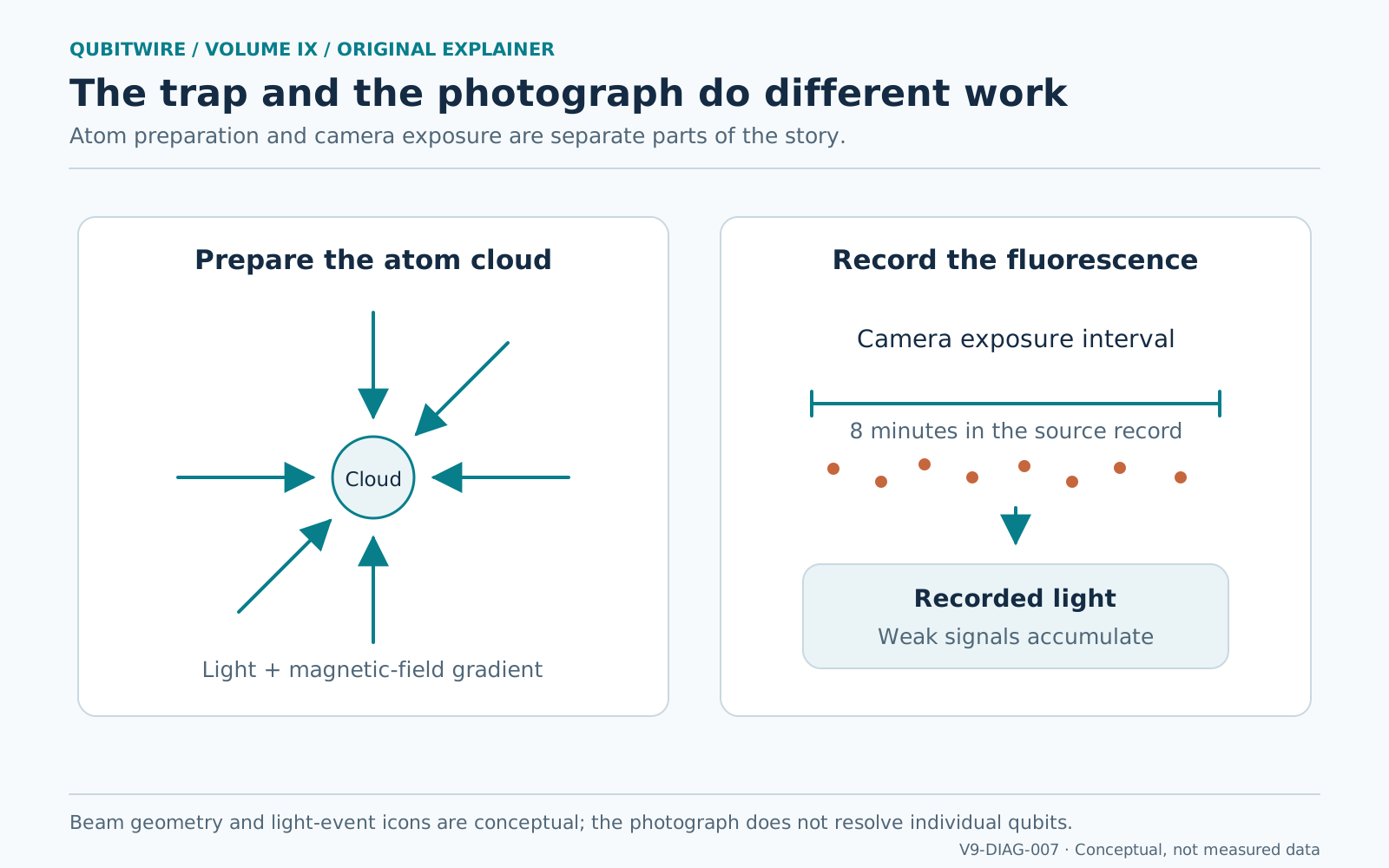
The left panel is a conceptual magneto-optical-trap sketch with three opposing beam pairs and a magnetic-field gradient around a cloud region. The right panel shows a camera exposure accumulating weak light over time. The source photograph reports an eight-minute exposure; the diagram does not resolve individual atoms or represent measured beam geometry.
Conceptual explanation; not an apparatus construction drawing or a measured result. Original QubitWire explanatory diagram.
Sources and further reading
- Cloud of ultracold atoms levitated in a magneto-optical trap ↗Balping / Wikimedia Commons
August 6, 2024 MPQ photograph, eight-minute exposure, infrared-filter explanation and CC BY-SA 4.0.
- Cavity Quantum Electrodynamics tutorial ↗Max Planck Institute of Quantum Optics
Separate research/tutorial example of MOT preparation and cold-atom handling; not identification of this particular apparatus.