
Model / Superconducting hardware
Inside a quantum computer
Most of what you see is the refrigerator. Find the tiny chip inside, send it a signal and see how one run becomes a bit.
Find the chip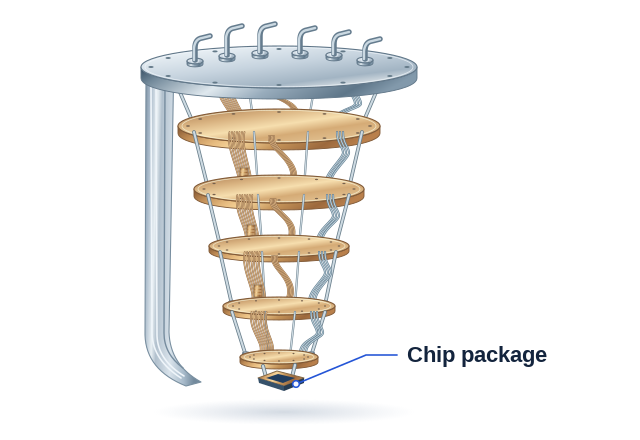
01 / 06 · Find the chip
Where is the chip?
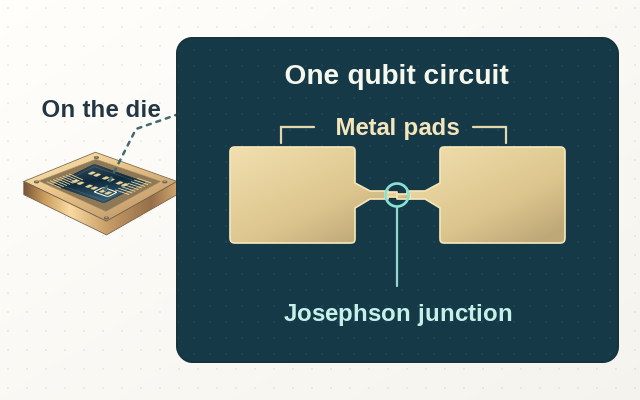
Look just below the lowest cooling stage. A small metal package holds the processor chip. The tiny electrical circuits patterned on that chip are the qubits.
See one qubit circuit
Inside the package
- Whole system
- The rack creates and records electrical signals. The refrigerator provides a cold, shielded home for the processor.
- Processor package
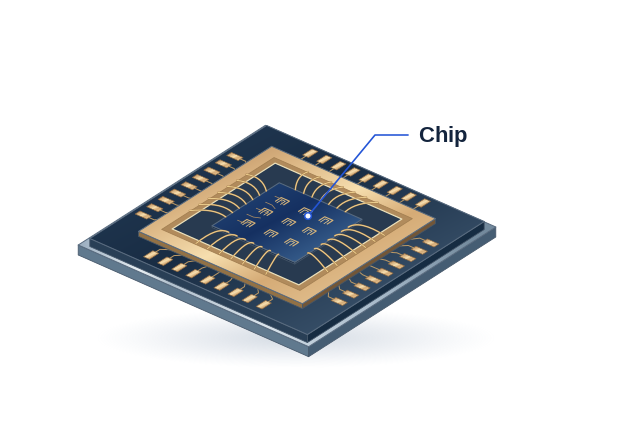
- The package holds the chip and routes electrical connections between the chip and its surroundings.
- Quantum chip
- Tiny patterned circuits on the chip act as qubits. This close-up enlarges the parts to show how they fit together.
02 / 06 · Keep it cold
Why is the fridge so big?
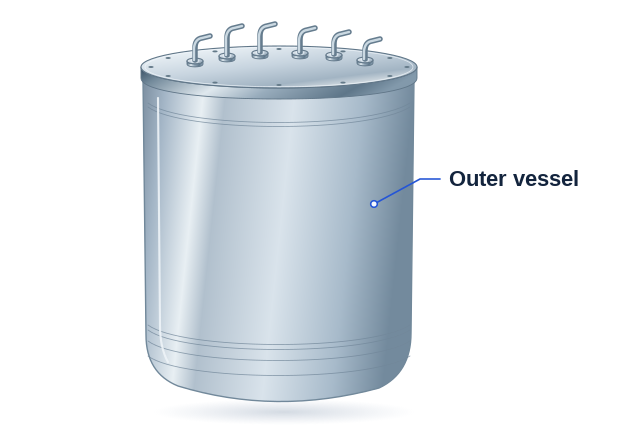
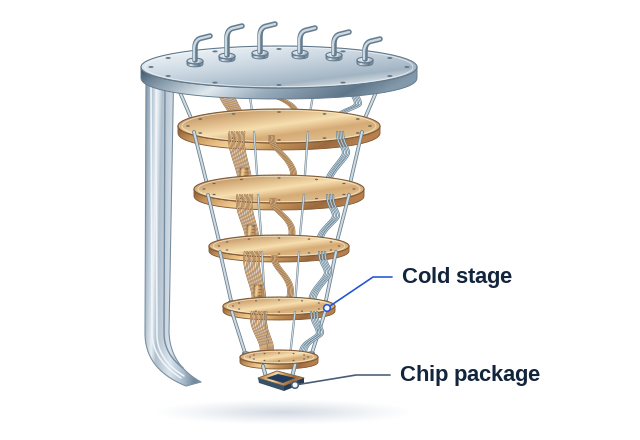
The same wires that carry instructions can carry heat. Each time a wire meets a colder metal plate, some of that heat drains away before it reaches the chip.
How do the shields help?
- Enclosure and vacuum
- The outer vessel surrounds a vacuum. With very little gas inside, much less heat can reach the cold parts through air.
- Cooling stages
- The metal stages become progressively colder toward the chip. A dilution refrigerator uses a mixture of helium isotopes for its coldest stage.
- Cold wiring
- Cables must carry useful signals without bringing too much heat or electrical noise down to the chip.
03 / 06 · Send a pulse
How does an instruction reach the chip?
A controller at room temperature shapes a microwave pulse. Follow its cable down to one circuit on the chip. Here the pulse asks the circuit to make a quarter turn in its quantum state.
How is a pulse shaped?
- Program
- A classical computer translates a circuit into operations the available device can perform.
- Signal conditioning
- Filters and attenuators help set the signal level and limit unwanted noise along the line.
- Pulse route
- A calibrated pulse can drive a chosen circuit operation. The drawing follows one representative route through a more complex wiring system.
04 / 06 · Change a state
Can you change the odds of seeing a 1?
Start with a qubit prepared in 0. A 60° turn gives it a one-in-four chance of measuring 1. Try 90°, then predict what 100 fresh runs of that preparation will show.
How the angle sets the odds
Each choice starts again in 0 and applies one rotation about the Y axis. When measured along Z, the chance of getting 1 is sin²(θ/2). Turns of 0°, 60°, 90° and 180° give 0%, 25%, 50% and 100%, respectively. At 360° the original odds return.
What can the same 50/50 prediction hide?
In a separate experiment, a Hadamard gate (H) prepares equal chances of 0 and 1. A phase shift changes how the two amplitudes combine when another H is applied.
| Measure | Chance of 0 | Chance of 1 |
|---|---|---|
| Before final H | 50% | 50% |
| After final H | 100% | 0% |
Each row starts over. The lower row applies both H gates before taking a single measurement. At 180°, that final H makes outcome 1 certain.
IBM Quantum · Phase gateWhat does the arrow mean?
- Physical circuit
- In this design, a superconducting circuit has distinct energy levels. Two chosen levels form the qubit used in the model.
- Coupled qubits
- Operations can link the states of two qubits. Their joint state can carry correlations that individual descriptions miss.
- Mathematical picture
- A state diagram is a picture of a calculation. A single measurement cannot reveal the complete state, and matched outcomes alone do not establish entanglement.
05 / 06 · Read a result
What comes back from the machine?
One run gives one bit. A circuit near the qubit sends a response back to the electronics, which assign it a 0 or a 1. Repeat the same preparation to see a pattern emerge.
| Bit | Prediction | Count | Share |
|---|---|---|---|
| 0 | 100% | — | — |
| 1 | 0% | — | — |
Why do the counts vary?
Each run starts from a fresh preparation. At 90°, either outcome has a 50% chance. One batch of 100 might give 53 zeros and 47 ones. Running again replaces the batch. At 0° the ideal model always gives 0, and at 180° it always gives 1.
More trials reduce typical random fluctuations. A biased receiver or an incorrectly calibrated pulse can still systematically shift the measured result.
IBM Quantum’s measurement reference
See how finite measurements affected a quantum key experiment
How does a signal become a bit?
- Readout circuit
- A superconducting qubit can slightly change the response of a nearby resonator. A probe helps make that difference observable.
- Return electronics
- The weak response travels through a chain of amplification and processing before a receiver digitizes it.
- Result record
- A classifier assigns a result to a response. Readout can make mistakes, and a single run gives only one record of the chosen measurement.
06 / 06 · Explore uses
What can a string of bits tell us?
Give each 0 a score of +1 and each 1 a score of −1. Their average estimates one property of the prepared state. Scientists can combine many such estimates to study a molecule.
(53 − 47) ÷ 100Ideal average 0
Compare the batch with the ideal prediction
53 zeros and 47 ones give a signed average of +0.06. The ideal prediction is P(0) − P(1) = 0. For 100 independent trials at this setting, the predicted standard deviation of the average is 0.1.
How researchers estimated hydrogen’s energy
In 2019, Ganzhorn and colleagues used two superconducting qubits to estimate energies of molecular hydrogen. A quantum circuit prepared a trial state. A classical computer combined measurements from different settings and adjusted the circuit for the next estimate.
The study tested a small molecule that classical calculations can also solve. It did not establish a speed advantage.
How do researchers use these estimates?
- Errors
- Imperfect controls, unwanted interactions and readout mistakes can affect an estimate. A larger experiment can demand more accuracy.
- Other machines
- Trapped ions and neutral atoms also serve as qubits. Their hardware and control methods differ from this superconducting example.
- What you have seen
- The chip holds the qubits. The surrounding machine protects and controls them. A classical computer turns the measurements into data researchers can use.