
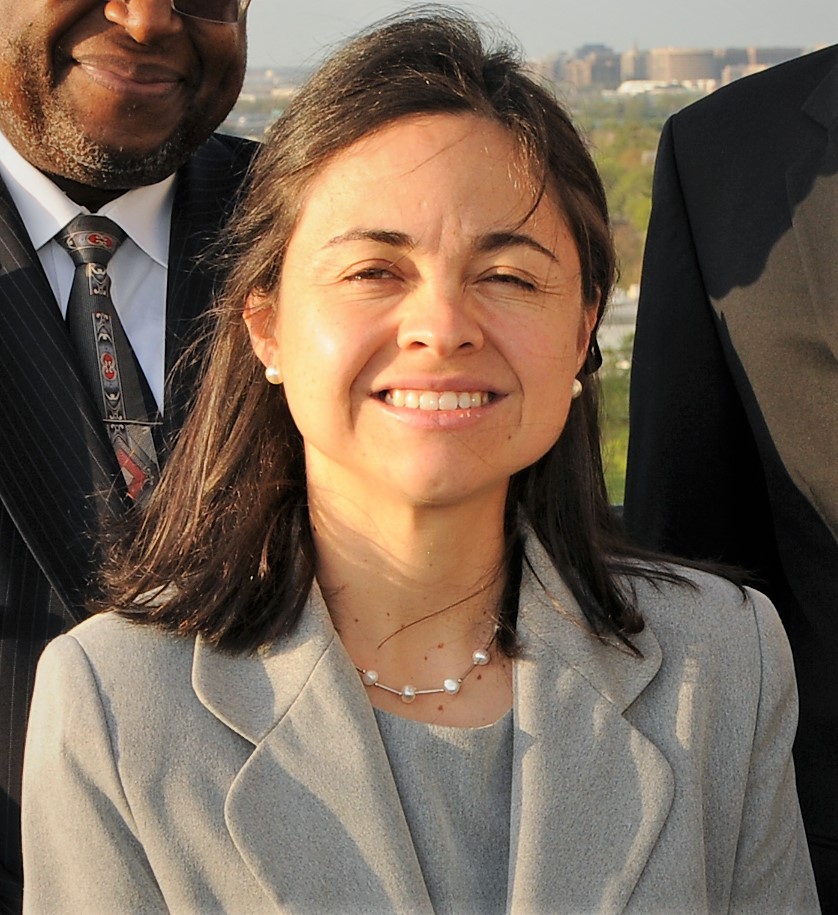

Rey develops theory for interacting atoms and quantum systems, connecting many-body physics with optical clocks, quantum simulation and precision measurement.
NISTarXiv / Annals of PhysicsAn atomic clock is also a controlled collection of quantum particles. Interactions among those particles can influence a measurement and provide a way to investigate many-body dynamics. Rey and collaborators build theoretical frameworks that connect these effects to experiments. Her contribution is especially relevant where quantum simulation and metrology meet: understanding the system's dynamics helps distinguish useful control from shifts and decoherence. This profile credits the shared theory work and does not attribute every JILA or NIST clock result to one researcher.
NISTarXiv / Annals of PhysicsDefining contributions
Work, in context- 2014
Modeling interactions in an optical lattice clock
Rey and coauthors developed a many-body framework for interactions and quantum dynamics during optical-clock interrogation, applying the model to observed shifts and fringe decay in strontium and ytterbium lattice clocks.
Coauthored theoretical framework by Ana Maria Rey and ten collaborators, including Alexey Gorshkov, Jun Ye and Andrew Ludlow.
Source-supported recordarXiv / Annals of Physics
The evidence map
Person → documented contribution → supporting source. Select a contribution to inspect what the evidence establishes.
Modeling interactions in an optical lattice clock
Probing many-body interactions in an optical lattice clock
Supports: Rey and coauthor identities, many-body master equation, lattice-clock applications and 2014 journal publication.
Published Oct 19, 2013 · Checked Sep 23, 2026Credit & limits: Coauthored theoretical framework by Ana Maria Rey and ten collaborators, including Alexey Gorshkov, Jun Ye and Andrew Ludlow.
Read the full contribution| Contribution | Evidence & what it supports | Credit & limits |
|---|---|---|
| Modeling interactions in an optical lattice clock2014 | Primary paperProbing many-body interactions in an optical lattice clock Rey and coauthor identities, many-body master equation, lattice-clock applications and 2014 journal publication. Published 2013-10-19 · Checked 2026-09-23 | Coauthored theoretical framework by Ana Maria Rey and ten collaborators, including Alexey Gorshkov, Jun Ye and Andrew Ludlow. |
Follow the evidence
2 sourcesPrimary papers, institutional records and attributed announcements. Each source supports the claims linked above.
- NISTInstitutional record
Ana Maria Rey
Current NIST/JILA identification, University of Colorado Boulder professor-adjoint role and research connecting quantum control, simulation and standards.
Checked 2026-09-23 - arXiv / Annals of PhysicsPrimary paper
Probing many-body interactions in an optical lattice clock
Rey and coauthor identities, many-body master equation, lattice-clock applications and 2014 journal publication.
Published 2013-10-19 · Checked 2026-09-23