
How much does a short storage window improve completion before a deadline?
A short memory window lets one heralded link wait for the other. The gain in completion probability depends on both link probabilities, the hold time and the deadline.
Source research checked . Teaching calculations are ideal models.
Two probabilistic links rarely succeed on the same attempt when each has a small heralding probability. Memory can preserve the first success while the second link keeps trying. But an unlimited-memory formula can hide the central engineering constraint: a state may cease to be useful before its partner arrives.
The discrete model tracks whether the request is empty, holds an A herald or holds a B herald, and how many partner-attempt slots remain before expiry. Completion is absorbing. Every time step transfers probability among these states, so the complete deadline probability can be calculated without sampling noise. The accompanying trace checks that completed and unfinished probability still sum to one.
A hard cutoff is deliberately simpler than physical decoherence. The stored state is granted full eligibility until its final valid slot and none afterward. This lets the reader isolate timing and compare no memory, a finite window and memory that lasts to the deadline. A physical networking article would additionally need storage efficiencies, state-quality measurements, swapping success, classical latency and a task-specific definition of usefulness.
Start with the assumptions
- Link attempts are independent with stationary probabilities.
- Only the missing link is attempted while one herald is held.
- A stored herald remains valid for the declared number of additional slots.
Empty-state simultaneous completion probability per slot = p_A p_B
A-held completion probability per partner attempt = p_B
Deadline probability follows exact finite-state probability propagation
Expected capped completion time = sum_{t=0}^{H-1} P(not complete after t slots)
Compare the input regimes
Each case uses invented inputs. The results follow from this model and do not describe measured hardware.
Baseline regime
Complete inputs
- Link A success per slot
- 0.08
- Link B success per slot
- 0.05
- Additional slots a stored herald remains valid
- 1
- Deadline slots
- 15
- Start empty. Each slot gives independent probabilities 0.08 and 0.05 for the two links. Simultaneous success ends the request.
- A lone success is held for 1 additional partner-attempt slots. On an unsuccessful final slot it expires; the next slot begins empty. The original link is not re-attempted while its herald is held.
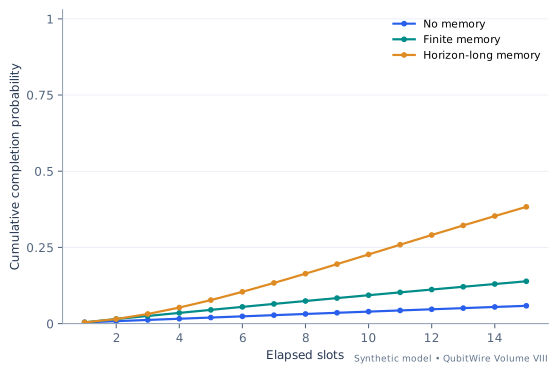
- Propagate the exact state probabilities through 15 slots. Completed plus unfinished probability remains one after every update. The completion probability is 0.138833.
| Calculated quantity | Synthetic result |
|---|---|
| Completion by deadline with finite memory | 0.138833273734 |
| Completion by deadline without memory | 0.0583487736147 |
| Completion with memory lasting to deadline | 0.383050442293 |
| Expected slots used, capped at deadline | 14.0406934552 |
| Extra completion probability from finite memory | 0.0804845001194 |
Finite memory raises deadline completion from 5.834877% to 13.883327%. The hard lifetime cutoff grants perfect usefulness before expiry and none after. It is not a physical fidelity-decay law. Storage write/read loss, swapping, classical latency and quantum-state verification are excluded.
Comparison regime
Complete inputs
- Link A success per slot
- 0.13
- Link B success per slot
- 0.08
- Additional slots a stored herald remains valid
- 6
- Deadline slots
- 30
- Start empty. Each slot gives independent probabilities 0.13 and 0.08 for the two links. Simultaneous success ends the request.
- A lone success is held for 6 additional partner-attempt slots. On an unsuccessful final slot it expires; the next slot begins empty. The original link is not re-attempted while its herald is held.
- Propagate the exact state probabilities through 30 slots. Completed plus unfinished probability remains one after every update. The completion probability is 0.803002.
| Calculated quantity | Synthetic result |
|---|---|
| Completion by deadline with finite memory | 0.803001846054 |
| Completion by deadline without memory | 0.269213360829 |
| Completion with memory lasting to deadline | 0.90395919036 |
| Expected slots used, capped at deadline | 15.9543143856 |
| Extra completion probability from finite memory | 0.533788485224 |
Finite memory raises deadline completion from 26.921336% to 80.300185%. The hard lifetime cutoff grants perfect usefulness before expiry and none after. It is not a physical fidelity-decay law. Storage write/read loss, swapping, classical latency and quantum-state verification are excluded.
Extended regime
Complete inputs
- Link A success per slot
- 0.19
- Link B success per slot
- 0.116
- Additional slots a stored herald remains valid
- 12
- Deadline slots
- 48
- Start empty. Each slot gives independent probabilities 0.19 and 0.116 for the two links. Simultaneous success ends the request.
- A lone success is held for 12 additional partner-attempt slots. On an unsuccessful final slot it expires; the next slot begins empty. The original link is not re-attempted while its herald is held.
- Propagate the exact state probabilities through 48 slots. Completed plus unfinished probability remains one after every update. The completion probability is 0.994875.
| Calculated quantity | Synthetic result |
|---|---|
| Completion by deadline with finite memory | 0.994875181106 |
| Completion by deadline without memory | 0.656906563676 |
| Completion with memory lasting to deadline | 0.997269894916 |
| Expected slots used, capped at deadline | 10.7541220778 |
| Extra completion probability from finite memory | 0.33796861743 |
Finite memory raises deadline completion from 65.690656% to 99.487518%. The hard lifetime cutoff grants perfect usefulness before expiry and none after. It is not a physical fidelity-decay law. Storage write/read loss, swapping, classical latency and quantum-state verification are excluded.
Try the reasoning: Compare a zero-slot memory with a memory lasting to the deadline. Where in the state update does expiry remove a stored herald?
Sources and model boundaries
- RFC 9340: Architectural Principles for a Quantum Internet ↗
Quantum network architecture must account for probabilistic entanglement generation, classical coordination, memory lifetime and application requirements. Informational research guidance, not an Internet Standards Track specification or a current performance survey. The synthetic link formulas are not claims made by the RFC.