
180 atoms reveal what happens before quantum matter settles down
A Nature paper published November 4 maps temporary regimes in a programmable quantum simulator. The journal milestone follows a preprint released in 2025.
Reading tools for text size, copying, printing and your reading list
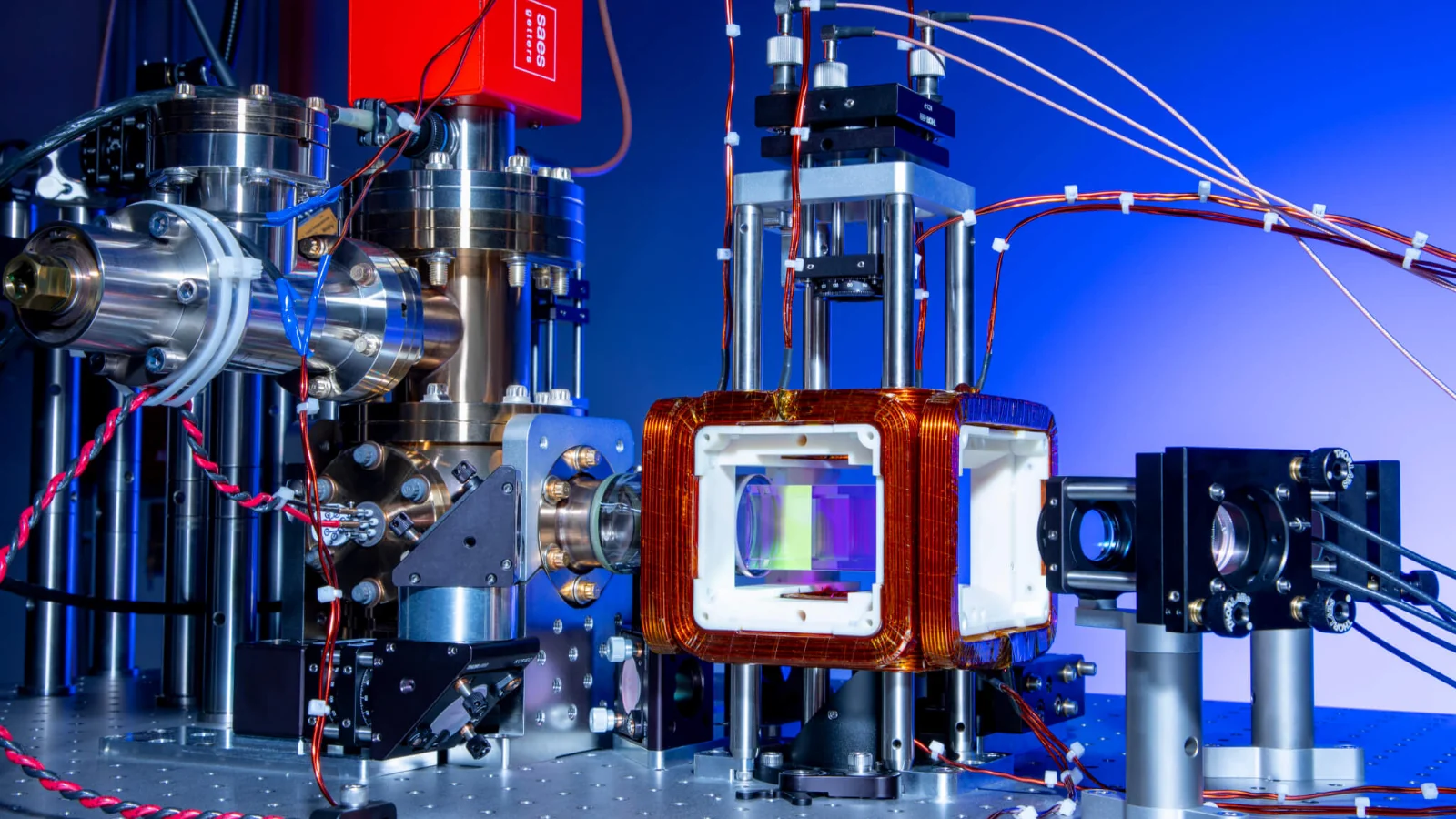

Give a group of quantum particles a sudden change of rules, and it need not settle smoothly into a final pattern. Researchers using up to 180 atoms have mapped several temporarily persistent regimes along the way. Their study, published in Nature on November 4, uses a programmable simulator to investigate how quantum matter evolves toward thermal equilibrium. Recognizable collective patterns can persist before that final state.[1][2]
The work turns a difficult process into an experiment whose controls can be adjusted and whose outcomes can be compared. An earlier version appeared in October 2025; the November 4 milestone is the journal publication.[1][2]
Make the change, then watch the response
A quantum simulator is a physical system arranged to study another quantum problem. Here, the researchers prepare atoms and abruptly change the experimental settings, a step physicists call a quench. They then study how the resulting patterns develop. The useful feature is control: they can change a setting and ask whether the response changes with it.[2]
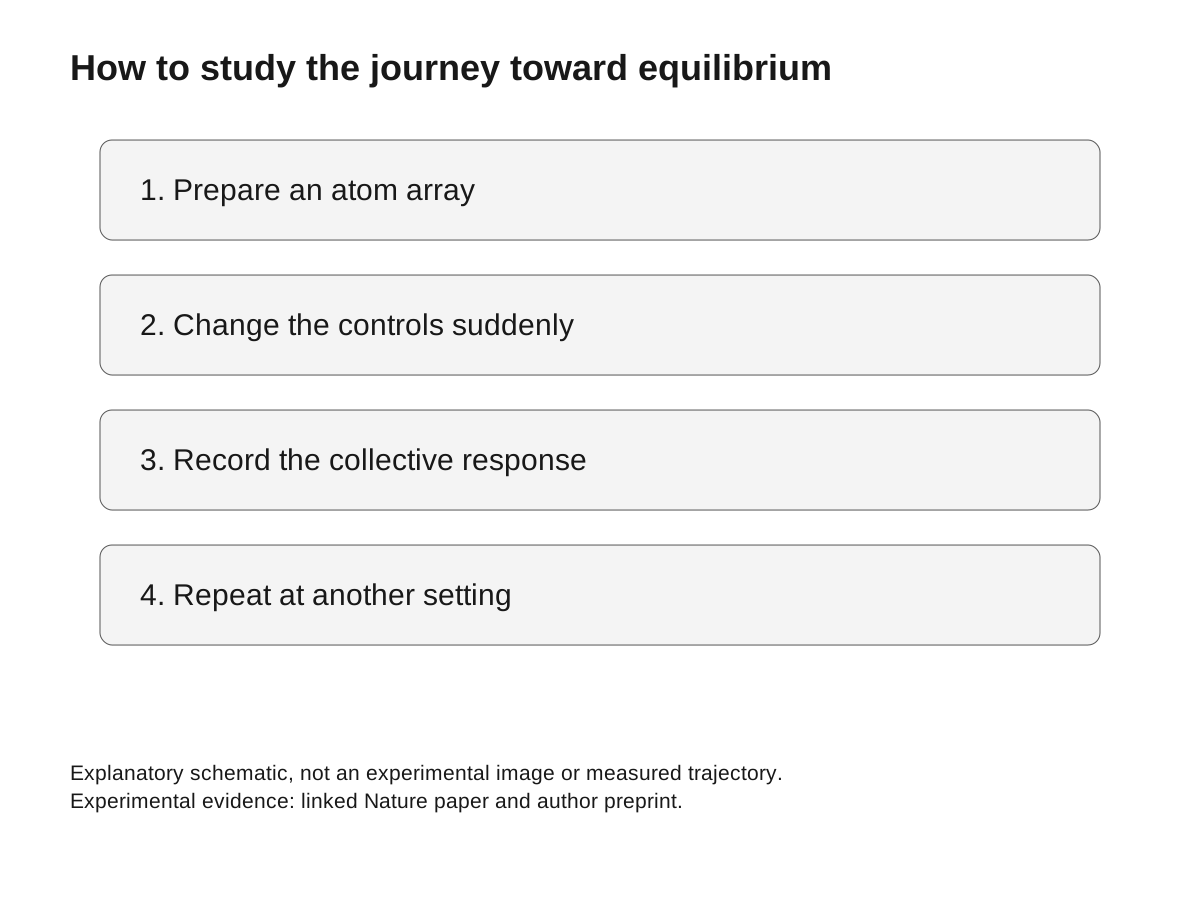
Read this graphic in text
- Prepare an atom array.
- Change the controls suddenly.
- Record the collective response.
- Repeat at another setting.
An explanatory sequence, not a measured trajectory.
Think of the scientific question as a film rather than a pair of photographs. Knowing the starting arrangement and the eventual destination leaves out the route between them. A temporary arrangement may have its own rules and its own boundaries. This analogy concerns the information in a sequence; it does not mean that atoms behave like familiar moving objects.
A temporary pattern can have structure
The study describes prethermal regimes: behavior that persists for a time before the system reaches thermal equilibrium. It also examines resonances that disrupt that behavior. In two dimensions, the authors identify a first-order dynamical phase transition and test that interpretation quantitatively. The technical term describes a sharp change in the system’s dynamical response as a control parameter changes.[1]
There are two separate questions here. Does a pattern last long enough to observe? And does its response change in a systematic way when the experiment is adjusted? A convincing account needs both the time record and the comparison across settings. One striking image alone would leave too much unresolved.
What the clock means
Long-lived is a relative description in this experiment. The experimental observations extend to four microseconds, while longer traces in the accompanying analysis come from numerical simulations. A microsecond is one millionth of a second. The significance lies in how the observed behavior compares with the system’s own dynamics, not in how long a person could watch it without a clock.[1][2]
Temporary order also does not mean that the system is motionless. A collective property can remain recognizable while microscopic dynamics continue. That distinction is useful whenever a headline describes a quantum state as stable: ask which property was measured and over what interval.
A scientific instrument, with a specific question
The array belongs to a broader effort to use controlled quantum systems as scientific instruments. A 2026 presentation about the cloud-accessible Aquila platform includes this prethermal study among its quantum-simulation experiments. That provides useful apparatus context; it does not independently reproduce the result.[3]
For an ordinary reader, the payoff is a better picture of what quantum research can contribute. A machine can be valuable because it lets researchers ask a controlled physics question. That value needs to be judged against the question and the evidence, rather than inferred from the number of atoms alone.
The next question is how far the pattern holds
Finite arrays and finite observation windows leave room for further tests. Larger systems, longer records where the apparatus permits them, and comparisons with other methods could show which features remain robust. Those are proposed follow-up questions, not milestones the researchers have already delivered.
The memorable result is that the route toward equilibrium can contain experimentally distinguishable structure of its own. The next useful update will explain what a changed experiment reveals about that route. It will not need a larger headline number to be interesting.
Keep your reading trail
Keep up with these topics
Choose the subjects you want to find again in Your Updates.