
A readout circuit makes high-resistance 2D quantum devices easier to measure
A tunable capacitor improves charge detection in two-dimensional devices. The October announcement describes a study published in August.
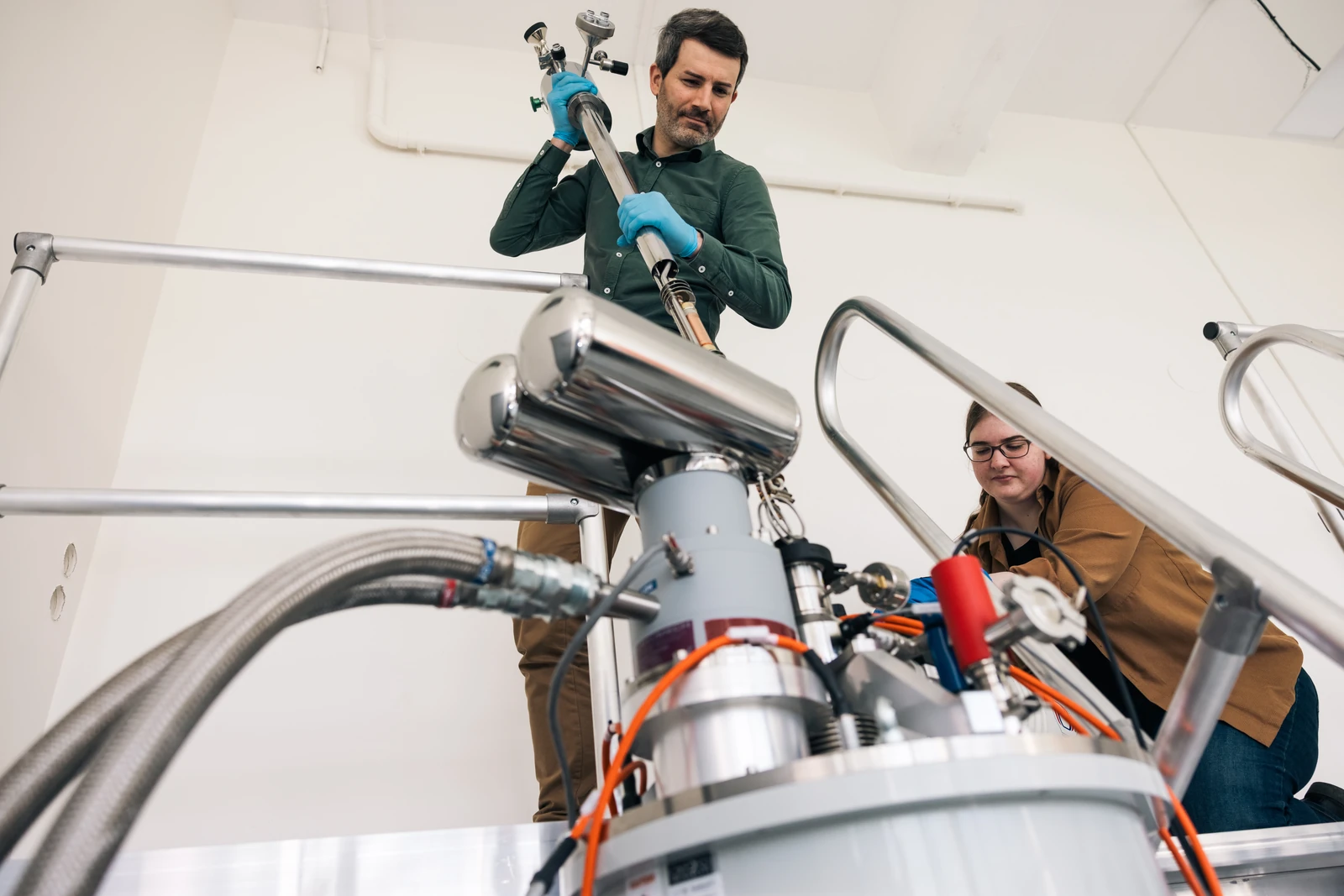

A better connection to a difficult device
Tohoku University’s October 16 announcement describes a high-frequency readout method for quantum devices made from two-dimensional materials. A tunable strontium-titanate capacitor helps match a high-resistance device to the measurement circuit, enabling sensitive charge detection in a perpendicular magnetic field. The underlying npj 2D Materials and Applications paper was published August 20; the October date is the university’s explanation of that work.[1]
Why an interface can limit a measurement
A device may contain interesting physics while producing a signal that is difficult to extract. The measurement apparatus has its own electrical characteristics. When those characteristics are poorly matched to the device, much of an applied signal can be reflected rather than interacting with the load in the intended way. An impedance-matching network changes how the device appears to the surrounding circuit. It can therefore improve access to an existing physical response without implying that the underlying quantum state has become intrinsically better.
Charge detection is a specific milestone
A charge sensor answers a question about electrical occupation or a charge-dependent response. That is an essential ingredient in many proposed devices, but it is not a complete measurement of every possible property. The route from a microscopic state to a readable voltage may require several stages, each with its own fidelity and time cost. A clear device story identifies those stages.
It tells readers which part was demonstrated and what additional operation would be needed to connect the sensor to the intended information carrier.
The practical question is whether the method travels
QubitWire’s analysis is that the next useful comparison should test how the readout method behaves across devices and operating conditions. Does its tuning range cover the variation that fabrication produces? How does sensitivity trade against bandwidth? Can the circuit be adjusted repeatedly without losing the desired operating point? These are questions for follow-up evidence, not performance claims established by a general announcement.
The story gives a concrete example of engineering around the boundary between a small device and the outside world. The device carries the charge response, the tunable matching element helps couple that response to the measurement line, and the line carries the readout signal. Improving this charge measurement does not by itself demonstrate spin or valley readout.
This lets a newcomer understand the immediate advance while giving a specialist a reason to examine the circuit and its operating range. The best future headline would identify a previously impractical measurement that the method makes routine under specified conditions.
Bandwidth needs a decision target
A measurement bandwidth describes part of a signal chain. The useful result for a device user is the time required to distinguish the intended states with a specified confidence. A follow-up that reports both quantities can reveal whether the circuit improvement translates into a faster complete decision or mainly changes one intermediate response.
Research in context · checked 20 Oct 2026
What reflection reveals about a mismatch
A worked explanation of the distinction behind the result.
For a simple teaching example, consider a transmission line with a real reference impedance Z₀ and a purely resistive load ZL. The voltage reflection coefficient is Γ = (ZL − Z₀)/(ZL + Z₀). The reflected power fraction is |Γ|². Real quantum-device circuits often have frequency-dependent complex impedances, so this deliberately simple model is not a fit to the experiment.
Choose hypothetical values of 50 ohms for the line and 1,000 ohms for the load. Then Γ = 950/1,050, or about 0.905. Squaring gives a reflected power fraction of roughly 0.819. In this idealized example, about 82 percent is reflected at the mismatched boundary.
A matching network can transform the impedance presented to the line at an intended operating frequency. It does not create energy or remove every source of measurement noise. Its usefulness depends on the behavior it produces over the frequencies and device conditions that matter. A narrow response can be helpful for sensitivity while limiting bandwidth; the right choice depends on the experiment.
This is why tuning deserves attention. If a device’s electrical properties change as its operating point is adjusted, a fixed match may work well only in a small region. A tunable element provides another control, but that control itself must behave reliably in the experimental environment.
The circuit picture also prevents a misleading inference from the word stronger. A stronger measured response might mean that the apparatus couples more effectively to the same device. It need not mean that the device’s quantum coherence has improved. To claim the latter, researchers would need a measurement that specifically tests coherence rather than only signal transfer.
Sources and evidence
- New High-Frequency Method Boosts 2D Material Readout for Next-Gen Quantum Computers ↗Source published 2026-10-16. university research announcement. Underlying npj 2D Materials and Applications paper published August 20 2026, DOI 10.1038/s41699-026-00730-0. News date must not replace study date.
Research in context · checked 20 Oct 2026
Is faster readout always better?
A worked explanation of the distinction behind the result.
A measurement speed has meaning only alongside the information obtained and the error rate. A very short acquisition can be fast but too uncertain to distinguish the states of interest. Repeating it many times may erase the apparent time saving. A longer acquisition can improve confidence while exposing the state to more disturbance or drift.
The useful comparison therefore asks how long the full procedure takes to reach a specified decision quality. It should include preparation and any repeat measurements required by that quality target. This framing connects a circuit improvement to the task it serves and makes results from different devices easier to compare without assuming that one advertised bandwidth number tells the whole story.
A resonant response can also shift when the device is tuned. Comparing sensitivity at each method’s best point answers a different question from comparing their performance across an entire operating range. The required range should be chosen from the experiment’s needs, not from the most attractive isolated trace.
Sources and evidence
- New High-Frequency Method Boosts 2D Material Readout for Next-Gen Quantum Computers ↗Source published 2026-10-16. university research announcement. Underlying npj 2D Materials and Applications paper published August 20 2026, DOI 10.1038/s41699-026-00730-0. News date must not replace study date.