
Skip to content
HARDWARE · QUANTUM PHOTONICS

Infleqtion Reports a Foundry-Made Quantum Laser Component. What Comes Next?

An October 6 announcement describes a silicon-nitride cavity prototype fabricated by Honeywell Aerospace. The manufacturing route matters, but it is not yet a performance or production-yield benchmark.
Published Source report Sources checked
My reading list
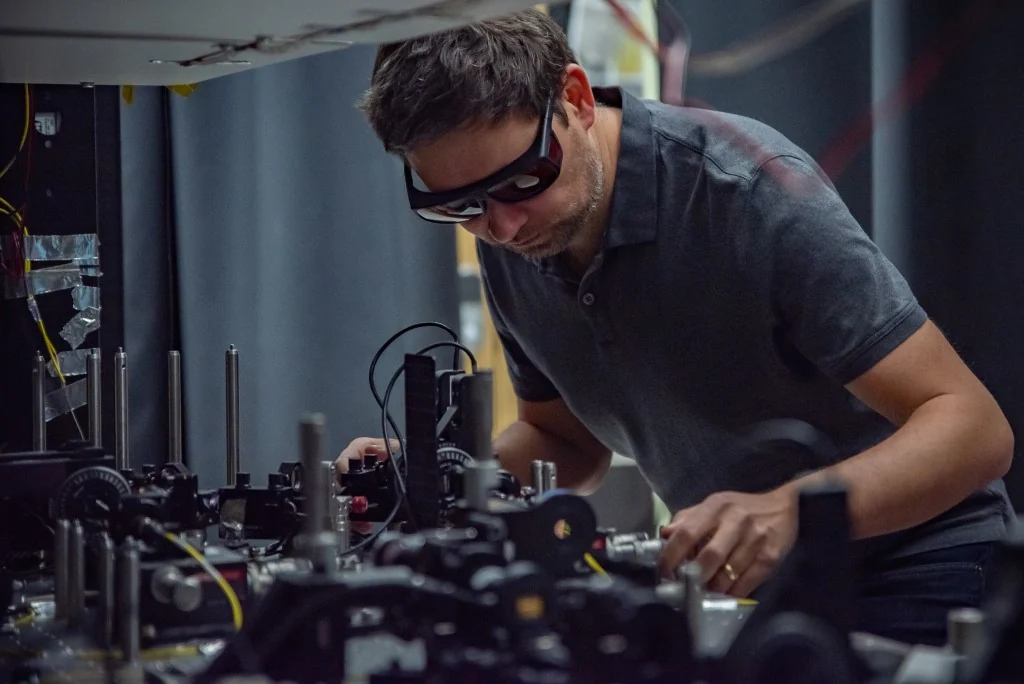
NIST physicist Krister Shalm wearing laser safety glasses while adjusting optical components on a laboratory bench.
NIST physicist Krister Shalm at an optical bench in a photograph published by NIST on January 23, 2023. Historical context for laboratory optics; this is not the Infleqtion–Honeywell cavity prototype or a facility involved in the announcement.Photo: Historical NIST quantum-optics laboratory context · R. Wilson/NIST · NIST public information; reuse permitted with creditFull image credit

Can quantum hardware shrink without giving up the laser stability it needs? On October 6, Infleqtion, Honeywell Aerospace and UC Santa Barbara announced a silicon-nitride optical cavity prototype fabricated at Honeywell’s photonics foundry. The partners say it reduces the footprint of laser stabilization. This is a component and manufacturing announcement, not a demonstration of a complete handheld quantum computer or sensor.[1]

A stable laser needs a frequency reference and a way to correct drift. A cavity supplies the reference; feedback can adjust the laser toward it. This matters for precision light used in quantum computing, clocks and sensing. Moving the reference onto a chip addresses one part of the optical system, while control electronics and packaging still determine the finished instrument.[2][3]

An earlier UCSB study shows why this approach is technically interesting. Published in July 2025, it stabilized a tunable laser using a ten-metre optical path coiled into a silicon-nitride resonator. Laser and reference cavity used the same fabrication platform. That separate experiment reported fundamental linewidths of 3–7 hertz across a 60-nanometre tuning range. Those numbers belong to the 2025 paper; the October announcement does not establish them for the Honeywell prototype.[1][2][3]

QubitWire’s analysis: the new announcement moves attention from whether an integrated reference can work to whether a fabrication process can reproduce useful devices. A smaller component does not automatically mean a smaller qualified system. For quantum users, the meaningful comparison is stability after packaging, power consumption and usable output across multiple devices—not chip area alone.[1][2][3]

The October release provides no numerical footprint, frequency-noise measurement, manufacturing yield or production volume. Its near-term applications are navigation and atomic timing, so quantum-computing benefits remain prospective. The next useful evidence would be measurements across a fabricated batch, followed by packaged temperature and vibration tests that show how much of the laboratory performance survives outside controlled conditions.[1][2][3]

Keep your reading trail

Your Updates →

Evidence & context

3 linked sources

An official October 6 announcement identifies a foundry-fabricated silicon-nitride cavity prototype without quantified device performance or yield. A distinct July 2025 peer-reviewed UCSB experiment explains the technical approach; its measured linewidths are not attributed to the new prototype.

How to read the evidence and dates

An announcement records what an organization stated. An experiment reports an observation. A simulation or resource estimate depends on its assumptions. QubitWire’s analysis connects these sources; the labels are not quality scores.

Published is the article’s first QubitWire publication. Updated marks a substantive content change. Sources checked records a review of the underlying evidence. An older paper can support a new explanation, and another press release about the same work is not independent replication.

QubitWire take

A foundry-made laser reference is a manufacturing step, not a complete compact quantum system. Watch for reproducibility and packaged stability before treating miniaturization as deployment.

Sources

  1. Infleqtion: October 6 cavity prototype and Honeywell foundry announcement
  2. Separate UCSB coil-stabilized laser experiment, Nature Communications, July 2025
  3. Full open-access manuscript of the July 2025 UCSB study
READ NEXT

Continue exploring

All Hardware stories
  1. Related reading

    QuEra Reports AI-Written Software Recovering Laser Locks in Seconds

    A dedicated testbed recovered in 695 of 700 timed trials, according to QuEra's account of its Claude-assisted control pilot.

    Source report
  2. Related reading

    Scientists Picked Up 6,100 Atoms With Light. Yes, Individually.

    Laser tweezers turn single atoms into movable quantum bits, and the resulting grid is something researchers can actually photograph.

    Published · Sources checked
THE QUANTUM BRIEFING

A clearer signal.
Read the latest edition.

A little perspective on a fast-moving field.

Read the on-site briefing →

Read selected quantum coverage in the on-site briefing, or register your interest below.