
AI helped a physicist tackle quantum gravity. What would count as a solution?
A Stanford preprint says it reproduced a subtle result about black holes. A physicist’s public critique explains why getting a familiar answer back is not the same as solving quantum gravity.
Reading tools for text size, copying, printing and your reading list
Start with two flashes of light: one sent outward at an earlier moment and one imagined traveling inward toward a later moment. The surfaces traced by those flashes bound a region of spacetime. Stanford physicist Venkatesa Chandrasekaran wants to use boundaries like these to build a quantum description of gravity. In an unreviewed preprint listed by arXiv on November 26 after a November 25 submission, he reports two checks: a calculation that stays finite where one approximation breaks down, and a match to a known result about black holes.[1][2]
The acknowledgments say Chandrasekaran developed some calculations and proofs with GPT-6 Astra over months, using roughly 400 million tokens of computing provided by OpenAI. He is the sole author and also thanks his OpenAI colleagues. In a November 26 public critique, University College London physicist Jonathan Oppenheim said the classical starting calculation looked sound to him, but challenged whether the paper establishes that the resulting quantum theory has the properties it needs.[1][3][4]
Why draw the boundary with light?
Einstein’s general relativity describes gravity as the shape of spacetime. Ordinary quantum calculations typically start with some background on which events happen. In a quantum theory of gravity, the shape of spacetime is itself part of what needs a quantum description. Chandrasekaran starts with two intersecting light cones, so the boundary is defined by where light can travel, not drawn on a rigid backdrop whose geometry is fixed in advance.[1]
On those boundaries, he solves certain restrictions from Einstein’s theory before turning the remaining variables into quantum quantities. The order matters. Oppenheim’s point is that ruling out certain possibilities in the classical theory first need not give the same quantum physics as imposing the restrictions on quantum states from the start. The paper proposes one route through that problem; it does not show that the choice is harmless.[1][3]
What the black-hole test tells us
The preprint calculates an amplitude involving a pair of gravitons, the hypothetical quantum units of gravitational waves. In the setup studied, the calculation returns a finite value when gravity’s strength is kept in the expression until after a sum is done. Expanding in that strength first gives a divergent term. This is a worked example of why the method could be useful, not a detection of gravitons or a demonstration that every calculation in the theory is finite.[1]
The other check is about entropy, which measures how many microscopic possibilities fit the same large-scale description. The preprint recovers a small mathematical correction that Ashoke Sen previously calculated for an idealized black hole. Think of that as matching an answer already in the back of the book. It is a useful check on a different method, not a new astronomical observation. Oppenheim questions whether the paper independently establishes that there are only finitely many quantum states in the region under discussion.[1][3][5]
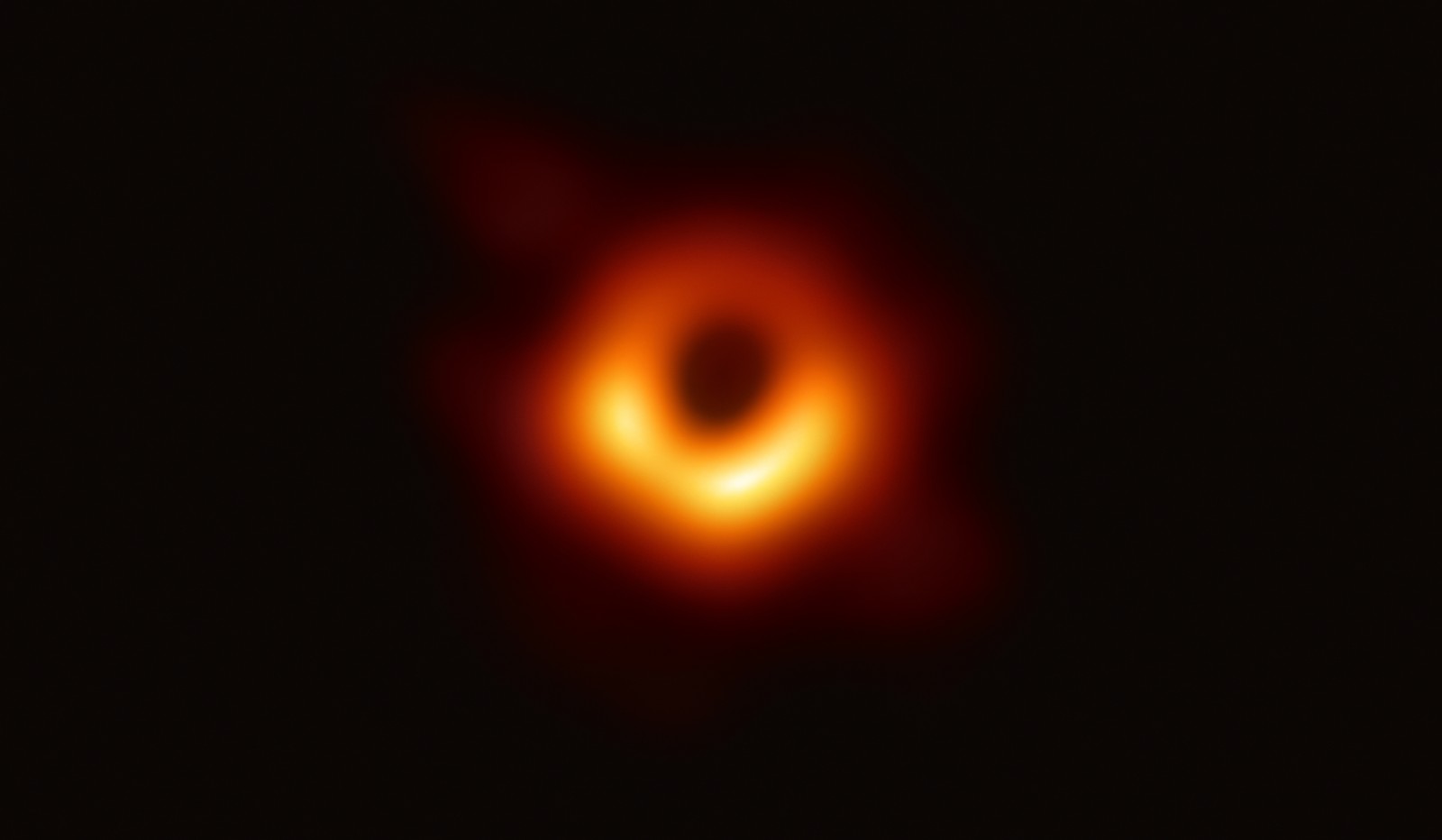
That distinction is visible in the image above. The Event Horizon Telescope used real radio measurements to reconstruct the shadow of the black hole in M87. Chandrasekaran’s preprint did not analyze those measurements; it works out what a mathematical framework says about an idealized case. A next step would be for other physicists to show that the construction is internally consistent and recovers Einstein’s familiar predictions in the regime where those predictions have been tested. The amount of AI-assisted work says nothing by itself about whether either condition is met.[1][3][5][6][7]