
Same brightness, wrong answer: the hidden problem in a chip that computes with light
Experiments on a silicon photonic chip show why matching the brightness at each output isn’t enough, and how a software model helped researchers fix the mismatch.
Reading tools for text size, copying, printing and your reading list
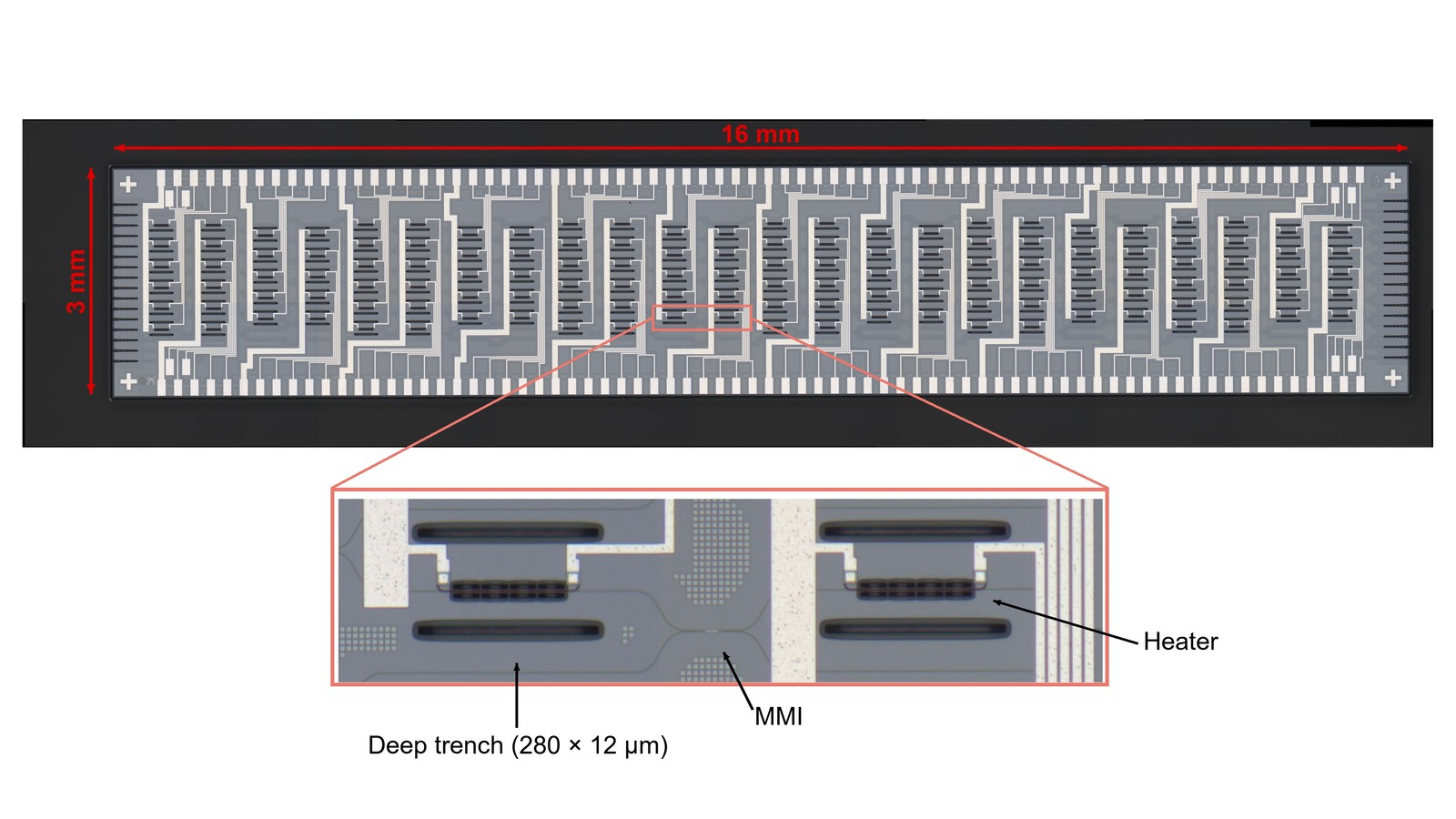
Two settings on the same silicon chip passed nearly identical brightness tests. But when researchers sent multiple light signals through together, the settings could produce different answers. In a new preprint, Huiwen Li, Ali W. Elshaari and their colleagues report that a software model helped them tell the settings apart and program one that did what they wanted. This matters for a simple reason: on a chip that computes by combining light, measuring how much light comes out doesn’t always tell you what the chip just did.[1]
The distinction is between the strength of a light wave and its phase, the position of a crest or trough relative to another wave. Imagine two speakers playing the same note. Either one on its own can sound equally loud. Play both at once and their waves can reinforce each other at your seat or partly cancel, depending on how the peaks line up. On the chip the same principle applies to light. Test one input at a time and two programs can give almost exactly the same results. Turn on several inputs with a stable relationship between their waves and the difference becomes visible.[1]
The brightness test barely noticed the fix
The team tested a silicon chip with 12 input and 12 output channels and 66 devices that split and recombine light. Tiny heaters change how the waves line up inside. Because real chips differ slightly from their design, the researchers built a software model of this particular chip. They trained it with many brightness measurements, lighting one input at a time and changing the heater settings. The model could use how brightness changed across those settings to constrain hidden properties of the chip. That is different from reading phase directly off one brightness measurement.[1]
For ten randomly chosen tasks on a four-input, four-output section of the chip, the researchers compared programs tuned for brightness alone with programs tuned for brightness and phase. On a scale where 1 is a perfect match, the average brightness scores were 0.9979 and 0.9985, respectively. The phase scores told a different story: 0.690 for the brightness-only programs, versus 0.996 for the ones that accounted for phase. Those are scores for how well the chip matched its instructions, not probabilities that a quantum operation succeeded.[1]
Crucially, the phase comparison did not just ask the software whether its own predictions were right. The researchers also used the physical chip to make two inputs interfere and checked the phase relationships through that interference. In another test, they checked whether the programmed chip would produce the intended brightness when several inputs carried light together. Across 13 target transformations and two ways of encoding the light, the average output match was 0.936 with brightness-only programming and 0.996 when phase was included.[1]
What this means for chips that use light
These experiments used classical laser light, not individual photons performing a quantum computation. The researchers checked phase predictions on selected sections spanning up to ten input and output channels, not arbitrary programs across all twelve. What the work offers is a way to calibrate programmable optics using brightness measurements for training, with interference measurements to check the result. That distinction is useful for both optical computing and photonic quantum hardware: a chip can send the right amount of light down each path and still get the calculation wrong when those paths meet.[1]