
Noise helped a quantum walk keep its direction. Here’s how.
A photonic experiment published on November 6 shows when noise can preserve or enhance a directional pattern across encoded light modes. The effect depends on the noise, its order, and the engineered loss.
Reading tools for text size, copying, printing and your reading list
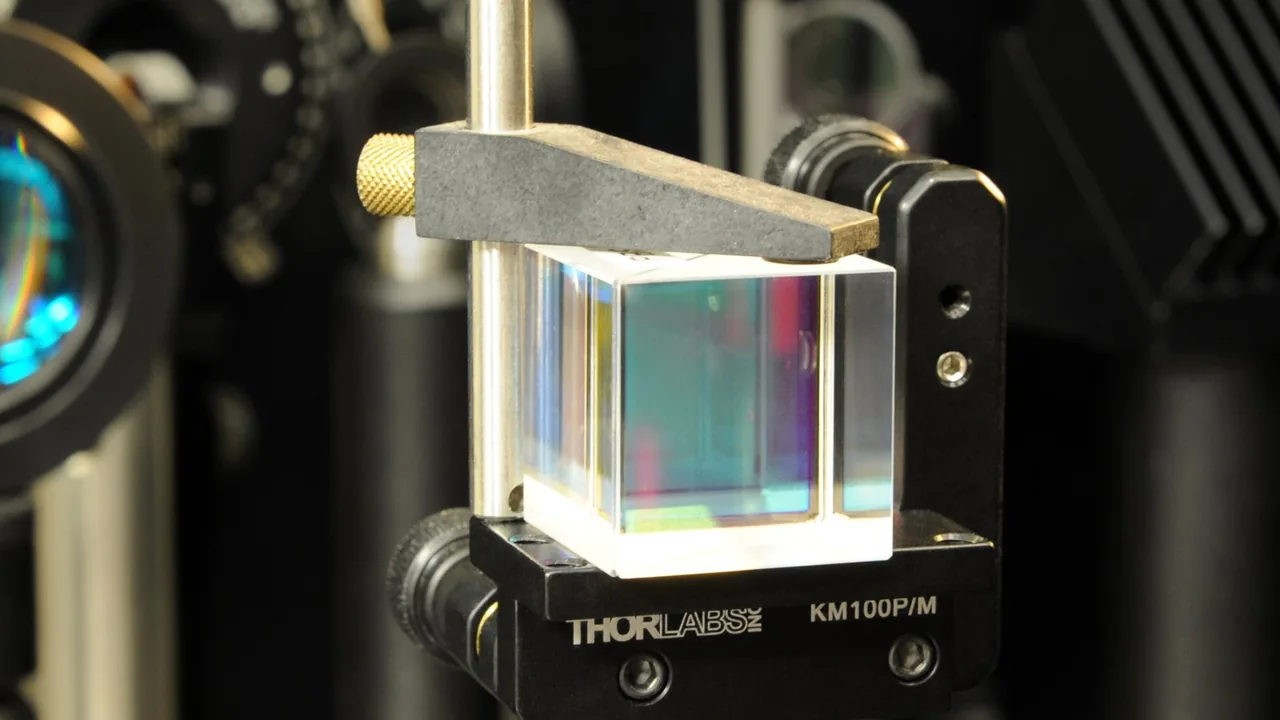

Noise is usually something physicists work hard to remove. In a controlled experiment with light, researchers have shown why that instinct sometimes needs a more careful question: remove it to achieve what?
A study published in Nature Communications on November 6 finds that deliberately introduced noise can preserve, and under tested conditions strengthen, directional drift in a photonic quantum walk. A different kind can suppress the effect or leave it intact, depending on where it enters the sequence. The result concerns a controlled transport effect, not faster quantum computation.[1]
The apparatus encodes the walk’s positions in light’s orbital-angular-momentum modes. Researchers measure how the detected distribution shifts across those encoded positions. This experimental detail comes from the publicly available April preprint.[2]
A different goal changes the meaning of an error
Imagine judging a crowd only by whether its average position moves toward an exit. That is a different test from asking every person to preserve a precise relationship with every other person. An intervention might help the first task while making the second impossible. This analogy describes the distinction between goals; it is not a model of the experiment.
Quantum computing needs carefully controlled relationships between quantum states. Noise remains a serious obstacle, and the theory and practice of error correction and error mitigation address that problem. A NIST-affiliated analysis of noisy circuits, for example, stresses how reliable mitigation depends on characterizing the noise well.[4]
The optical work asks a different question: can a directional transport effect survive when coherence is reduced? The relevant phenomenon has the ungainly name "non-Hermitian skin effect." In suitable open systems, many modes can accumulate toward a boundary. "Open" matters here: the system exchanges energy or particles with its surroundings, so loss is part of its behavior rather than simply a missing correction to an ideal isolated machine. Earlier theory had already examined how versions of this effect could survive incoherent dynamics.[3]
The order matters
The experiment compares dephasing, which disrupts phase relationships, with amplitude damping, which changes state populations. Moving amplitude damping from before the engineered loss step to after it changes the outcome. The journal abstract reports that amplitude damping before the engineered loss suppresses and ultimately eliminates the effect. Applied afterward, it can preserve the effect and enhance drift at sufficiently large loss.[1][2]
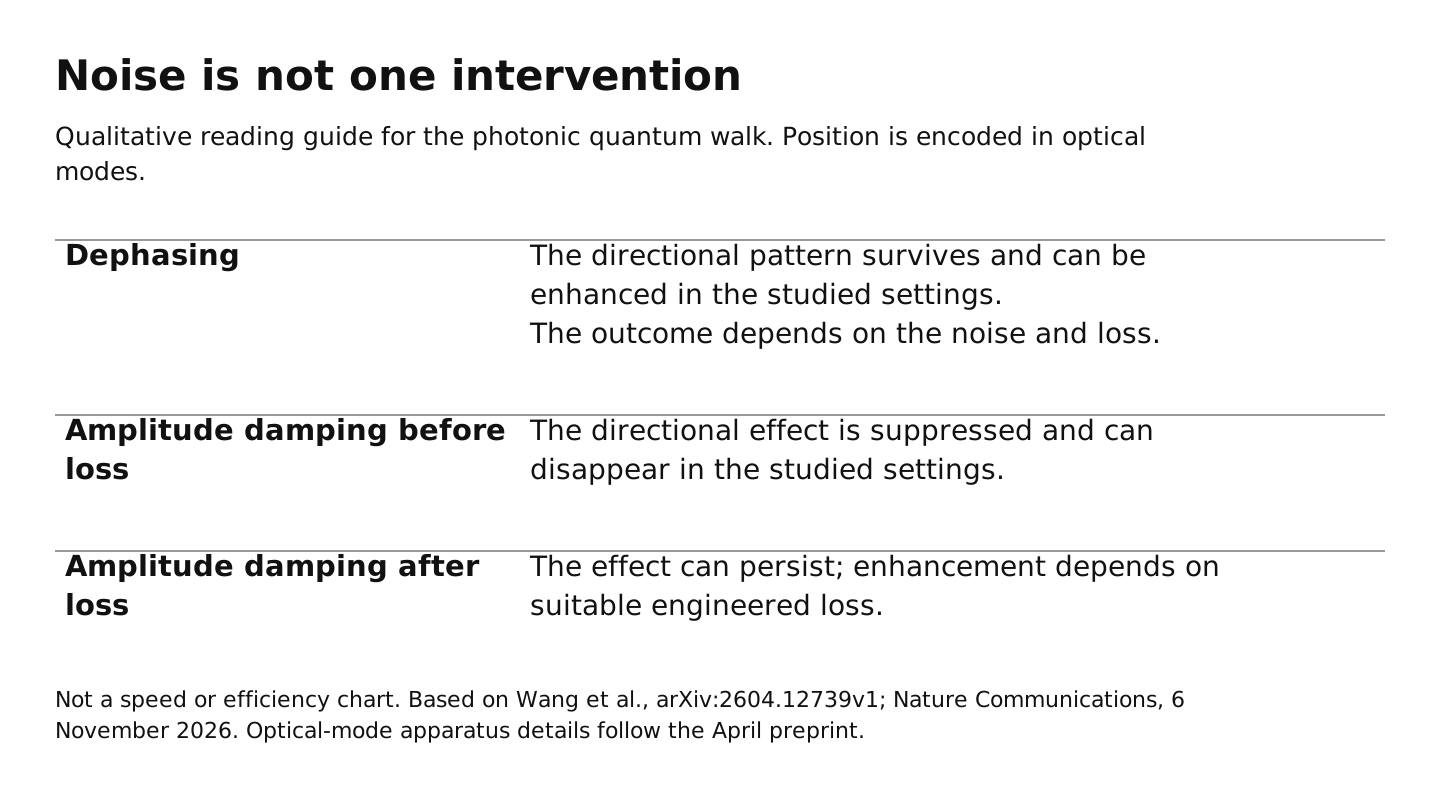
For a newcomer, the useful question is not whether a device is "noisy" in the abstract. Ask what kind of disturbance it experiences, what operation follows it, and what outcome the experiment is designed to preserve. Those questions turn a surprising headline into an explanation that can be checked.
Other recent theory makes the same need for specificity apparent. A separate Physical Review B study examined how a particular noise process could restore directional behavior in a different modeled system. It offers context for the wider research direction, not an independent replication of this experiment.[5]
What this does, and does not, establish
The latest work gives researchers a controlled way to examine a boundary between coherent quantum behavior and more classical transport. Its public preprint describes a photonic apparatus and finite sequences, rather than a deployed communications link or a general-purpose processor.[2]
That difference should guide the next question. A practical transport device would need its own evidence: how much useful output survives, how much input is lost, what resources the controls require, and whether the behavior remains useful when the device grows or its conditions change. A faster shift in an experiment's measured distribution is not, by itself, a complete efficiency result. These are questions for further evaluation, not measurements supplied by this study.
The timing also deserves clarity. November 6 is the journal publication date. The researchers first posted the work publicly in April. The result has newly reached its peer-reviewed publication stage; it was not first revealed this morning.[1][2]
The idea readers can carry away is both surprising and practical: before deciding whether a disturbance is harmful, define the job. Preserving a quantum calculation and encouraging one-way transport are different jobs. That distinction is where this experiment becomes interesting.