
A quantum error decoder that lets neighboring circuits do the work
A University of Tokyo design drops the central controller. Its modeled speed looks promising, but the slowest cases and hardware footprint matter.
Reading tools for text size, copying, printing and your reading list
A quantum computer can generate clues about its errors faster than a separate computer can make sense of them. Researchers at the University of Tokyo have proposed taking the boss out of that second computer. Their design, Amatlas, lets an array of small processors exchange information with their neighbors instead of waiting for a central controller to tell the whole array when to advance. The work, posted as a preprint, is a hardware design and simulation study, not a test on a quantum computer.[1]
The clues come from checking groups of that together protect one piece of quantum information. A check flags a change without reading the protected information itself. The flags don’t say exactly where the error happened. A conventional computer called a decoder uses patterns in the flags, across both the chip and several rounds of checks, to infer what likely went wrong. If the decoder can’t keep up with the incoming checks, its work can pile up.[1][2]
Moving the work, not the clock
Neighboring processors in Amatlas group together clues that may come from related errors. The design assigns a processor to each check location on the two-dimensional layout and keeps past readings in that processor’s local memory. That way, the processors can handle data across space and time without building a three-dimensional network of processing circuits. There’s still a common clock; what’s gone is the central controller that makes the whole array wait at each step.[1]
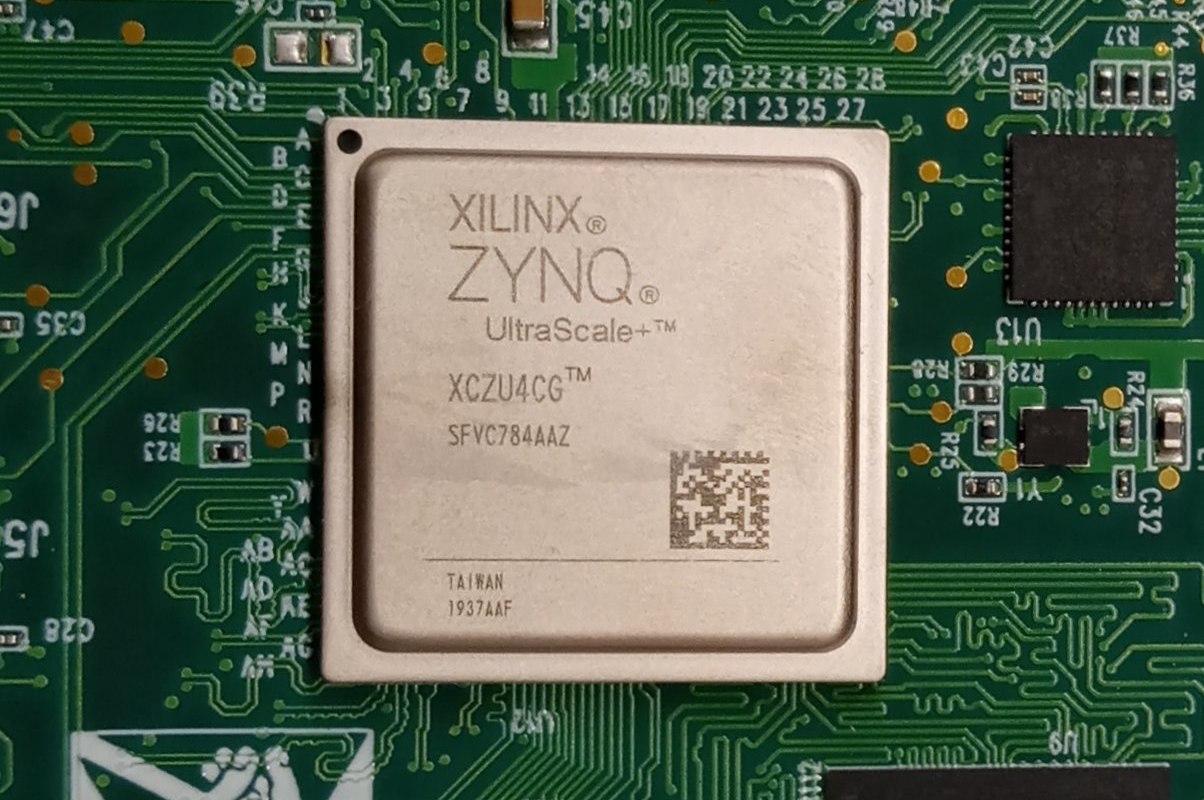
At the largest code size the team fitted on the programmable chip on the Xilinx VCU129 board, the estimate came to 462 nanoseconds per round at an assumed physical error rate of 0.1%. That number comes from simulated cycle counts and the clock speed estimated after laying out the circuits. The design decodes a batch of rounds, then divides by the number of rounds: 462 nanoseconds is not how long a live quantum computer waited for a correction. At the same noise level, the 99.99th percentile reached 1,543 nanoseconds per round, more than three times the mean. At 0.5% modeled noise, the mean rose to 953 nanoseconds.[1]
What still has to fit
The largest design used 91.2% of the chip’s look-up tables, the building blocks for programmable digital logic. And in separate simulations the team estimated a 0.72% error threshold, slightly lower than the 0.78% it cites for a reference decoder under the same noise model. Below that threshold, making the code bigger is expected to suppress logical errors; it isn’t a guarantee for a real machine with different noise. The next useful test is to connect the decoder to a live stream of quantum measurements and see whether it keeps up when difficult rounds arrive in bursts.[1]
Keep your reading trail
Keep up with these topics
Explore the subjects covered in this story.