
A quantum defect can lose energy by starting a ripple in a magnet
A peer-reviewed experiment found that spins in a thin crystal still relaxed near absolute zero. The researchers traced the remaining energy loss to magnetic waves the spins could create themselves.
Reading tools for text size, copying, printing and your reading list
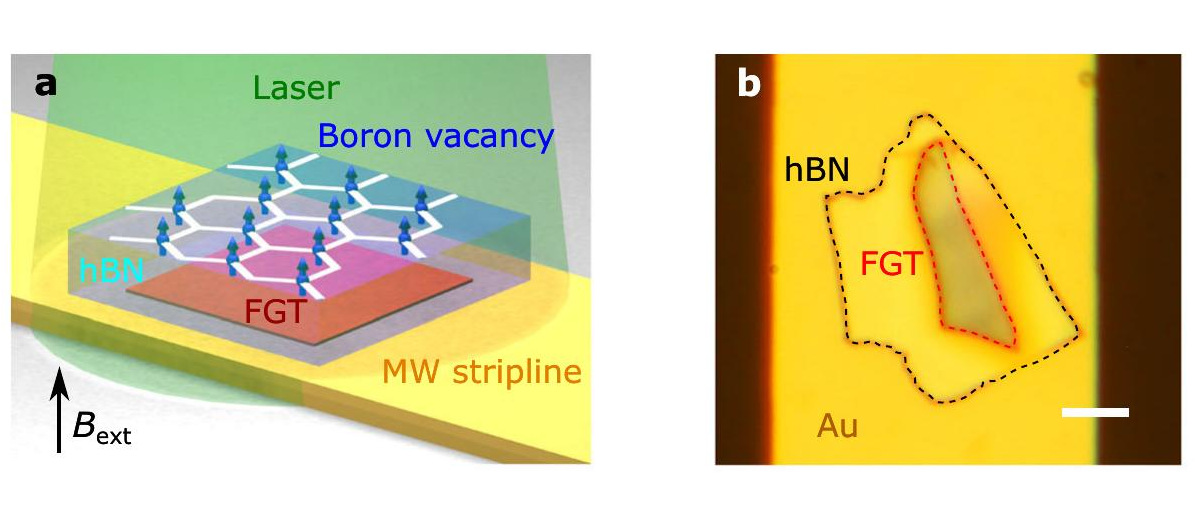
Cooling a quantum device can quiet much of the noise around it. But cooling does not remove every way for it to lose energy. In a study published November 27 in Science Advances, researchers found that excited spins in a thin crystal could still relax by creating tiny magnetic waves in a nearby magnet, even when very few of those waves were already present. The result identifies a loss mechanism that engineers could try to suppress or deliberately make use of.[1][2]
The experiment uses hexagonal boron nitride, a layered crystal in which a missing boron atom can leave behind an optically readable spin. The team put a flake containing these defects above a film of yttrium iron garnet, a magnetic insulator. They prepared the spins and used changes in their light emission to see how quickly the prepared state relaxed. They inferred the emission of magnons, the quantum units of waves in a magnet, from that decay and how it changed across samples. This was not a direct count of individual magnons.[1]
Why cooling did not make the effect vanish
At higher temperatures the magnetic film already contains waves excited by heat. The defects can absorb energy from those waves or release energy into them. But an excited defect can also relax by creating a wave that was not there before, much as an excited atom can give off a photon in an otherwise dark room. Cooling suppresses the first set of processes more than the second.[1]
For one sample the team tracked relaxation from 58 to 300 millikelvin, or 0.058 to 0.300 degrees above absolute zero. As the temperature fell, the relaxation rate approached a floor rather than disappearing. The rate also rose when the researchers used a thinner metal spacer between the defects and the magnet. In separate tests, strengthening the applied magnetic field lowered the inferred spontaneous emission rate across the three samples tested. Together those checks helped tie the leftover relaxation to the neighboring magnet, rather than to temperature alone.[1]
What changed when more defects shared the magnet
At 90 millikelvin, the two sparsest groups of defects relaxed at nearly the same rate. The two denser groups relaxed faster. The team’s model attributes that change to some of the defects interacting with the same magnetic waves, so the group relaxes differently from a collection of isolated spins. The result is evidence about how the group loses energy, not a demonstration that individual defects became or passed a quantum message.[1]
An earlier experiment by members of the team used defects in the same kind of crystal to detect spin waves excited in a magnetic film. The new paper, first circulated as a preprint in June, asks the reverse question: can an excited defect put energy into a nearly quiet magnet? The peer-reviewed measurements make a case that it can. The next engineering question is whether that connection can be controlled well enough to do more than drain energy from the spin.[1][2][3]