
A single defect in diamond picked out the waves inside a tiny magnet
A quantum probe detected subtle changes around a magnetic disk without having to shake it so hard that its natural response changed.
Reading tools for text size, copying, printing and your reading list
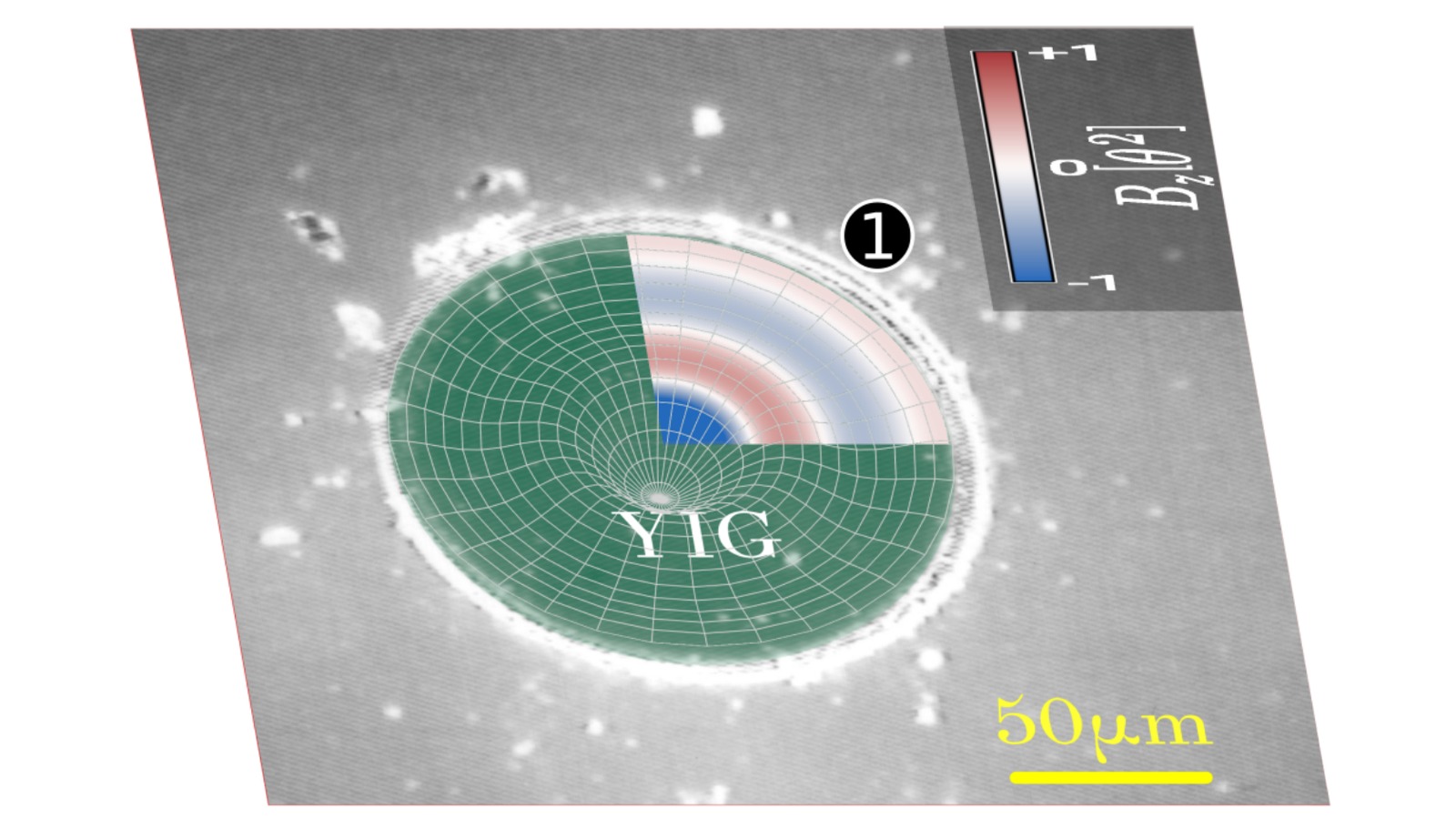
Tap a bell gently and you hear its natural notes. Hit it hard enough and you can make it vibrate in ways that muddle what you wanted to hear. A similar problem crops up when scientists measure waves in a magnet: the drive that makes the signal easier to detect can also change the signal. In a new experiment, researchers used a single defect in a tiny diamond to pick out the natural resonances of a magnetic disk while keeping the drive weak.[1]
The disk was made of yttrium iron garnet, a magnetic material often used to study spin waves. In a spin wave, the direction of magnetization tilts and swivels in a coordinated pattern. The material itself doesn’t slosh around. Like waves on a drumhead, several different patterns can fit into the same disk, and each responds most strongly at its own frequency. The experiment used a disk just 168 micrometers across, but the probe wasn’t trying to listen to the whole thing at once.[1]
The diamond read a quieter signal
The researchers used two microwave tones. One stirred the magnet gently. The other let them read the behavior of the diamond defect, a nitrogen atom next to a vacant site in the crystal. By reading light from that defect, they could track a tiny change in the magnetic field at the probe’s position. Separating the two jobs meant they didn’t have to drive the disk as hard just to get a readable signal from the diamond.[1]
The signal wasn’t the rapid back-and-forth field of the wave itself. When the magnetization swivels farther away from its resting axis, the part that points along that axis gets slightly smaller. That produces a small change in the field outside the disk. The diamond detected this change even when the angle of the swivel was only about one degree. The team used it to separate different resonances, reporting a half-width of about two megahertz for the narrow responses.[1]
A scan revealed where the signal changed sign
Moving the probe across the surface exposed a feature that a reading from one fixed spot would miss. In the simplest mode, the detected field change switched sign at about 60 percent of the disk radius from the center, where the team’s model also put the transition. That doesn’t mean the magnetization reversed direction there. The probe sensed the magnetic field outside the material. Its sign change was consistent with a wave pattern whose motion died down at the disk’s edge.[1]
A single defect is tiny, but that doesn’t make this an atom-by-atom map. The value of the experiment is more practical: the same probe could distinguish resonances by frequency and show how their signals changed across one sample. That gives researchers a way to test how small magnets support spin waves without driving them so strongly that the measurement is mostly telling them about the drive.[1]