
A diamond picked up magnetic noise from a crystal just 8 nanometers thick
As researchers cooled ruthenium chloride, a sensor inside a diamond responded to stronger magnetic fluctuations. The signal gives physicists a new way to test a possible quantum spin liquid, but it does not prove they found one.
Reading tools for text size, copying, printing and your reading list
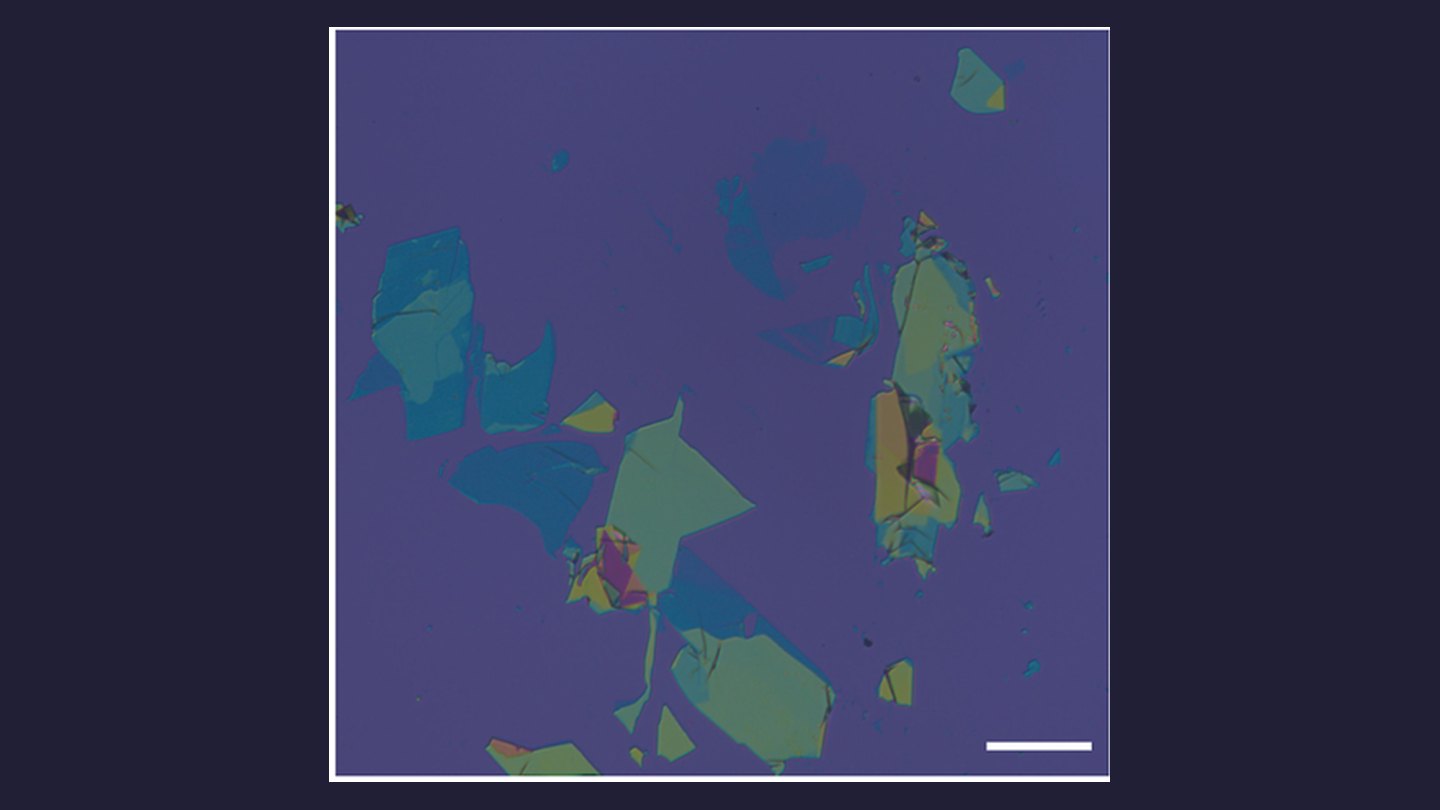
A piece of diamond can do something a jeweler would never ask of it: listen for magnetic noise from a sliver of crystal only 8 nanometers thick. In a preprint listed November 25, Jitender Kumar and colleagues placed tiny flakes of a layered form of ruthenium chloride on a diamond chip. When they cooled the thinnest flake, about 8 nanometers thick, the diamond registered stronger magnetic fluctuations below about 100 kelvin. Another part of the same diamond, away from the flake, behaved differently.[1]
The diamond is the detector
The sensor was a set of tiny defects: each one consists of a nitrogen atom beside a missing carbon atom in the diamond lattice. The researchers used light to prepare the defects in a known spin state, let them sit for different amounts of time, then used their fluorescence to see how much of the prepared state remained. Magnetic fluctuations in the nearby flake can push the defects out of that state faster. By comparing fluorescence after different waits, the researchers could estimate a relaxation time. A shorter time near the flake indicated more noise at the frequencies the defects were tuned to detect.[1]
Several of the authors had already used individual diamond defects to detect magnetic noise from the same material at room temperature in 2024. The new work looks at what changes as the material cools. On the thinnest flake, the relaxation time leveled off between about 160 and 100 kelvin and then fell. Away from the flake, it kept rising as the temperature dropped. That comparison matters because the diamond has background noise of its own. The team also adjusted the magnetic field to tune the sensor and found evidence that, at lower temperatures, more of the magnetic noise was concentrated toward the lower of the two frequencies they probed.[1][2]
A clue, not a verdict
Two thicker flakes, about 95 and 150 nanometers, added a second clue. Below about 50 kelvin, the researchers needed a fast and a slow decay to describe how the sensor settled. At 10 kelvin, the thin flake and the control did not show that same two-part behavior. The team thinks the thicker flakes gave the nearby defects a less uniform magnetic environment, but the exact microscopic cause remains unresolved. Three sample thicknesses also do not establish a sharp cutoff.[1]
Ruthenium chloride interests physicists because of a prediction about how spins interact in its honeycomb-like layers. In an ideal quantum spin liquid, magnetic moments avoid settling into a repeating pattern even at very low temperature, while their quantum states stay linked. Real ruthenium chloride also shows conventional magnetic ordering under some conditions. And a rise in noise does not uniquely identify the exotic excitations predicted for a spin liquid. The next useful test is to measure more layers and more frequencies to see whether the noise follows the distinctive pattern the theory predicts. The diamond gives researchers a way to ask that question locally rather than averaging over a much larger sample.[1]