
Could Quantum Computers Help Make Sense of CERN’s Next Data Flood?
The collider is in a major upgrade shutdown. Quantum research is exploring possible tools for future analysis—not replacing the LHC or its computing grid.
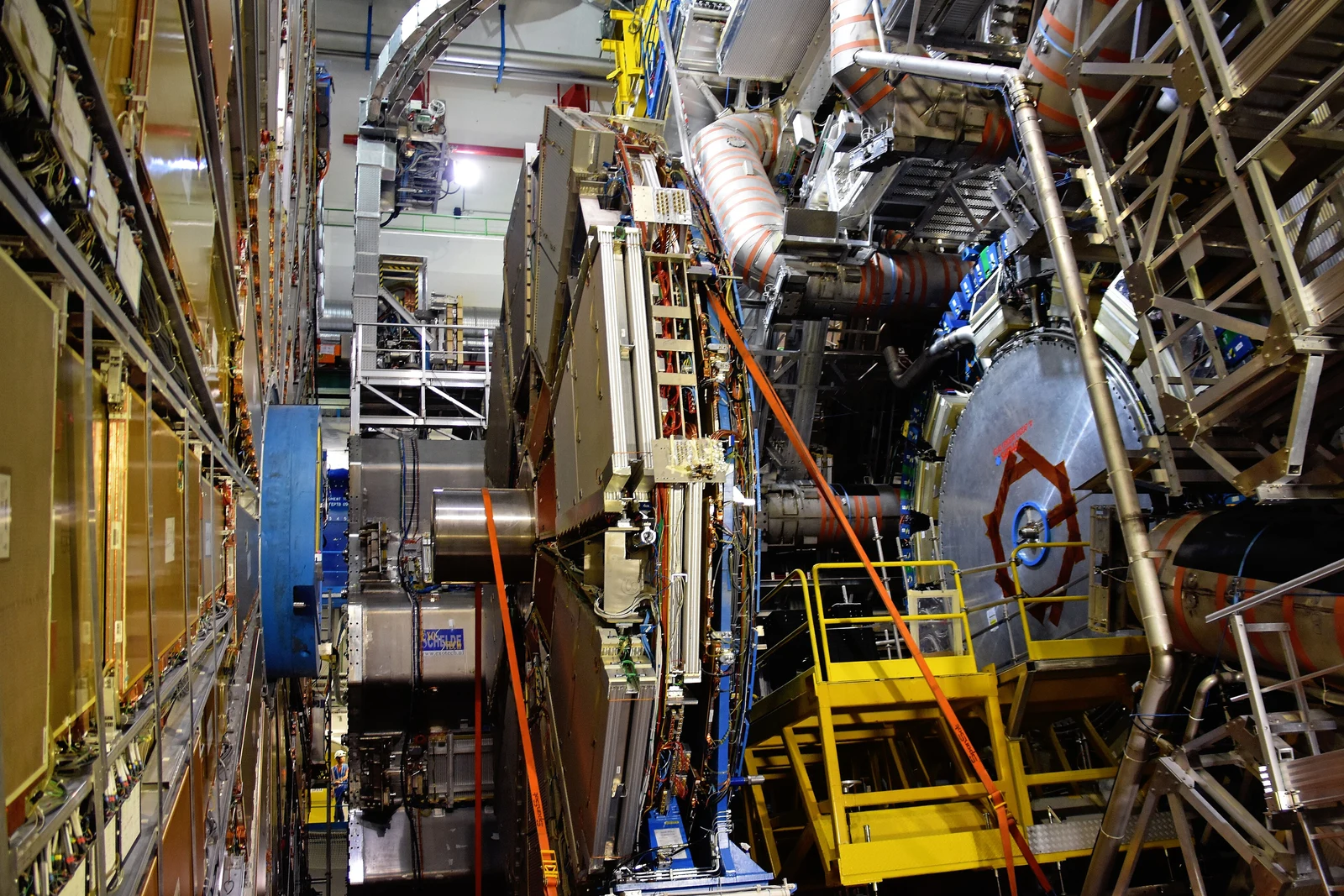

A particle collision lasts almost no time. Working out what happened can become an enormous computing problem. That contrast helps explain why CERN is exploring quantum computing. Its research programme considers whether quantum technologies could contribute to high-energy physics, including hybrid computing and algorithms. The ambition is not to replace the Large Hadron Collider with a quantum computer. One creates conditions for experiments; the other might eventually help answer some of the questions those experiments generate.[1]
There is also an important present-tense correction. The LHC entered Long Shutdown 3 on June 27, 2026. The shutdown supports a major upgrade programme. Photographs of particle detectors can make every CERN story look like a live-collision report, but that is not what is happening here.[2]
A detector records clues, not a finished explanation
A collision can produce many particles. A detector records signals as particles pass through different components. Researchers then reconstruct what most plausibly happened from those signals.
CERN’s documented quantum graph-neural-network project, describing work from 2020 and 2021, focuses on one part of this task: particle tracking. Charged particles leave signals through tracking layers, and their paths bend in a magnetic field. Connecting the appropriate signals helps reconstruct a trajectory and infer properties such as momentum. The project explores the feasibility of using quantum algorithms to assist this work. It does not establish that a quantum method is already the production solution.[3]
Imagine trying to reconstruct many journeys through a city from a large collection of time-stamped sightings. A sighting at one intersection could belong to several possible routes. Physical constraints help narrow the choices, but the problem becomes more tangled as the scene becomes busier. The analogy is deliberately limited. Particle reconstruction involves precise detector geometry, physics and statistical methods, not ordinary traffic tracking. But the basic challenge is recognisable: turn a crowded collection of observations into a reliable account of distinct paths.
More data is an opportunity and a burden
The upgrade programme is designed to make the LHC a more powerful source of experimental information. That means computing is not merely a back-office service. It is part of turning the experiment into usable science. The shutdown includes changes to accelerator and detector systems; it is not simply a pause while researchers wait for quantum hardware.[2]
A larger dataset can provide more opportunities to find rare phenomena or make precise measurements. It can also require more work to filter, store, reconstruct and analyse. Collecting information and extracting an answer from it are related achievements, but they are not the same achievement.
This creates a useful way to understand the quantum question. Researchers do not need a device that is mysteriously “faster at everything.” They need to identify a particular expensive subproblem, express it in a form the device can handle and establish that the complete workflow benefits. That is a much more demanding question than whether a small demonstration can be made to run.
The classical system is already a global machine
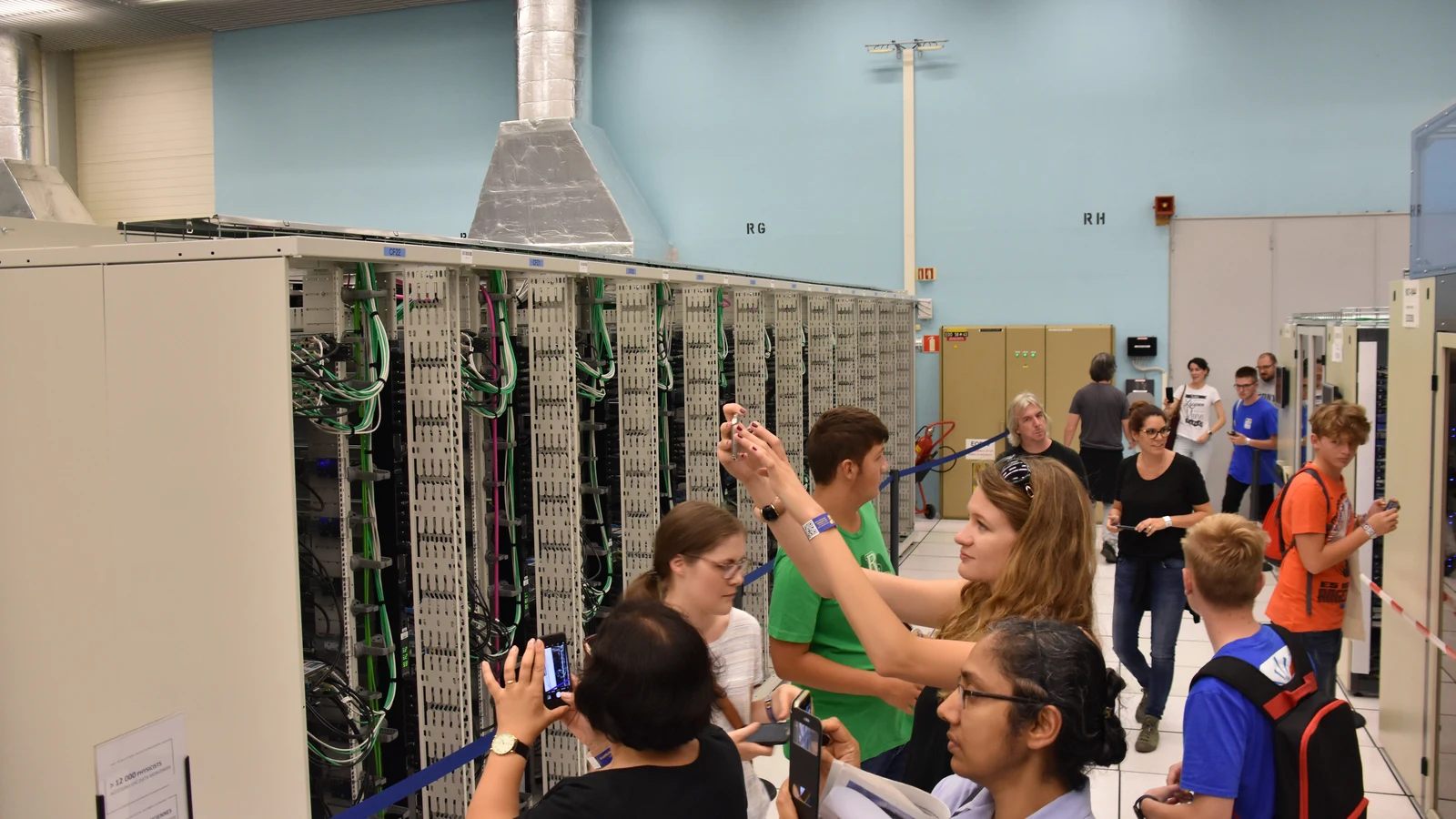
CERN does not analyse its data on a single giant computer sitting beside a detector. The Worldwide LHC Computing Grid provides distributed storage and computing resources across a large international network. CERN describes its mission as storing, distributing and analysing data from the LHC experiments.[4]
The grid is the essential backdrop to any quantum proposal. A new method has to find a place in an established scientific workflow, not defeat a fictional baseline in which no one has previously optimised the problem. Think of adding a specialised tool to a well-equipped workshop. The new tool may be excellent at one operation. Its value depends on how often that operation occurs, how materials reach it, what preparation it needs and whether its output is useful to the next stage.
This is why a server-room photograph can be as important as a detector photograph in explaining the story. The visible experiment and the computing infrastructure are different parts of the same scientific effort. Quantum hardware would add another part, not erase the existing ones.

A promising idea has to survive the round trip
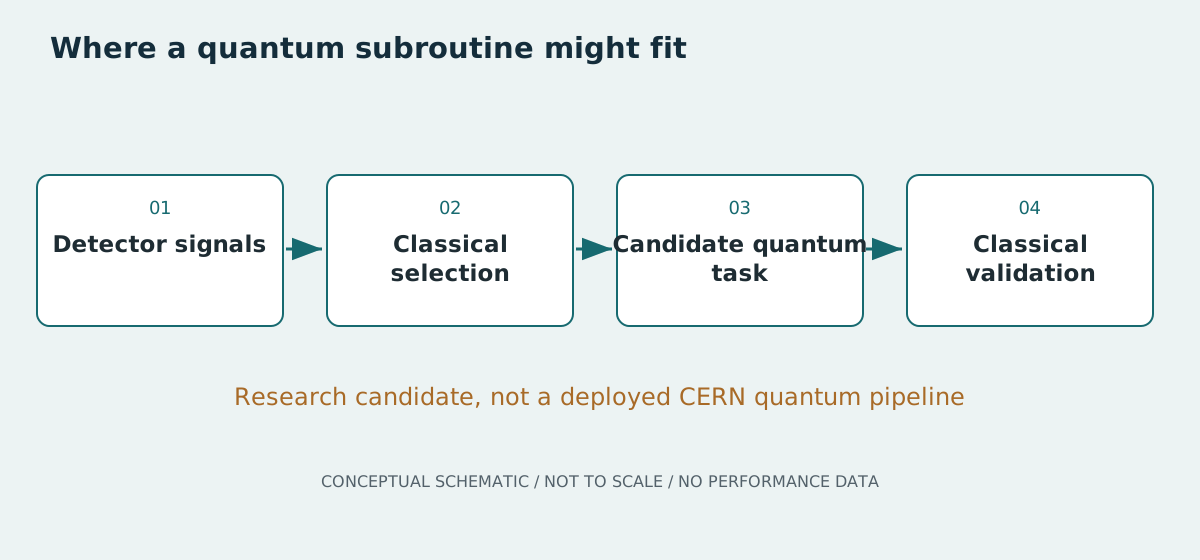
A proposed quantum workflow starts with a problem that usually exists in classical form. Data and model choices have to be represented in a way the quantum procedure can use. After the procedure runs, measurements have to be turned into a useful result. These surrounding steps are part of quantum computing in practice.[5]
Consider an imaginary accelerator that performs one internal step extremely quickly but requires slow preparation and repeated attempts. Its headline speed for that step would not tell us how quickly the overall job finishes. The same reasoning applies here. The fair boundary is the complete task, with a specified quality requirement.
That does not mean every early experiment must beat a production computing system to be scientifically worthwhile. Small demonstrations can test an encoding, an interaction or a hypothesis. The important thing is to describe which question was tested rather than borrowing the language of a result that has not been achieved.
CERN’s programme is explicitly a research and development effort. Its structure includes hybrid infrastructures and applications alongside other quantum-technology activities. That framing leaves room for promising ideas, negative results and changes of direction. It is not a declaration that quantum computing has solved the collider’s future computing needs.[1]
The most useful result may be a well-defined limit
For an experimental algorithm, a negative result can still be valuable. It may show that an encoding is too costly, a circuit too noise-sensitive or a classical method stronger than anticipated. Those findings can prevent years of effort being spent on an appealing but unsuitable route.
A positive result also needs boundaries. An improvement on a simplified dataset might identify a promising mechanism without establishing an advantage on full detector data. Performance measured on an ideal simulator does not automatically describe noisy hardware. A successful local component may still require substantial work before integration.
These are ordinary standards of scientific comparison. They should make the story more interesting, not less. They reveal that the central challenge is to discover where a fundamentally different kind of computation can make a meaningful contribution. For readers following the work, look for clearly stated problem sizes, realistic data, strong classical comparisons, uncertainty estimates and a complete accounting of the steps around the quantum routine. Those details are more informative than an unexplained “quantum-powered” label.
Two very different frontiers can meet
The LHC explores matter through extraordinary physical experiments. Quantum computing explores what controlled quantum systems can calculate. Their intersection is compelling because both confront behaviour that is difficult to describe with simple everyday intuition. But the connection should not be inflated into science fiction. A quantum computer would not turn a detector into a portal, make the accelerator itself quantum in some newly discovered sense or eliminate conventional analysis. Its contribution, should useful methods emerge, could be a much narrower and more practical improvement.
That possibility is enough to justify attention. While the collider undergoes its upgrade, researchers can ask how future observations might become answers. The dramatic machinery provides the photographs. The deeper story is the work of making sense of what it will reveal.