
Ordinary light batches parts of a quantum-circuit simulation
A physical four-qubit encoding test and a modeled seven-qubit search answer different questions.
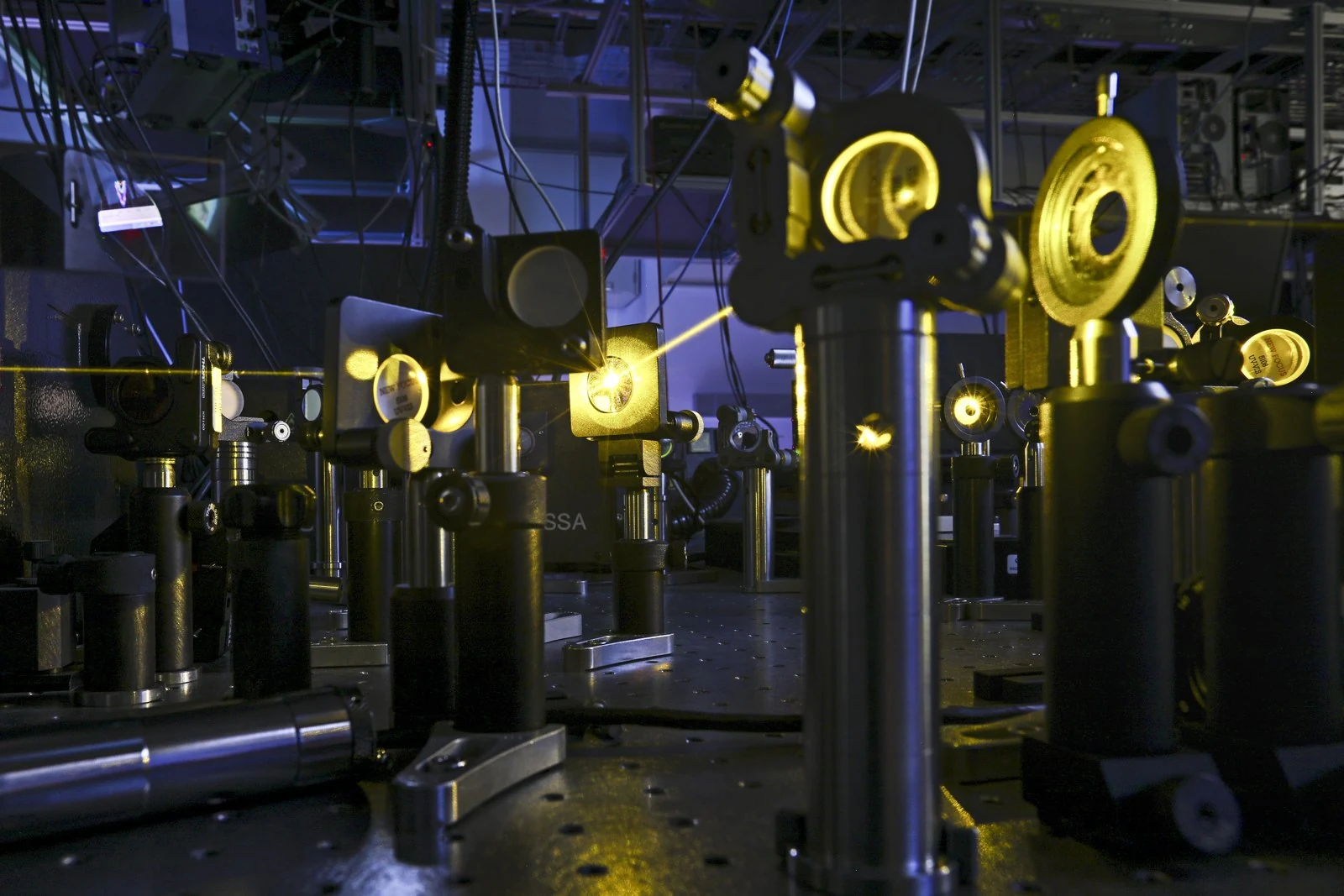

Researchers have used classical light to process batches of operations representing quantum circuits. The October 26 preprint combines spatial and wavelength channels in an optical tensor-processing architecture. Its central experimental result is a physical encoding and readout demonstration, not the construction of a quantum computer.[1]
The experiment processes all 16 computational-basis inputs for each of three four-qubit gates. Measurements for the different wavelength channels were taken separately in this proof of concept. The average optical reconstruction fidelities for those gates were approximately 0.48 to 0.57 before background subtraction and 0.85 to 0.86 after subtracting independently measured dark-field backgrounds.[1]
A separate numerical propagation model evaluates algorithm examples, including a seven-qubit Grover search over all 128 target cases. That larger algorithmic exercise should not be described as a seven-qubit physical demonstration. The paper’s optical reconstruction metric also should not be relabeled as the of a quantum processor.[1]
The distinction is easier to see by separating representation from execution. A conventional computer can represent a circuit without possessing the described by that circuit. Here, light carries parts of the mathematical representation. The engineering question is how faithfully that optical arrangement performs the specified transformations and how much useful work it can process at once.
Background subtraction belongs in the story because it changes the reported reconstruction accuracy. A reader evaluating an instrument would want both the directly measured result and the result after correction, with the correction procedure specified. Publishing only the higher figure would obscure how much the measurement environment contributes to the answer.
Batching creates a plausible throughput argument, but it does not establish an end-to-end energy or speed advantage by itself. Loading inputs, calibrating optics and reading outputs all belong in a practical comparison. The next informative benchmark would give those costs for the same task and accuracy target as a conventional implementation, rather than infer a system-wide win from parallel optical channels alone.